
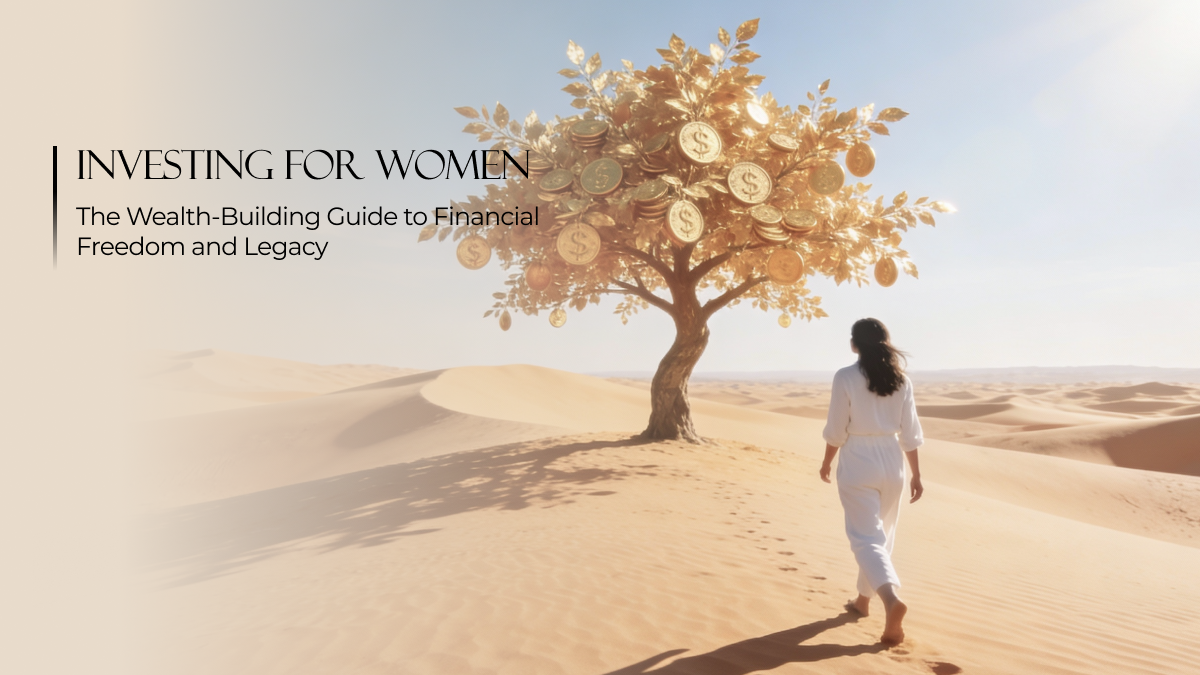
Investing for Women | The Wealth-Building Guide to Financial Freedom and Legacy
This guide is intended for educational purposes only. It does not provide financial or investment recommendations, nor does it assume responsibility for any losses, gains, or outcomes resulting from decisions based on its content. Readers are advised to seek qualified professional guidance appropriate to their personal circumstances before making any investment or financial decision.
Note
Cluster 5 Context Block – “Women & Wealth: From Knowledge to Freedom”
Women & Wealth: From Knowledge to Freedom is HerMoneyPath’s in-depth editorial series on how women build financial independence, confidence, and legacy.
Across every chapter, this cluster explores the intersection of gender, money, and freedom — revealing how women can invest strategically, lead with purpose, and achieve long-term security without sacrificing their values.
Combining financial education, behavioral insights, and real-world strategies, each article translates data and research into clear, actionable guidance designed for modern women — entrepreneurs, executives, and professionals who want to turn discipline into wealth and wealth into impact.
This cluster is grounded in real-world experience, expert analysis, and trusted global research — drawing on verified data from institutions such as UN Women, the World Bank, the OECD, McKinsey & Company, Vanguard, and Fidelity Investments.
Every chapter reinforces a core belief: that financial freedom is not just about numbers — it’s about choice, stability, and self-determination.
Continue your journey through this series with: [Article #76 – Woman, Achieve Financial Independence: Multiply Your Income and Break Free From Financial Vulnerability] (e.g., “Chapter 2 – Mindset Shift: From Scarcity to Abundance.”)
Women have historically faced barriers to building wealth, including income gaps, career interruptions related to caregiving, and longer life expectancy. These factors increase the importance of long-term financial planning and consistent investing.
This article explains why investing plays a central role in women’s financial independence. It begins with mindset, showing how moving from short-term scarcity thinking to long-term planning supports better financial decisions. It then outlines key foundations, such as budgeting with purpose, emergency savings, debt management, and retirement preparation.
The guide presents core investment tools used to build wealth over time, including stocks, bonds, exchange-traded funds, real estate, and retirement accounts. It emphasizes diversification, automation, and patience rather than speculation or frequent trading.
Research indicates that consistent investing and long-term discipline can improve outcomes during market volatility. Beyond financial results, building wealth can increase stability, autonomy, and resilience.
The article also connects wealth building to leadership, entrepreneurship, and long-term legacy, and reviews emerging themes such as sustainable investing and digital finance. By combining education, planning, and disciplined investing, women can reduce vulnerability and strengthen long-term security across generations.
Quick Read (Condensed Version)
For generations, women were excluded from wealth-building systems, leaving lasting gaps in income, assets, and financial confidence. This guide reframes investing not as a technical challenge, but as a strategic path to freedom, resilience, and legacy.
It explores why women need tailored wealth strategies — from historical barriers and caregiving penalties to longer life expectancy and career interruptions — and how mindset shifts from scarcity to abundance unlock consistent, confident investing.
Readers learn the foundations of financial planning, including budgeting, emergency savings, debt management, and long-term protection, before moving into the core investment toolbox: stocks, bonds, ETFs, real estate, and retirement accounts.
The article also shows how women’s natural strengths — patience, discipline, and risk awareness — translate into stronger long-term results, especially during market volatility. Through real-life scenarios, it demonstrates how small, consistent actions compound into lasting wealth.
Beyond numbers, this guide expands wealth into freedom of choice, leadership, and social impact, highlighting future opportunities in sustainable investing, digital finance, and the global economy. Investing, for women, becomes not just a financial decision, but a foundation for independence and intergenerational change.
Quick Takeaways (At-a-Glance)
- Women live longer than men, making retirement planning and wealth preservation non-negotiable.
- Consistency beats risk-taking — women often achieve better long-term results through steady investing.
- The gender wealth gap is real: women earn about 20% less globally, yet manage most household budgets.
- Underrepresentation persists: only 24% of Certified Financial Planners in the U.S. are women.
- In entrepreneurship, women own about 40% of small businesses but receive less than 3% of venture capital.
- By 2030, women are projected to control two-thirds of U.S. household wealth — marking a historic shift in financial power.
Strategic Interlinks (Cluster 5)
Also read:
- [Article #107 – How the 2008 Crisis Reshaped Women’s Careers in America: And Why the Gender Wealth Gap Still Widens Today]
- [Article #110 – The Gender Wealth Gap: Why Women Retire With Less]
These companion articles expand on this introduction by exploring, in depth, women’s financial education, investor behavior, and leadership in wealth building.
Initial References (APA 7th Edition)
- UN Women. (2022). Gender Snapshot 2022. United Nations Women.
- Vanguard Group. (2019). How America Invests. Vanguard.
- Pew Research Center. (2021). The Gender Pay Gap in 2021. Pew Research Center.
- World Bank. (2012). World Development Report 2012: Gender Equality and Development. Washington, DC.
Table of Contents
Women and Wealth: The Definitive Guide to Investing and Building Financial Freedom
Front Matter
- Expanded Summary (SEO-Optimized)
- Quick Read (Condensed Version)
- Quick Takeaways (At-a-Glance)
- Strategic Interlinks (Cluster 5)
- Initial References (APA 7th Edition)
Introduction (SEO-Optimized)
Chapters
- Chapter 1 – Why Women Need a Definitive Guide to Wealth Building
- Chapter 2 – The Mindset Shift: From Scarcity to Abundance
- Chapter 3 – Laying the Foundation: Financial Education and Planning
- Chapter 4 – The Investment Toolbox Every Woman Needs
- Chapter 5 – Risk and Resilience: How Women Can Leverage Their Strengths
- Chapter 6 – Wealth Building in Practice: From Scenarios to Strategies
- Chapter 7 – Creating Long-Term Freedom: Beyond Money
- Chapter 8 – Breaking Barriers: Women, Leadership, and Financial Independence
- Chapter 9 – The Future of Women and Wealth: Trends and Opportunities
Conclusion
Action Plan
References
Revised Summary
For generations, investing and wealth creation were framed as an exclusive club — dominated by men, filled with jargon, and built on the false belief that women “weren’t interested.” Today, that narrative is changing. Women are no longer outsiders; they are investors, entrepreneurs, and leaders actively reshaping financial markets.
This guide offers a definitive roadmap for women ready to take control of their financial futures. It explores the psychological, cultural, and historical barriers that created the gender wealth gap — and provides actionable strategies to close it. From building emergency savings to designing investment portfolios, from overcoming money fears to embracing new financial opportunities, this is about investing with clarity, resilience, and confidence.
The focus here is not on speculation or quick wins, but on sustainable wealth building — setting clear goals, managing risk wisely, and viewing money as a tool for expanding choices. Whether you are managing debt, planning for retirement, or seeking growth investments, you will learn how to align your financial decisions with long-term freedom.
Above all, this is an invitation to reimagine financial independence. Wealth is not just about numbers — it’s about choice: the peace of mind to face challenges without fear and the confidence to pursue dreams without hesitation. For women everywhere, building wealth is not only possible — it is essential.
Curiosities – Women, Wealth & Investing
- Women live 5–7 years longer than men — making retirement planning and long-term wealth strategies even more crucial.
- Research shows that while women are less likely to invest in high-risk assets, their consistent and disciplined approach often yields better long-term returns.
- Despite earning roughly 20% less globally, women manage household budgets in over 70% of families, highlighting their central role in daily financial decisions.
- Only 24% of Certified Financial Planners in the U.S. are women — underscoring the need for greater female representation in financial leadership.
- Women own nearly 40% of small businesses, yet receive less than 3% of venture capital, exposing persistent funding barriers.
- By 2030, women are projected to control two-thirds of U.S. household wealth, positioning them as key decision-makers in global finance.
Introduction
For centuries, the stories of wealth, investing, and financial leadership were told in a male voice. Bankers, stockbrokers, and entrepreneurs — the traditional images of success — rarely included women. Yet behind the scenes, women have always been the backbone of economies: managing households with limited resources, budgeting with precision, ensuring children’s education, and sustaining small businesses often without recognition (Folbre, 2021).
Today, women are no longer silent participants. They are demanding a seat at the financial table — and, in many cases, building tables of their own. This shift represents more than progress; it signals a new era of financial empowerment where investing becomes an act of confidence, freedom, and legacy.
Quick Stat – Why This Guide Matters
- Women live on average 6–8 years longer than men — yet retire with 30–40% less wealth (World Economic Forum, 2023).
- Closing the gender wealth gap could add $28 trillion to global GDP by 2025 (McKinsey, 2023).
Why Women’s Wealth Matters
Financial freedom for women is not a luxury — it is power. When women gain access to wealth-building tools, their choices ripple outward: strengthening families, transforming communities, and stimulating economies. Research shows that when women invest, outcomes improve across health, education, and poverty reduction (UN Women, 2022).
Wealth in women’s hands is more than personal security — it’s social transformation. That’s why financial literacy, tailored investing strategies, and retirement planning for women are no longer optional — they are urgent.
Interlink: [Article #52 – Generational Lessons: What Millennial Women Learned From the 2008 Crash]
The Barriers That Persist
Despite decades of progress, systemic barriers remain. Cultural narratives still whisper that money is “too complicated” or “too risky” for women. The gender pay gap continues to restrict income potential (World Economic Forum, 2023), while caregiving roles — disproportionately assigned to women — limit both time and career advancement (Boushey, 2016).
Even within finance, women’s voices remain underrepresented, leaving systems ill-equipped to address their unique realities. That is why accessible investment tools and women-centered financial planning are critical for closing the wealth gap.
Interlink: [Article #76 – Woman, Achieve Financial Independence: Multiply Your Income and Break Free From Financial Vulnerability]
The Purpose of This Guide
This guide exists because women deserve more than recycled clichés about money. It provides evidence-based strategies designed to close the gender wealth gap and empower women to take action. It reframes finance through a feminine lens — moving from scarcity to abundance, hesitation to confidence, and silence to strategy.
Each chapter blends knowledge, mindset, and action, covering:
- Why women need a definitive wealth guide.
- Mindset shifts that transform fear into confidence.
- Financial planning fundamentals — budgeting, debt, and retirement.
- Key investing tools — from ETFs to real estate.
- Inspiring success stories of women who achieved financial freedom.
- Leadership, entrepreneurship, and future trends in finance.
Wealth Beyond Numbers
This is not a quick-fix manual — it’s a sustainable roadmap. True wealth isn’t built overnight or measured only in returns; it’s about security, freedom, and peace of mind. Because women live longer than men, financial strategies must include long-term protection, retirement longevity, and legacy planning (Kahneman, 2011).
Interlink: [Article #90 – The Hidden Price of Credit Card Debt for Women in America: How to Cut Interest, Escape Traps, and Build Financial Freedom]
A New Financial Era
The future belongs to women who embrace financial empowerment, literacy, and independence. It’s not about mirroring men’s methods — it’s about leveraging women’s natural strengths: resilience, consistency, and vision. This guide will walk you step by step — from mindset to investing, planning to leadership, resilience to legacy. It’s time for women not only to participate in the economy — but to define its future.
CTA – Your Next Action
Continue your journey: Read the next chapters to discover how women can shift from scarcity to abundance through practical investing strategies.
Reflect and share: If this introduction resonated with you, consider sharing it with someone who may also benefit from a clearer, more confident relationship with money.
Chapter 1 – Why Women Need a Definitive Guide to Wealth Building
Why single out women when talking about wealth building?
Isn’t money supposed to be neutral?
In theory, yes. In practice, the systems that shape financial opportunity are anything but neutral. Women encounter structural barriers, cultural expectations, and psychological hurdles that make building wealth uniquely complex (World Economic Forum, 2023). Ignoring these realities doesn’t erase them — it reinforces them. Recognizing them is the first step toward closing the gender wealth gap and achieving lasting financial independence.
Quick Stat – Why This Chapter Matters
- Women retire with only two-thirds of men’s wealth, despite living five to seven years longer (OECD 2021; WHO 2021).
- Over a lifetime, the gender pay gap costs women hundreds of thousands in lost investment potential (Goldin 2021).
A Brief Historical Context
For most of history, women were legally and socially excluded from financial independence.
- In ancient Rome, a woman’s property was controlled by her father or husband (Kelly 1992).
- In Europe, married women had no right to wages or inheritance (Folbre 2021).
- In Brazil, until the Civil Code of 1916, married women needed male consent to manage property (Del Priore 2011).
- And in the U.S., only in 1974—with the Equal Credit Opportunity Act—could women apply for credit in their own names (U.S. National Archives 1974).
That late entry into finance compounded over generations: men passed down property and financial literacy, while women often inherited financial silence (Allen 2020).
Interlink: [Article #76 – Woman, Achieve Financial Independence: Multiply Your Income and Break Free From Financial Vulnerability]
The Gender Pay and Wealth Gap
On average, women in the U.S. earn 82 cents for every dollar men earn — with even wider gaps for women of color (BLS 2022). Across a lifetime, this small difference snowballs into massive losses in wealth potential.
Research confirms that women retire with two-thirds of men’s wealth (OECD 2021) — a critical shortfall given their longer life expectancy (WHO 2021).
The Hidden Cost of Caregiving
Career breaks to care for children or aging parents bring missed promotions, interrupted earnings, and smaller pensions. While caregiving creates enormous social value, its financial costs remain invisible (Boushey 2016).
Interlink: [Article #90 – The Hidden Price of Credit Card Debt for Women in America: How to Cut Interest, Escape Traps, and Build Financial Freedom]
The Confidence Gap
Studies show women’s investment portfolios often outperform men’s because of patience and consistency (Fidelity 2017). Yet hesitation persists, fueled by jargon, underestimation, and lack of representation (McKinsey & Lean In Org 2022).
This is not incompetence — it’s a confidence gap. Expanding education and women-focused financial networks is essential to turning hesitation into empowerment.
A Pattern That Echoes Millions of Women
Many women expertly manage household budgets, plan expenses with precision, and sustain long-term financial discipline, yet hesitate when it comes to investing — often perceiving it as overly complex or risky. In reality, the core skills required to build wealth are already present; what is missing is not capability, but confidence, access, and clear guidance.
Why a Definitive Guide Matters
Women don’t need this guide because they are less capable; they need it because the financial system was not built with them in mind. Understanding exclusion, pay inequality, caregiving penalties, and confidence gaps isn’t about victimhood — it’s about strategy, clarity, and empowerment.
Looking Forward
Women are rewriting financial history — leading companies, launching startups, and shaping sustainable investing. Yet systemic barriers remain. This chapter lays the foundation: women need tailored strategies because the playing field has never been level. The following chapters will show how to move from scarcity to abundance, build resilient financial foundations, and leverage investments to create legacies. Because wealth is not just about money — it’s about freedom, choice, and dignity.
CTA – Your Next Action
Continue your journey: Read Chapter 2 – The Mindset Shift: From Scarcity to Abundance to see how women can replace hesitation with confidence.
Reflect and share: If this chapter resonated with you, consider sharing it with someone navigating similar financial questions.
Chapter 2 – The Mindset Shift: From Scarcity to Abundance
When conversations about wealth building arise, the focus usually centers on numbers and tactics — how much to save, which stocks to buy, when to diversify. Yet beneath every financial decision lies something even more powerful than spreadsheets: mindset.
For many women, that mindset has been shaped for generations by scarcity (Mullainathan & Shafir, 2013). Scarcity is not just about having less money; it is about living with the constant fear of not having enough — the stress of second-guessing every purchase, the anxiety of bills piling up, the invisible weight of financial insecurity (Shapiro & Burchell, 2012).
Even financially stable women often carry this feeling because scarcity is not only material — it is cultural and emotional.
Quick Stat – Scarcity vs. Abundance
- 82% of U.S. women worry about money every week, compared with 68% of men (APA 2023).
- Women who adopt an abundance mindset are 40% more likely to invest consistently and build long-term wealth (Fidelity 2017).
The Hidden Cost of Scarcity Thinking
Scarcity narrows vision. It forces short-term survival decisions and discourages long-term growth. It traps money in low-yield accounts, delays career moves, and prevents entrepreneurial risks that build wealth (Fidelity 2017).
The cost isn’t only financial — it is emotional and physical. Scarcity erodes confidence, strains relationships, and undermines health. Chronic money stress is linked to anxiety, insomnia, and lower overall well-being (APA 2019).
Interlink: [Article #158 – Emotional Spending in Times of Uncertainty: The Invisible Cost of Stress]
Reframing Wealth as Opportunity
Moving from scarcity to abundance doesn’t deny reality — it redefines it. Money is not a fixed pie; it’s a resource that can expand through wise choices, collaboration, and vision (Dweck 2006).
Scarcity whispers: “I can’t invest because I don’t earn enough.”
Abundance replies: “I can start small, invest consistently, and let compounding work for me.”
Even investing $50 a month in an index fund signals a mindset shift toward growth.
The Role of Financial Education in Abundance
Knowledge is the strongest antidote to fear.
Financial education turns money from a source of anxiety into a tool for empowerment (OECD 2021).
Interlink: [Article #182 – Debt Is Not a Lack of Shame: The Emotional Healing of Financial Recovery]
Community and Collective Abundance
Scarcity isolates: abundance multiplies.
Women who share experiences and strategies are more likely to negotiate salaries, invest regularly, and pursue higher goals (UN Women 2022).
From Fear to Freedom
Scarcity says: “You’ll never have enough.”
Abundance answers: “I can grow. I can create. I am worthy of financial freedom.”
This mindset shift breaks silence, builds confidence, and opens the door to legacy. The journey doesn’t start with money — it starts with a single, empowered thought.
Interlink: [Article #76 – Woman, Achieve Financial Independence: Multiply Your Income and Break Free From Financial Vulnerability]
CTA – Your Next Action
Keep reading: Chapter 3 – The Psychology of Money: Why We Spend, Save, and Fall Into Debt to uncover the hidden drivers of financial behavior.
Continue reflecting: This chapter prepares the mindset needed for deeper financial understanding in the chapters ahead.
Chapter 3 – Laying the Foundation: Financial Education and Planning
When building a house, no architect starts with the roof. They begin with the foundation — the structure strong enough to support every wall that follows. Wealth building works the same way. Without a solid base, every investment strategy, ambitious plan, or dream of freedom rests on shaky ground. For women especially, creating this foundation is not optional — it is essential (OECD 2021).
Quick Fact – Why Foundations Matter
- Women with a written financial plan are three times more confident about their future than those without one (Fidelity 2021).
- Yet globally, only 32% of women have such a plan, compared with 55% of men (OECD 2021).
Why the Foundation Matters
Financial education is too often treated as a privilege — reserved for business schools, boardrooms, or the wealthy. In truth, financial literacy is a basic life skill (Lusardi & Mitchell 2014). When women lack that literacy, they’re asked to navigate life blindfolded.
A strong foundation brings:
- Clarity — replacing confusion with understanding.
- Confidence — turning hesitation into action.
- Stability — ensuring women can weather storms without panic.
Without this base, even high-earning women risk falling into debt cycles, missed opportunities, and fragile retirements (Fidelity 2021).
The Core Pillars of a Financial Foundation
1. Budgeting with Purpose
A budget isn’t restriction — it’s direction. When aligned with personal values, it empowers choice (HBR 2019). Instead of asking, “What do I have to cut?”, ask, “Does my spending reflect the life I want to build?”
2. Emergency Savings
Life is unpredictable — cars break down, jobs change, medical bills appear. Without an emergency fund, women are more vulnerable to debt traps and predatory lending (Shapiro & Burchell 2012).
Experts recommend saving three to six months of expenses, but even $500 can reduce dependence on credit cards.
3. Debt Management
High-interest debt is the enemy of freedom.
Women — often targeted by consumer-credit marketing — need clear repayment strategies. Understanding interest, prioritizing high-APR balances, and avoiding minimum-payment traps can turn debt from a chain into a stepping-stone.
Interlink: [Article #90 – The Hidden Price of Credit Card Debt for Women in America: How to Cut Interest, Escape Traps, and Build Financial Freedom]
4. Goal Setting
Money without goals drifts. Defining short-, medium-, and long-term goals anchors every decision. For women, goal setting is more than planning — it’s an act of self-determination (McKinsey & Lean In Org 2022).
5. Insurance and Protection
Without health, disability, or life coverage, a single emergency can erase years of progress (World Bank 2022). Insurance isn’t a luxury; it’s financial armor.
Box – The Daily Micro-Decisions That Shape Wealth
- Cooking at home instead of ordering takeout.
- Saving bonuses instead of spending them immediately.
- Canceling one unused subscription and redirecting that money to savings.
Small, consistent choices compound into long-term security. They are the hidden bricks of a financial foundation.
The Confidence Link
Planning isn’t just financial — it’s psychological. Women who budget, save, and understand debt negotiate better, invest earlier, and stress less (Sandberg 2013). Confidence isn’t built overnight; it grows with every habit practiced consistently.
The Knowledge Gap
Globally, men score higher on financial quizzes — but when confidence is removed as a factor, the gap nearly disappears (Lusardi & Mitchell 2014). Women often know more than they think. What limits them is not competence, but confidence.
Interlink: [Article #76 – Woman, Achieve Financial Independence: Multiply Your Income and Break Free From Financial Vulnerability]
Building Beyond the Basics
A foundation is built brick by brick, paycheck by paycheck. Once it’s strong, investing becomes less intimidating and more intentional. From there, women can step into stocks, bonds, and real estate not with fear — but with clarity and conviction.
A Foundation for Freedom
Strong foundations create freedom:
- Freedom to walk away from unhealthy jobs or relationships.
- Freedom to say yes to opportunities without fear.
- Freedom to reclaim control over your financial story.
Because a foundation isn’t just concrete beneath a house — it’s the ground that makes everything else possible.
CTA – Your Next Step
Continue your journey: Read Chapter 4 – The Investment Toolbox: Demystifying Stocks, Bonds, and Real Estate for Women.
Share awareness: This chapter can help others rethink the foundations of financial security.
Chapter 4 – The Investment Toolbox Every Woman Needs
Once a strong financial foundation is in place, the next step is to open the investment toolbox. For many women, this is where hesitation begins. Finance has long been portrayed as a jargon-filled arena dominated by men in suits. But the truth is simple: investing is not a secret society — it is a set of learnable tools (Lusardi & Mitchell 2014). And for women, mastering these tools is not only possible — it is transformative.
Quick Stat – Why Investing Matters
- Women who invest consistently earn 0.4% higher average returns than men, largely thanks to patience and lower trading frequency (Fidelity 2017).
- Yet only 26% of women feel confident about investing, compared with 46% of men (McKinsey 2023).
Why Investing Matters
Savings protect; investing multiplies. Inflation silently erodes idle cash, while compounding transforms steady contributions into exponential growth (OECD 2021). For women — who tend to live longer, earn less, and face more career interruptions — investing is not optional. It is the lever that helps turn structural disadvantages into financial freedom (UN Women 2022).
The Core Tools of Investing
- Stocks (Equities): Ownership in companies and historically the highest long-term returns (Barber & Odean 2001). For instance, the S&P 500 has averaged roughly 10% annual growth over several decades.
- Bonds (Fixed Income): Provide stability and predictable income (Vanguard 2019). They cushion volatility when markets fall.
-
Mutual Funds & ETFs: Offer instant diversification without complexity; ETFs are beginner-friendly and low-cost (Fidelity 2021).
Interlink: [Article #183 – Rewriting Growth: Building a Balanced and Sustainable Consumption Economy] - Real Estate: Generates wealth through appreciation, rental income, or REITs (World Bank 2022). Tangible assets often appeal to women seeking security.
- Retirement Accounts: 401(k), IRA, or global equivalents; even modest, consistent contributions compound massively over decades (OECD 2021).
- Alternative Investments: Gold, crypto, or private equity can add diversification — but they are optional, not foundational (Lopez 2020).
The Power of Diversification
No carpenter builds with a single tool; no investor should rely on one asset class. Diversification spreads risk and stabilizes returns. A classic 60/40 portfolio — 60% equities and 40% bonds — delivered about 8% annualized returns over the past 50 years (Morningstar 2022). During downturns, bonds cushioned losses while equities fueled recovery. Diversification isn’t about chasing every trend; it’s about balancing growth with security.
Breaking the Fear Barrier
One of the most common long-term risks in wealth building is postponing investing — not because women lack ability, but because uncertainty quietly delays action.
- Saving $200 per month in a bank account for 30 years totals about $72,000.
- Investing the same in an index fund at 7% returns totals about $245,000 (Barber & Odean 2001).
The difference is not luck — it’s time plus compounding. Interlink: [Article #76 – Woman, Achieve Financial Independence: Multiply Your Income and Break Free From Financial Vulnerability]
Real-World Data on Women Investors
During the 2008 crisis, men were 50% more likely to panic-sell than women (Vanguard 2019). By holding steady, women preserved long-term gains. Similarly, Fidelity’s Women Talk Money (2021) study showed that women investors who stayed the course during COVID-19 volatility achieved stronger overall performance. Resilience — not reckless risk-taking — is women’s hidden advantage.
Tools Create Confidence
Investing isn’t about mastering everything at once. It’s about starting small, learning continuously, and growing steadily. The very qualities women already possess — discipline, patience, and resilience — make them natural investors (David 2016).
CTA – Your Next Step
Next step: In Chapter 5, you’ll learn how risk works — and why women’s steady approach often becomes an investing advantage over time.
Share the power: If this chapter clarified the basics, consider sharing it with someone who’s been delaying investing out of uncertainty.
Chapter 5 – Risk and Resilience: How Women Can Leverage Their Strengths
When most people hear the word risk, the first reaction is often negative. Risk feels dangerous, uncertain — even reckless. In finance, it’s almost synonymous with loss. Because women have long been socialized to avoid risk, many step back from opportunities that could grow their wealth (Sandberg 2013). Yet research shows that women’s caution is not a weakness — it’s a hidden strength. When combined with strategy, it becomes one of the most powerful forces for building lasting wealth.
The Reality of Risk
Every financial decision carries risk:
- Keeping money in a savings account avoids volatility, but inflation quietly erodes its value (OECD 2021).
- Investing in stocks offers higher returns, but short-term swings test patience and confidence (Barber & Odean 2001).
- Even doing nothing is risky — missed opportunities guarantee stagnation.
The goal isn’t to eliminate risk — that’s impossible. It’s to measure and manage it. Risk is the price of opportunity; resilience is the ability to withstand short-term storms while staying on course for long-term growth (Fidelity Investments 2017).
Why Women Approach Risk Differently
Studies consistently show women invest more cautiously than men:
- They trade less frequently.
- They avoid speculative bets.
- They prefer diversified, long-term portfolios (Vanguard 2019).
At first glance, this looks conservative — yet the data tells a different story. Vanguard’s 2021 study found that women were 40% less likely than men to panic-sell during downturns. Fidelity (2021) confirmed that women’s portfolios outperformed men’s by about 0.4% annually, precisely because they stayed the course, reinvested dividends, and avoided emotional reactions. What the world calls caution is, in fact, resilience in action.
Interlink: [Article #158 – Emotional Spending in Times of Uncertainty: The Invisible Cost of Stress] (explores emotional and behavioral roots of women’s risk approach).
The Cultural Weight of Risk
Historically, women were discouraged from taking financial risks. For generations, investing was portrayed as “too complex” or “too dangerous,” reinforcing dependence on men or institutions (Folbre 2021).
That cultural message still echoes today. Many women feel anxious when markets fluctuate — not because they lack skill, but because they were told money “wasn’t their space.” Breaking this cycle requires reframing risk not as gambling but as a spectrum that can be calibrated. On one end are ultra-safe bonds; on the other, speculative assets like cryptocurrency. Between them lies a wide range of balanced strategies tailored to each woman’s comfort level and goals (OECD 2021).
The Role of Resilience
Resilience is not avoidance — it’s endurance. It’s the ability to face volatility without losing direction. Resilience tends to come from a few repeatable principles:
- Diversifying across asset classes, industries, and regions.
- Maintaining an emergency fund to avoid liquidating investments during crises.
- Automating contributions to retirement accounts, ensuring progress continues even in uncertainty (Lusardi & Mitchell 2014).
Each step acknowledges that storms will come — but ensures the ship remains strong enough to sail through them.
Box – Risk Across Life Stages
- Early Career (20s–30s): Higher tolerance is appropriate. With decades ahead, women can lean more heavily on equities.
- Mid-Career (40s–50s): Balance becomes key. Mixing stocks, bonds, and retirement assets builds stability without sacrificing growth.
- Pre-Retirement (55+): Preservation takes priority. Focus on bonds, annuities, or dividend-paying equities for dependable income.
This life-cycle view helps women see risk not as a fixed identity (“I’m cautious”) but as a dynamic strategy that evolves with time and objectives.
Turning Strength into Strategy
Women often turn caution into an advantage when they align their approach with five long-term principles:
- Start Small, Scale Steadily – Build confidence through manageable amounts.
- Think Long-Term – Longevity makes patience an edge, not a delay.
- Diversify Widely – Spread exposure to reduce shocks.
- Automate Contributions – Remove emotion and avoid market-timing mistakes.
- Redefine Success – View success as steady progress toward freedom, not quarterly wins.
Real Cases, Real Proof
- During the 2008 crisis, women were significantly less likely to sell at market lows, enabling stronger rebounds (Vanguard 2019).
- Fidelity’s Women Talk Money (2021) report found that women who maintained regular contributions through COVID-19 outperformed male investors.
These aren’t isolated examples. They reveal a consistent truth: discipline outperforms speculation.
CTA – Integrating What You’ve Learned
If risk has felt like a threat, this chapter reframes it as something measurable — and therefore manageable. Next, Chapter 6 brings these ideas into real-life scenarios that show how consistency, not perfection, shapes wealth over time.
Related Reading: [Article #110 – The Gender Wealth Gap: Why Women Retire With Less]
Looking Ahead
Women’s caution is not a flaw to correct but a strength to refine. Combined with education, diversification, and vision, it positions women to thrive where others falter. Risk is unavoidable — but so is opportunity. When women embrace both with resilience, they don’t just accumulate wealth; they redefine strength in investing, proving that the steady hand often steers farther than the fast one.
Chapter 6 — Wealth Building in Practice: From Scenarios to Strategies
Theory explains why wealth matters; practice shows how it is built. This chapter translates principles into real-world scenarios that demonstrate how consistent, intentional action compounds over time.
Quick Stat – Why Practice Matters
- Women who begin investing earlier accumulate significantly more wealth over time.
- Yet many still report uncertainty about where to start.
Scenario 1 — Starting Small
A young professional begins investing a modest monthly amount into a low-cost ETF.
Over decades, compounding transforms small contributions into substantial wealth.
The lesson is simple: time in the market matters more than timing the market.
Interlink:
[Article #76 – Woman, Achieve Financial Independence: Multiply Your Income and Break Free From Financial Vulnerability]
Scenario 2 — Automation in Mid-Career
A mid-career professional automates monthly investments into a retirement plan.
Automation replaces willpower with systems, keeping progress steady during uncertainty.
Interlink:
[Article #71 – Retirement After the Great Recession: How Global Financial Crises Reshape Women’s Long-Term Security]
Scenario 3 — Resilience Under Pressure
A single mother continues investing modestly through market volatility.
By staying consistent, she preserves long-term gains and builds stability.
Resilience — not perfection — drives results.
Interlink:
[Article #45 – The Hidden Cost of Credit Card Convenience for Women in America]
Scenario 4 — Diversifying Entrepreneurial Income
An entrepreneur reinvests a portion of business profits into diversified assets. Separating business and personal finances increases resilience during downturns.
From Individual Action to Collective Impact
When women invest, the impact extends beyond the individual — influencing families, workplaces, and communities toward greater financial literacy and resilience.
Next: Chapter 7 expands wealth beyond numbers — exploring freedom, legacy, and social impact.
Chapter 7 – Creating Long-Term Freedom: Beyond Money
When most people think of wealth, they picture numbers on a bank statement or the size of an investment portfolio. Yet while financial assets are essential, true wealth extends far beyond money. It’s the freedom to choose without fear, to design a life aligned with one’s values, and to create ripples of change in families and communities. For women, this expanded definition of wealth is especially powerful (McKinsey & Lean In Org 2022).
Quick Stat – Why Wealth Beyond Money Matters
- 70% of women reinvest their income into family and community priorities, compared with 30–40% of men (World Bank 2022).
- Women with financial freedom report 40% higher life satisfaction due to time flexibility and reduced stress (OECD 2021).
Redefining Wealth
Wealth isn’t the mere absence of poverty — nor is it measured by luxury cars or vacation homes. For many women, real wealth is peace of mind: the confidence to face emergencies, support loved ones, and pursue dreams without anxiety (Fidelity 2021). It is also measured in time — the freedom to decide how and with whom to spend life’s most precious resource (Lopez 2020).
Interlink: [Article #76 – Woman, Achieve Financial Independence: Multiply Your Income and Break Free From Financial Vulnerability]
The Emotional Return on Investment
Money delivers financial returns, but the deeper reward is emotional. The relief of an emergency fund, the pride in a growing retirement account, and the calm of reduced stress translate into stronger confidence and healthier relationships (Harvard Business Review 2019). For women balancing roles as caregivers, professionals, and partners, financial independence restores mental clarity and breathing room.
Wealth as Legacy
Long-term freedom also means looking beyond the self. Wealth becomes legacy:
- Family: education, debt-free inheritance, and healthy money habits.
- Community: donations, scholarships, and support for small businesses.
- Society: impact investing that shapes a sustainable future (UN Women 2022).
Interlink: [Article #177 – Her Wealth Legacy: Passing Down Wisdom, Not Just Money]
Beyond Numbers: Time and Autonomy
One of the most overlooked dimensions of wealth is time. Financial independence allows women to walk away from toxic workplaces, reduce hours to care for loved ones, or pursue purpose-driven projects. Example: an executive who builds financial stability early can later dedicate time to mentoring or community leadership. That freedom — the ability to choose — is the ultimate dividend (David 2016).
The Social Impact of Women’s Wealth
When women gain financial freedom, the benefits cascade outward. They are more likely to reinvest in families and local economies (World Bank 2022). In emerging markets, microfinance improves nutrition and education; in developed nations, women lead the growth of impact investing (Vanguard 2019). Wealth in women’s hands doesn’t stop at personal success — it reshapes societies.
Principles for Building Wealth Beyond Money
- Define Freedom Goals – Ask: What would I do if money were no longer a daily worry?
- Integrate Well-Being – Include health, relationships, and personal growth.
- Prioritize Legacy – Plan wills, trusts, and charitable giving.
- Align Investments with Values – Consider ethical, ESG, or sustainable funds.
- Protect Time – Use financial freedom to reclaim hours for family, rest, and creativity.
Looking Ahead
This chapter reframes wealth as more than accumulation — it’s about meaning, balance, and legacy. For women, that perspective connects finance with deeply held values of care, community, and resilience. Long-term freedom isn’t only about retiring comfortably; it’s about living fully today while building security for tomorrow.
Interlink: [Article #90 – The Hidden Price of Credit Card Debt for Women in America: How to Cut Interest, Escape Traps, and Build Financial Freedom]
CTA – Your Next Step
Deepen Your Journey: Explore upcoming articles that connect money, mindset, and empowerment.
Share the Impact: If this chapter resonated, send it to a friend, sister, or colleague — one conversation can change another woman’s financial future.
Chapter 8 – Breaking Barriers: Women, Leadership, and Financial Independence
Leadership and wealth have always been intertwined. Those who control resources shape not only boardroom outcomes but also policy, culture, and family legacies. For centuries, women were excluded from this equation—not for lack of talent, but because of structural and cultural systems that enforced financial dependence (Kabeer 2016; World Economic Forum 2023). Today, that narrative is shifting. Women are stepping into leadership and claiming financial independence on their own terms. This evolution is more than equity—it is economic, social, and generational transformation.
Quick Stats – Women in Leadership and Wealth
- Women represent nearly 50% of the global workforce but hold under 30% of senior-leadership roles (McKinsey 2023).
- Female-led startups receive under 3% of venture-capital funding yet generate 10% more revenue per dollar invested (BCG 2018).
- Closing the gender gap in leadership could add $12 trillion to global GDP by 2030 (McKinsey 2020).
Historical Barriers to Leadership
Women’s economic labor—household management, small-business operations, community care—was always present but rarely recognized. Formal exclusion from property rights, wages, and credit access rendered them financially invisible (Perkins 2019).
Even after reforms, gaps persist:
- Until 1974, U.S. women could not apply for credit independently.
- Today, women are 40% of entrepreneurs but receive less than 3% of venture funding.
- Women remain underrepresented in finance, law, and tech—the sectors that define the future.
Interlink: [Article #76 – Woman, Achieve Financial Independence: Multiply Your Income and Break Free From Financial Vulnerability]
Financial Independence as a Gateway to Leadership
Wealth is power. Financial independence enables women to leave toxic workplaces, fund ventures, and make choices based on vision—not survival. Leadership is not confined to the C-suite; it begins in households, communities, and mentorship networks (Sandberg 2013).
Women in Business and Entrepreneurship
Despite systemic barriers, women entrepreneurs demonstrate resilience and impact:
- They reinvest a greater share of profits into families and communities (OECD 2021).
- Female-led ventures deliver higher efficiency and ROI per dollar (BCG 2018).
Supporting women in business isn’t philanthropy—it’s one of the highest-return economic investments available.
Interlink: [Article #171 – Wealth Gaps at Work: The Rise of Gendered Financial Burnout]
Leadership in the Workplace
Only 10% of Fortune 500 CEOs are women (Catalyst 2023). Yet research shows female leaders emphasize sustainability, collaboration, and employee well-being—challenging short-term, profit-only models. Leadership also begins in everyday acts: negotiating fair pay, advocating representation, and aligning portfolios with purpose.
Breaking Cultural Narratives
Persistent myths—“men are better with money,” “women are risk-averse”—still limit progress (Lopez 2020). They’re dismantled by:
- Representation: women visibly leading in finance, policy, and enterprise.
- Mentorship: women lifting other women, compounding opportunity.
Every visible success expands what others believe is possible.
Core Dimensions of Financial Leadership
- Build Financial Independence First – freedom precedes influence.
- Develop Negotiation Skills – know your market value and ask.
- Commit to Lifelong Learning – finance, strategy, and leadership evolve.
- Mentor and Seek Mentorship – reciprocal growth multiplies impact.
- Align Wealth with Values – invest ethically and lead authentically.
Scenario in Practice – Leadership Through Autonomy
A mid-career professional once viewed leadership as unattainable. She began by negotiating fair pay, investing steadily, and educating herself financially. Confidence followed competence; influence followed confidence. Eventually, she mentored younger colleagues—demonstrating that leadership begins the moment a woman takes ownership of her resources.
Looking Ahead
Breaking barriers is more than fairness—it’s economic strategy. Closing gender-leadership gaps could inject trillions into global growth (McKinsey 2020). Each financially independent woman widens the path for others. Leadership through wealth is no longer aspiration—it is actionable reality.
Interlink: [Article #90 – The Hidden Price of Credit Card Debt for Women in America: How to Cut Interest, Escape Traps, and Build Financial Freedom]
CTA – Your Next Step
Deepen Your Knowledge: Explore related articles on women’s entrepreneurship, leadership, and financial strategy.
Amplify the Change: Share this chapter with a friend, colleague, or mentee—representation grows stronger when women lift each other.
Chapter 9 – The Future of Women and Wealth: Trends and Opportunities
Finance never stands still. It evolves with technology, global markets, and cultural change. For women, this evolution brings not only new risks but also unprecedented opportunities to lead. The next decade of wealth creation will be defined by digital currencies, sustainable investing, artificial intelligence, and the expanding digital economy. By engaging with these forces today, women position themselves not as passive participants but as architects of tomorrow’s financial systems (World Economic Forum 2023).
Quick Stats – Women and the Future of Finance
- By 2030, women are projected to control $30 trillion in global wealth (McKinsey 2020).
- Women investors are twice as likely as men to prioritize ESG and sustainable funds (Morgan Stanley 2019).
- Digital-finance adoption among women entrepreneurs in emerging markets grew 65% from 2020 to 2023 (OECD 2023).
The Rise of Digital Currencies
Cryptocurrencies such as Bitcoin and Ethereum have disrupted traditional finance through decentralized networks that bypass banks (Narayanan et al. 2016). For women—historically excluded from credit and lending—decentralization can be transformative.
- In emerging markets, women use mobile wallets and blockchain payments to escape predatory lending (OECD 2021).
- A 2023 IMF report highlighted digital assets as catalysts for financial inclusion.
Still, caution is vital. Crypto should remain a small, diversified allocation, not a portfolio foundation (Yermack 2015).
Interlink: [Article #161 – The Credit Illusion: How Fintech Reinvented Debt — and Why Women Pay the Price]
Sustainable and Ethical Investing
One of the fastest-growing financial movements is ESG (Environmental, Social, Governance) investing. Women lead this shift, aligning capital with conscience (Morgan Stanley 2019).
- ESG funds grew by $500 billion (2020–2022) (Morningstar 2023).
- Female investors increasingly direct money toward climate action, gender equity, and community development.
This “dual return”—profit plus purpose—marks a transition from wealth as accumulation to wealth as impact.
Interlink: [Article #183 – Rewriting Growth: Building a Balanced and Sustainable Consumption Economy]
The Expanding Digital Economy
Beyond crypto, the digital economy opens inclusive paths through fintech, remote work, and online entrepreneurship.
- Remote platforms help women integrate careers and caregiving (ILO 2021).
- Fractional-investing apps lower entry barriers to as little as $5.
- Online communities amplify literacy, mentorship, and accountability.
Rather than waiting for access, women are building their own financial ecosystems.
Emerging Trends That Will Shape the Next Decade
- Artificial Intelligence – Robo-advisors democratize financial planning (Agrawal et al. 2019).
- Micro-Investing & Crowdfunding – Small, collective capital fuels major innovation (Belleflamme et al. 2014).
- Global Connectivity – Cross-border investing reduces dependence on local volatility (IMF 2022).
- Personalized Finance – AI-driven analytics tailor portfolios to women’s unique life stages and goals.
The Opportunity for Women
The real risk lies not in new technology—but in being left behind. Financial literacy, curiosity, and resilience will decide who benefits. Women who start small, join learning communities, and keep experimenting will not just adapt to change—they’ll shape it.
Interlink: [Article #76 – Woman, Achieve Financial Independence: Multiply Your Income and Break Free From Financial Vulnerability]
Scenario in Practice – Future-Ready Wealth
A young professional begins with small contributions to ESG funds, explores fractional crypto, and joins a women’s finance network. Within five years, she builds a balanced portfolio and launches a side business through crowdfunding. Her journey shows how digital tools, sustainable investing, and peer networks combine into a future-ready wealth strategy.
Looking Ahead
The next era of women’s wealth will be written not only in balance sheets but in inclusion, sustainability, and innovation:
- Digital currencies: expand access.
- ESG investing: aligns money with values.
- The digital economy: redefines how women earn and invest.
Women who engage now will not merely ride financial transformation—they will define its direction (World Bank 2022).
Interlink: [Article #153 – Rethinking Global Resilience – Building a Safer Financial Future]
CTA – Your Next Step
Continue exploring: Future chapters and related articles examine how technology and sustainability reshape women’s financial power.
Share the Vision: Send this chapter to a friend, daughter, or colleague—because the future of finance is brighter when women lead it together.
Conclusion – From Knowledge to Freedom
Wealth, at its core, is more than numbers — it’s a story of resilience, courage, and choice. For centuries, women were excluded from financial spaces, silenced in discussions about money, and discouraged from pursuing independence (Piketty 2014). Today, women stand at a decisive turning point. Armed with financial literacy, strategy, and confidence, they are no longer silent participants but active leaders in wealth creation (UN Women 2022).
A Roadmap Revisited
This guide traced that evolution — from mindset to mastery — showing how women can build freedom through both structure and self-belief:
- Why women need a tailored roadmap, grounded in history and lived experience.
- How to shift from scarcity to abundance thinking.
- The pillars of planning — budgeting, debt control, and emergency savings.
- The investment toolbox — stocks, bonds, funds, and retirement accounts.
- Risk reframed as resilience — steady, disciplined investing that endures.
- Proof that modest, consistent action drives transformation.
- Wealth beyond money — independence, legacy, and well-being.
- Women’s leadership and entrepreneurship as systemic change engines.
- Future opportunities — crypto, ESG investing, and the digital economy.
The path forward is clear. Barriers remain — structural, cultural, and psychological — yet women now walk equipped with community, evidence, and strategy. What was once exclusion has become possibility. What was once silence has become strategy. Wealth is not just about assets; it is about dignity, stability, and choice. For women, this journey transcends the personal — it transforms families, communities, and economies (World Economic Forum 2023). The time has come to close the gender wealth gap and redefine financial freedom for a new generation.
Interlink: [Article #110 – The Gender Wealth Gap: Why Women Retire With Less]
Inspirational Box – The Final Word
True wealth isn’t measured by what you earn — it’s measured by the freedom it creates. Each choice — to save, invest, learn, or share — is a brick in the foundation of independence. For women, those bricks build not just personal freedom but intergenerational impact.
CTA – Your Next Step
Keep Building: Explore our related articles to deepen your financial journey.
Share the Impact: If this guide inspired you, forward it to a friend, sister, or colleague — one shared resource can spark another woman’s transformation.
Quick Read – Conclusion (Condensed)
Wealth for women is more than numbers — it’s about freedom, resilience, and legacy. This definitive guide to financial empowerment shows how women can overcome barriers, shift from scarcity to abundance, and build lasting independence. It covers essentials like budgeting, debt management, emergency savings, and investing in stocks, bonds, ETFs, and retirement accounts — while highlighting women’s innate strengths: patience, consistency, and long-term discipline.
The conclusion ties these lessons to purpose, exploring how sustainable finance, community networks, and digital innovation open new paths for freedom. Financial independence is not just personal security — it’s a generational force for equality and transformation. Every decision to save, invest, learn, or share expands that impact. Women who act today will not only close the wealth gap — they will redefine financial freedom itself.
Action Plan – Steps Toward Financial Freedom
- Start Where You Are
- Educate Continuously
- Automate Your Growth
- Diversify for Stability
- Define Your Wealth Vision
- Build Community
- Embrace the Future
Editorial Note
This article belongs to Cluster 5 – Women & Wealth: From Knowledge to Freedom, a project designed to equip women with clarity, autonomy, and purpose. Each chapter translates complex financial research into accessible, human-centered insights — bridging economics, psychology, and practical strategy to redefine what wealth truly means. Through this initiative, HerMoneyPath.com seeks to close the gender wealth gap, elevate women’s voices in financial spaces, and inspire sustainable change. “Financial independence isn’t just about numbers — it’s about choice.”
Disclaimer
This publication is for educational purposes only. It does not provide personalized financial or investment advice and assumes no responsibility for individual outcomes. Readers should consult licensed professionals before making financial or investment decisions.
Complete Bibliography (APA 7th Edition)
- Ariely, D. (2008). Predictably irrational: The hidden forces that shape our decisions. HarperCollins.
- Fidelity Investments. (2021). 2021 women and investing study. Fidelity Investments. https://www.fidelity.com
- Fidelity Investments. (2022). Why women investors are outperforming men. Fidelity Investments. https://www.fidelity.com
- Kahneman, D. (2011). Thinking, fast and slow. Farrar, Straus and Giroux.
- Lusardi, A., & Mitchell, O. S. (2011). Financial literacy and retirement planning in the United States. Journal of Pension Economics and Finance, 10(4), 509–525. https://doi.org/10.1017/S147474721100045X
- Lusardi, A., & Mitchell, O. S. (2014). The economic importance of financial literacy: Theory and evidence. Journal of Economic Literature, 52(1), 5–44. https://doi.org/10.1257/jel.52.1.5
- Merriam-Webster. (n.d.). Scarcity. In Merriam-Webster.com dictionary. Retrieved August 15, 2023, from https://www.merriam-webster.com/dictionary/scarcity
- Merriam-Webster. (n.d.). Abundance. In Merriam-Webster.com dictionary. Retrieved August 15, 2023, from https://www.merriam-webster.com/dictionary/abundance
-
Pew Research Center. (2021). The gender pay gap in 2021. Pew Research Center.
Home
- Schwab, K. (2020). The global competitiveness report: How countries are performing on gender parity. World Economic Forum.
- Tversky, A., & Kahneman, D. (1974). Judgment under uncertainty: Heuristics and biases. Science, 185(4157), 1124–1131. https://doi.org/10.1126/science.185.4157.1124
- United Nations. (1979). Convention on the Elimination of All Forms of Discrimination Against Women (CEDAW). United Nations Treaty Series, 1249, 13.
- United Nations. (2015). Transforming our world: The 2030 agenda for sustainable development. United Nations. https://sdgs.un.org/2030agenda
- UN Women. (2022). Progress on the Sustainable Development Goals: The gender snapshot 2022. United Nations. https://www.unwomen.org
- Vanguard. (2019). How America invests 2019: Investor behavior across generations. The Vanguard Group.
- Vanguard. (2021). Women and investing: A behavioral perspective. The Vanguard Group.
- World Bank. (2012). World development report 2012: Gender equality and development. World Bank Publications.
- World Economic Forum. (2020). Global gender gap report 2020. World Economic Forum.
- World Economic Forum. (2023). Global gender gap report 2023. World Economic Forum.