
Introduction
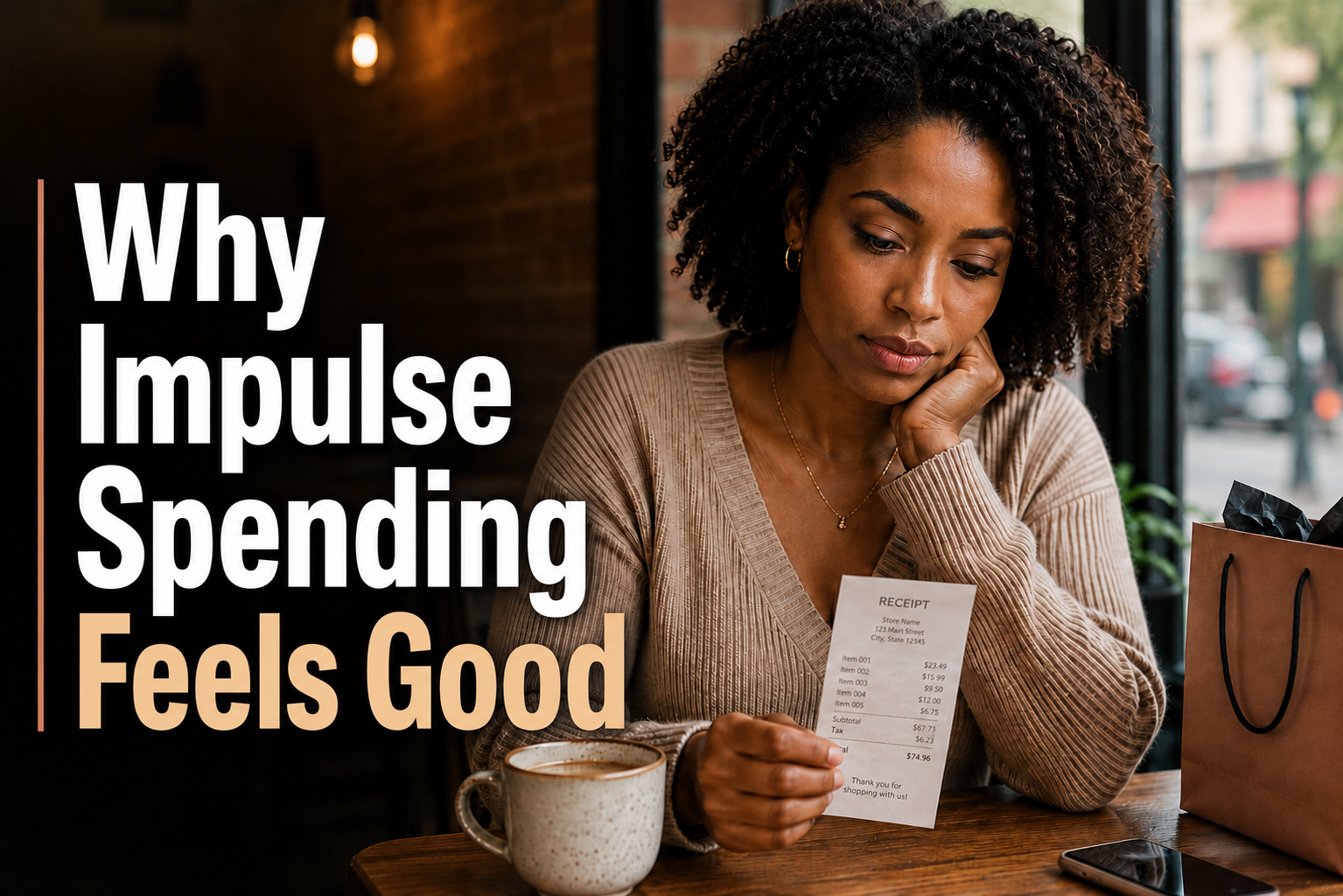
An impulse purchase can happen in seconds. A notification appears, a product feels unusually relevant, a saved card removes the effort of paying, and the order is complete before the buyer has compared the purchase with the rest of her financial life. The cost often feels small or distant in that moment. It becomes more concrete later, when the emotional charge fades, the package arrives, or the transaction appears on a credit card statement.
That sequence is the focus of this article: trigger → immediate purchase → delayed awareness of cost → regret → a more protective pause next time. The goal is not to label every unplanned purchase as harmful or to suggest that women lack self-control. It is to identify what happens in the brief interval between noticing an urge and completing a transaction.
Impulse spending can overlap with emotional spending, but the two are not identical. Emotional spending is defined by the emotional function of the purchase—such as comfort during stress. Impulse spending is defined by speed, reduced reflection, and the absence of a meaningful pause. A purchase may be emotional, impulsive, both, or neither.
Shopping platforms, advertising, payment design, fatigue, social comparison, boredom, excitement, and a sense of deservingness can all influence that instant. None of them determines a purchase on its own. Together, however, they can make buying feel easier than stopping.
The practical objective is simple: make the trigger visible early enough to create choice. A pause does not need to eliminate desire. It only needs to reconnect the purchase with its total cost, purpose, and effect on future financial margin before payment is complete.
Quick Answer
Impulse spending is an unplanned or weakly planned purchase completed with little reflection. It becomes more likely when an emotional or environmental trigger creates urgency and a low-friction checkout makes immediate action easy. The reward is felt now, while the cost is noticed later. The most effective practical response is to insert a barrier between urge and payment: name the trigger, leave the cart, remove saved payment details, calculate the full cost, and return after a predetermined waiting period.
Key Insights
- Impulse spending is about the moment of action. Its defining feature is a fast decision with little space for comparison or reflection.
- A trigger is not the same as a need. Stress, boredom, celebration, social comparison, scarcity language, personalization, and convenience can all create urgency without creating lasting value.
- The reward and the cost arrive at different times. Anticipation and relief are immediate; the effect on cash flow, credit, or savings is often delayed.
- Regret is useful information. It can reveal the trigger, time, platform, payment method, or emotional state that repeatedly shortens reflection.
- Practical barriers work at the point of risk. Removing saved cards, muting retail alerts, using a waiting rule, and checking total cost create decision space before the transaction.
- The aim is not perfect control. It is to make important purchases intentional and prevent repeated quick decisions from quietly consuming future income.
Chapter 1 — The Moment an Impulse Purchase Begins
An impulse purchase rarely begins with a complete financial decision. It begins with attention. Something interrupts the buyer: a product, a message, a mood, a memory, a comparison, or an invitation to act now. The first question is often not “Does this fit my priorities?” but “Do I want this feeling to continue?”
The five-second decision chain
A simplified impulse sequence often looks like this:
- A trigger captures attention. It may be internal, such as boredom or frustration, or external, such as an alert or recommendation.
- The product acquires an emotional meaning. It begins to represent relief, reward, belonging, efficiency, confidence, or a better future self.
- The mind produces a fast justification. “It is inexpensive,” “I deserve it,” “I may need it later,” or “I can return it.”
- Checkout removes the remaining delay. A stored card, digital wallet, or installment option makes action almost effortless.
- Evaluation occurs after payment. Only later does the purchase compete with bills, savings, debt repayment, space, or other priorities.
Classic consumer research describes the buying impulse as a sudden and powerful urge that can temporarily reduce consideration of consequences (Rook, 1987). This does not mean reflection disappears. It means reflection arrives too late to influence the transaction.
Impulse is not defined by price
A $12 purchase can be intentional, while a $300 purchase can be impulsive. Price matters for financial impact, but speed and reduced deliberation define the mechanism. An item can also be useful and still be bought impulsively. The question is not whether the product has any value; it is whether the decision had enough space to test that value before payment.
This distinction prevents moralizing. The objective is not to classify every spontaneous pleasure as a failure. It is to identify decisions that repeatedly produce regret, conflict with stated priorities, or move costs into a future month without deliberate agreement.
The missing pause
The most important feature of the sequence is the missing pause between urge and action. During that pause, a buyer could ask: What triggered this? What is the total cost? What will this replace? Would I choose it tomorrow? When the environment removes that interval, the first emotional interpretation can become the final financial decision.
The rest of this article examines the forces that compress that pause and the barriers that can restore it.
Chapter 2 — Emotional Triggers That Make Buying Feel Urgent
Emotions do not make financial decisions irrational. They supply information, motivation, and meaning. The risk appears when a feeling creates urgency and the purchase is completed before the buyer can distinguish between wanting the item and wanting a change in emotional state.
Common internal triggers
- Stress: buying promises relief or closure.
- Boredom: browsing creates stimulation and novelty.
- Fatigue: convenience becomes more valuable, while comparison feels more difficult.
- Sadness or frustration: a purchase offers a quick positive event.
- Celebration: excitement can reduce attention to limits because spending feels earned.
- Social comparison: an item appears to close a gap between the buyer and the image she sees.
- Deservingness: “I work hard” or “I never do anything for myself” turns the purchase into symbolic compensation.
- Fear of missing out: not buying feels like losing an opportunity, status, or future benefit.
The same trigger will not affect every person in the same way. A useful map is personal and specific. “Stress makes me spend” is too broad. “After difficult work calls, I open shopping apps and buy beauty products with a stored credit card” identifies a time, context, category, and payment route.
Impulse spending versus emotional spending under stress
The overlap between these concepts must be clear. Emotional spending under stress examines buying as a way to regulate ongoing pressure or overload. This article examines the shorter decision window: the cue, justification, checkout, and delayed realization that can occur in seconds or minutes.
A stressed buyer may plan a purchase for several days; that purchase can be emotional without being impulsive. Another buyer may respond instantly to a personalized alert while feeling calm; that purchase can be impulsive without serving as stress relief. The most vulnerable situation occurs when emotional need and instant checkout reinforce each other.
Why naming the trigger matters
A vague instruction such as “have more discipline” offers no point of intervention. Naming the trigger does. If boredom begins the sequence, the barrier should appear during browsing. If fatigue is the trigger, discretionary decisions can be moved away from late-night hours. If comparison drives the urge, unfollowing or muting a source may matter more than creating another budget category.
The trigger is not an excuse for the cost. It is the earliest useful information about where to interrupt the decision.
Chapter 3 — Environmental and Digital Triggers
Impulse does not occur only inside the buyer. Physical and digital environments organize attention, increase salience, and reduce the time available to reconsider. Convenience can be genuinely beneficial, but it also changes the architecture of choice.
Urgency and scarcity cues
Messages such as “only two left,” countdown timers, low-stock warnings, expiring carts, and limited-access offers convert a preference into a deadline. The buyer begins evaluating the cost of missing the offer instead of the value of owning the product.
Some urgency is real. Some is part of ordinary promotion. Some interface practices can be deceptive or manipulative. The U.S. Federal Trade Commission has documented digital design practices that can obscure choices, create false urgency, hide important terms, or make an action easier than its reversal (FTC, 2022). The practical response is to treat urgency as a reason to slow down, not as proof that buying is wise.
The separate HerMoneyPath analysis of Black Friday debt focuses specifically on discounts, promotional scarcity, and the feeling that overspending is saving. Here, promotional urgency is only one of several triggers that can shorten an everyday decision.
Personalization and repeated exposure
Recommendations based on searches, clicks, wish lists, prior purchases, and engagement can make an item feel unusually well matched. Repeated exposure also increases familiarity. The result can feel like an independent desire even when the platform has repeatedly returned the same option to attention.
Personalization does not remove agency, and an algorithm does not need to know a buyer’s emotions to influence timing. It only needs to display an appealing item during a moment when attention is fragmented and checkout is easy.
Social proof and comparison
Reviews, popularity labels, influencer content, “trending” signals, and images of idealized lives can make a product appear socially validated. The decision silently shifts from “Is this useful to me?” to “Why does everyone else already have this?”
Social proof can provide valuable information. It becomes an impulse trigger when popularity substitutes for a personal decision rule. A highly rated product can still be unnecessary, mistimed, or unaffordable.
Checkout without friction
A physical purchase once required several steps: traveling, carrying the item, waiting, presenting payment, and seeing money leave. Digital buying can compress the process into a tap. Stored cards, one-click checkout, autofill, digital wallets, and instant credit reduce effort precisely when delay could support reflection.
Friction is not always an inconvenience to eliminate. In discretionary spending, one extra step can protect a decision. Logging in again, retrieving a card, or leaving the cart until tomorrow gives the initial emotional signal time to weaken.
Chapter 4 — Why the Cost Feels Distant at Checkout
Impulse spending is encouraged by a timing mismatch: the emotional benefit is immediate, while the financial consequence is delayed or divided. The buyer feels acquisition now but may not feel the loss until a statement closes, an installment repeats, or another expense competes for the same income.
Reward appears before ownership
Neuroeconomic research has found that activity in reward-related systems during product viewing can help predict purchase decisions, while the anticipated price and cost also influence the outcome (Knutson et al., 2007). The relevant lesson is not that the brain forces anyone to buy. It is that anticipation itself can be rewarding before the product provides any practical benefit.
This helps explain why browsing, adding to cart, and confirming an order can feel more exciting than owning the item later. The strongest emotional moment may belong to the transaction, not the product.
Payment can reduce cost visibility
Payment research suggests that timing, salience, and form influence how strongly a transaction feels connected to giving up money (Prelec & Loewenstein, 1998; Soman, 2001; Raghubir & Srivastava, 2008). Cash is not automatically better in every situation, and credit is not inherently harmful. The risk is that a low-salience method can allow the urge to dominate while the total cost remains abstract.
Before buying, convert an abstract payment into a visible commitment:
- Read the full price, including tax, shipping, fees, and interest.
- For installments, multiply the payment by the number of payments.
- For credit, ask whether the statement can be paid in full without moving another priority.
- Translate the cost into a tradeoff: emergency savings, debt repayment, retirement contribution, childcare, travel, or another personal goal.
For a deeper analysis of this mechanism, see how credit card convenience can make spending feel less immediate.
Delayed cost is still real cost
An installment changes timing, not price. A credit limit changes access, not affordability. A return policy changes reversibility, not the effort required to correct a purchase. When these tools are used intentionally, they can be useful. When they are recruited by an impulse, they can move today’s emotional decision into several future paychecks.
Chapter 5 — Why Regret Arrives After the Purchase
Regret often appears when the conditions that supported the purchase disappear. The countdown ends, the excitement falls, the difficult day passes, and the buyer evaluates the item from a calmer state. The question changes from “How will this feel right now?” to “Was this worth what it cost?”
A change in perspective
Research on regret describes it as a comparison between the chosen outcome and an alternative that now appears better (Zeelenberg & Pieters, 2007). After an impulse purchase, the alternative may be keeping the money, choosing a different item, waiting for more information, or avoiding another card balance.
Regret is therefore not proof that the buyer is irresponsible. It is evidence that the evaluation criteria changed after the immediate trigger lost strength. That information can help redesign the next decision.
Three forms of post-purchase regret
- Product regret: the item is disappointing, unnecessary, duplicated, or rarely used.
- Financial regret: the transaction reduces cash flow, increases debt, or displaces a more important use of money.
- Process regret: the buyer dislikes how quickly or automatically the decision happened, even if the item is acceptable.
Process regret is especially valuable for this article because it points directly to the missing pause. A buyer may keep the product and still decide that future purchases in that category require a 24-hour delay.
Do not let regret restart the cycle
Shame can turn a specific transaction into a global identity: “I am terrible with money.” That conclusion hides the actionable evidence. A more useful review is: “The urge appeared after 10 p.m.; a notification opened the app; the card was saved; I focused on the monthly installment; I regretted the purchase when I saw the full statement.”
This description produces possible barriers. The identity statement produces only self-criticism. If shame is already making it difficult to look at balances or discuss debt, understanding money shame can help separate accountability from silence.
Chapter 6 — Build Your Personal Impulse-Spending Trigger Map
A trigger map turns regret into data. It does not require tracking every purchase forever. Reviewing five to ten regretted or questionable transactions can reveal patterns that a monthly total cannot show.
Record the decision, not only the amount
For each purchase, note:
- Time and place: late night, commute, work break, store, social media, or bed.
- Emotion: stressed, bored, excited, lonely, tired, frustrated, or rewarded.
- Trigger: notification, influencer post, sale, low-stock message, free-shipping threshold, or remembered desire.
- Justification: “I deserve it,” “It is almost gone,” “It is only $20,” or “I can return it.”
- Payment route: debit, stored credit card, digital wallet, or installment plan.
- Later reaction: satisfied, neutral, product regret, financial regret, or process regret.
Look for repeated combinations
The most useful pattern is usually a combination, not a single cause. Examples include:
- fatigue + late-night scrolling + stored card;
- celebration + social comparison + beauty purchase;
- work frustration + browsing + “treat myself” justification;
- limited-time message + fear of missing out + installment checkout;
- free-shipping threshold + cart expansion + low attention to total cost.
Once the combination is visible, choose a barrier that interrupts its actual route. A generic rule will be weaker than a targeted one. For late-night app purchases, log out and remove the card. For free-shipping expansion, compare the delivery fee with the cost of the extra items. For social comparison, mute the account or move the app away from the home screen.
Separate exceptions from patterns
One regretted purchase may be an isolated mistake. A recurring combination deserves a system. Frequency, financial effect, distress, secrecy, and difficulty stopping matter more than achieving a perfect record. The trigger map should reduce uncertainty, not create another source of surveillance or guilt.
Chapter 7 — Create a Pause Before Buying
Because impulse spending is fast, the intervention must occur before checkout. A promise to “do better next month” arrives too late. The following barriers are designed to lengthen the decision just enough for cost and priorities to re-enter the picture.
Use the HMP Pause
When a nonessential purchase feels urgent, use three questions:
- H — What is happening? Name the emotion, cue, and context without judgment.
- M — What does this money replace? Identify the full cost and the competing use of the money.
- P — What pause fits this purchase? Leave the page and return only after a predetermined delay.
The waiting period can match the size and reversibility of the decision. A small discretionary item might require the rest of the day. A larger purchase might require 24 or 72 hours. The important feature is that the rule is chosen before the urge, not negotiated during it.
Add physical or digital friction
- Remove saved cards from retail sites and shopping apps.
- Turn off promotional notifications, texts, and emails.
- Log out after each session.
- Delete shopping apps used mainly during vulnerable times.
- Use a wish list instead of the cart.
- Require a written reason for purchases above a personal threshold.
- Keep discretionary spending in a separate account or clearly visible category.
These barriers do not prohibit buying. They make the transaction slightly slower than the trigger.
Challenge the fast justification
Each familiar justification can have a prepared response:
- “It is only $20.” What is the monthly total of similar purchases?
- “I deserve it.” Do I deserve this item, or do I need rest, recognition, time, or support?
- “I can return it.” Would I buy it if all sales were final?
- “The sale ends tonight.” Would I want it at full price next week?
- “The payment is small.” What is the total price and how many future paychecks are already committed?
Make intentional pleasure visible
A barrier should not turn financial life into permanent deprivation. A realistic system can include guilt-free discretionary money. The distinction is that the amount is chosen in advance and the purchase remains connected to available cash, rather than being decided entirely by a trigger.
Chapter 8 — Protect Credit, Savings, and Future Income
One impulse purchase may have little financial effect. Repetition changes the picture. Several small transactions can reduce the cash available for saving, and a larger unplanned purchase can create a balance that remains after the emotional benefit has disappeared.
From quick purchase to future obligation
Credit can separate the decision from its consequence. If a balance is not paid in full, the original purchase may continue claiming future income through interest. Multiple installments can also accumulate into a fixed monthly burden even when each checkout looked manageable.
The Federal Reserve’s 2025 household survey, published in 2026, shows why margin matters: many U.S. adults continue to navigate unexpected expenses, bill pressure, savings constraints, and varied credit outcomes (Federal Reserve Board, 2026). Those findings do not prove that impulse spending causes hardship. They show that an unplanned cost can matter more when financial room is already limited.
Do not turn this article into a shopping-habits article
The financial accumulation deserves attention, but it is not the central search intent here. Shopping habits and consumer debt examines how repeated everyday purchases use credit and consume future income over time. This article remains focused on the instant that starts each transaction and the barriers that can stop it before it becomes part of a larger pattern.
Use three financial guardrails
- A cash-flow guardrail: discretionary purchases must fit after essentials and planned priorities.
- A credit guardrail: do not use a credit limit as the measure of affordability; use the amount that can be repaid without carrying a new balance.
- A future-income guardrail: count existing installments before accepting another one.
If the problem is not the instant purchase but a budget that repeatedly collapses under irregular expenses, unrealistic limits, or insufficient income, see why budgeting fails and how to make a budget stick. A better budget and a stronger pause can support each other, but they solve different problems.
Chapter 9 — Respond Without Shame or False Promises
Understanding a trigger does not erase responsibility for a purchase. It makes responsibility more precise. Instead of demanding unlimited willpower, the buyer changes the environment, timing, or payment path that repeatedly makes reflection difficult.
Progress is a longer decision window
Success does not require never buying spontaneously again. Useful progress may look like fewer regretted purchases, smaller financial effects, faster returns, less secrecy, more purchases paid from planned funds, or a greater ability to leave an item overnight.
A pause can also lead to an intentional “yes.” After waiting and checking the full cost, the buyer may still decide that the item fits her priorities. The value of the pause is not automatic refusal. It is a decision made with more complete information.
When the pattern needs more support
Impulse spending is not the same as compulsive buying-shopping disorder. Clinical literature describes compulsive buying as a persistent pattern associated with distress, impairment, or difficulty controlling repeated buying behavior (Black, 2007; Black, 2022). An article cannot diagnose that condition.
Consider qualified financial and/or mental health support when spending repeatedly causes serious debt, secrecy, relationship conflict, intense distress, inability to cover essentials, or a persistent feeling of being unable to stop despite harmful consequences. Seeking help is not evidence of failure. It is an appropriate response when self-directed barriers are not enough.
Restore choice at the earliest point
The central question is not “How can I become immune to emotion and marketing?” No one makes decisions outside context. A more useful question is “What would give me ten minutes, one night, or one extra step before this trigger becomes a payment?”
That small interval is where total cost, personal priorities, and future freedom can re-enter the decision.
Frequently Asked Questions
What is impulse spending?
Impulse spending is an unplanned or weakly planned purchase made with little time for reflection. It often occurs when an emotional or environmental trigger creates urgency and checkout makes immediate action easy.
What are common impulse-spending triggers?
Common triggers include stress, boredom, fatigue, celebration, social comparison, fear of missing out, personalized recommendations, low-stock messages, countdowns, free-shipping thresholds, saved cards, one-click checkout, and installment offers.
Is impulse spending the same as emotional spending?
No. Impulse spending is defined mainly by speed and reduced reflection. Emotional spending is defined by the emotional purpose of the purchase, such as comfort or relief. A purchase can be impulsive, emotional, both, or neither.
Why do I regret purchases after buying them?
Regret often appears after the trigger, excitement, or urgency fades and the full cost becomes more visible. You may then compare the purchase with a better alternative, such as saving the money, waiting, or choosing something else.
How can I stop an impulse purchase before checkout?
Name the trigger, leave the cart, calculate the full cost, identify what the money would replace, and apply a waiting rule chosen in advance. Removing saved cards and turning off retail notifications can add useful friction.
Does a 24-hour waiting rule work for every purchase?
No single delay fits every decision. The purpose is to create enough distance for the trigger to weaken and reflection to return. A small purchase may need a shorter delay, while a larger or financed purchase may need 24 to 72 hours or more.
Can small impulse purchases affect financial security?
Yes, when they repeat. The effect usually comes from accumulation: less money for savings, more use of credit, additional installments, and less flexibility for future expenses. One small purchase, however, should not automatically be treated as a financial crisis.
Should I stop using credit cards to control impulse spending?
Not necessarily. Credit cards can be useful payment tools. If a saved card or delayed statement repeatedly makes cost feel invisible, removing stored details or using a more visible payment method for discretionary purchases may create a helpful pause.
When should I seek professional help?
Consider professional support when shopping repeatedly causes significant debt, secrecy, distress, relationship conflict, missed essentials, or a persistent inability to stop despite harmful consequences. A qualified financial counselor and a licensed mental health professional can address different parts of the problem.
Conclusion
Impulse spending is not defined by a particular product or price. It is defined by a compressed decision: a trigger captures attention, the purchase acquires emotional meaning, a fast justification reduces resistance, checkout makes action easy, and the full cost is evaluated later.
That sequence explains why regret can coexist with financial knowledge. The buyer may understand her goals and still make a quick purchase when reward is immediate, cost is abstract, and the environment removes natural pauses. The practical answer is not shame or a promise of perfect self-control. It is a barrier placed before payment.
A trigger map can show when and where the pattern begins. A waiting rule can allow urgency to fall. Removing saved payment details can reconnect desire with effort. Calculating total cost can bring future income into the present decision. One well-placed barrier may be more useful than a long list of rules applied after regret.
For women building savings, paying down debt, preparing for uncertainty, or protecting retirement goals, the pause matters because every purchase is also an allocation of future choice. The goal is not to eliminate pleasure. It is to make sure that a momentary trigger does not make that allocation alone.
Research Context
This article draws on consumer psychology, behavioral decision research, neuroeconomics, payment research, U.S. consumer-protection analysis, and household financial data. The evidence supports examining impulse spending as an interaction among personal state, environmental cues, payment design, and decision timing rather than as a simple measure of character.
Classic impulse-buying research describes a sudden urge and reduced consideration of consequences. Research on affect and consumer behavior helps explain why emotion can increase the appeal of immediate action. Neuroeconomic and payment studies provide evidence about reward anticipation and the salience of cost. The FTC report documents design practices that may impair consumer choice, while Federal Reserve data supplies broader context about the financial margin available to U.S. households.
Evidence limits: No single study proves that a specific trigger causes a particular person to buy. Laboratory tasks, surveys, clinical research, and consumer-market reports answer different questions and may not represent every U.S. woman or every purchasing context. References to women’s paid and unpaid workloads provide context, not a claim that women are inherently more impulsive. The practical barriers in this article are decision aids, not guaranteed treatments.
Disclaimer
This article is for educational and informational purposes only. It does not provide individualized financial, legal, psychological, medical, or therapeutic advice and should not replace guidance from a qualified professional who can consider your circumstances.
HerMoneyPath does not diagnose compulsive buying-shopping disorder or recommend a specific financial product, debt strategy, or treatment. Financial decisions should be evaluated in light of personal income, expenses, obligations, goals, and professional guidance when appropriate.
References
Black, D. W. (2007). A review of compulsive buying disorder. World Psychiatry, 6(1), 14–18. https://pubmed.ncbi.nlm.nih.gov/17342214/
Black, D. W. (2022). Compulsive shopping: A review and update. Current Opinion in Psychology, 46, 101321. https://pubmed.ncbi.nlm.nih.gov/35367751/
Board of Governors of the Federal Reserve System. (2026). Economic Well-Being of U.S. Households in 2025. https://doi.org/10.17016/8960.2
Federal Trade Commission. (2022). Bringing Dark Patterns to Light. FTC staff report.
Knutson, B., Rick, S., Wimmer, G. E., Prelec, D., & Loewenstein, G. (2007). Neural predictors of purchases. Neuron, 53(1), 147–156. https://doi.org/10.1016/j.neuron.2006.11.010
OECD. (2025). Gender gaps in paid and unpaid work persist. https://doi.org/10.1787/25a6c5dc-en
Prelec, D., & Loewenstein, G. (1998). The red and the black: Mental accounting of savings and debt. Marketing Science, 17(1), 4–28. https://doi.org/10.1287/mksc.17.1.4
Raghubir, P., & Srivastava, J. (2008). Monopoly money: The effect of payment coupling and form on spending behavior. Journal of Experimental Psychology: Applied, 14(3), 213–225. https://doi.org/10.1037/1076-898X.14.3.213
Rook, D. W. (1987). The buying impulse. Journal of Consumer Research, 14(2), 189–199. https://doi.org/10.1086/209105
Rook, D. W., & Gardner, M. P. (1993). In the mood: Impulse buying’s affective antecedents. Research in Consumer Behavior, 6, 1–28.
Soman, D. (2001). Effects of payment mechanism on spending behavior: The role of rehearsal and immediacy of payments. Journal of Consumer Research, 27(4), 460–474. https://doi.org/10.1086/319621
Zeelenberg, M., & Pieters, R. (2007). A theory of regret regulation 1.0. Journal of Consumer Psychology, 17(1), 3–18. https://doi.org/10.1207/s15327663jcp1701_3