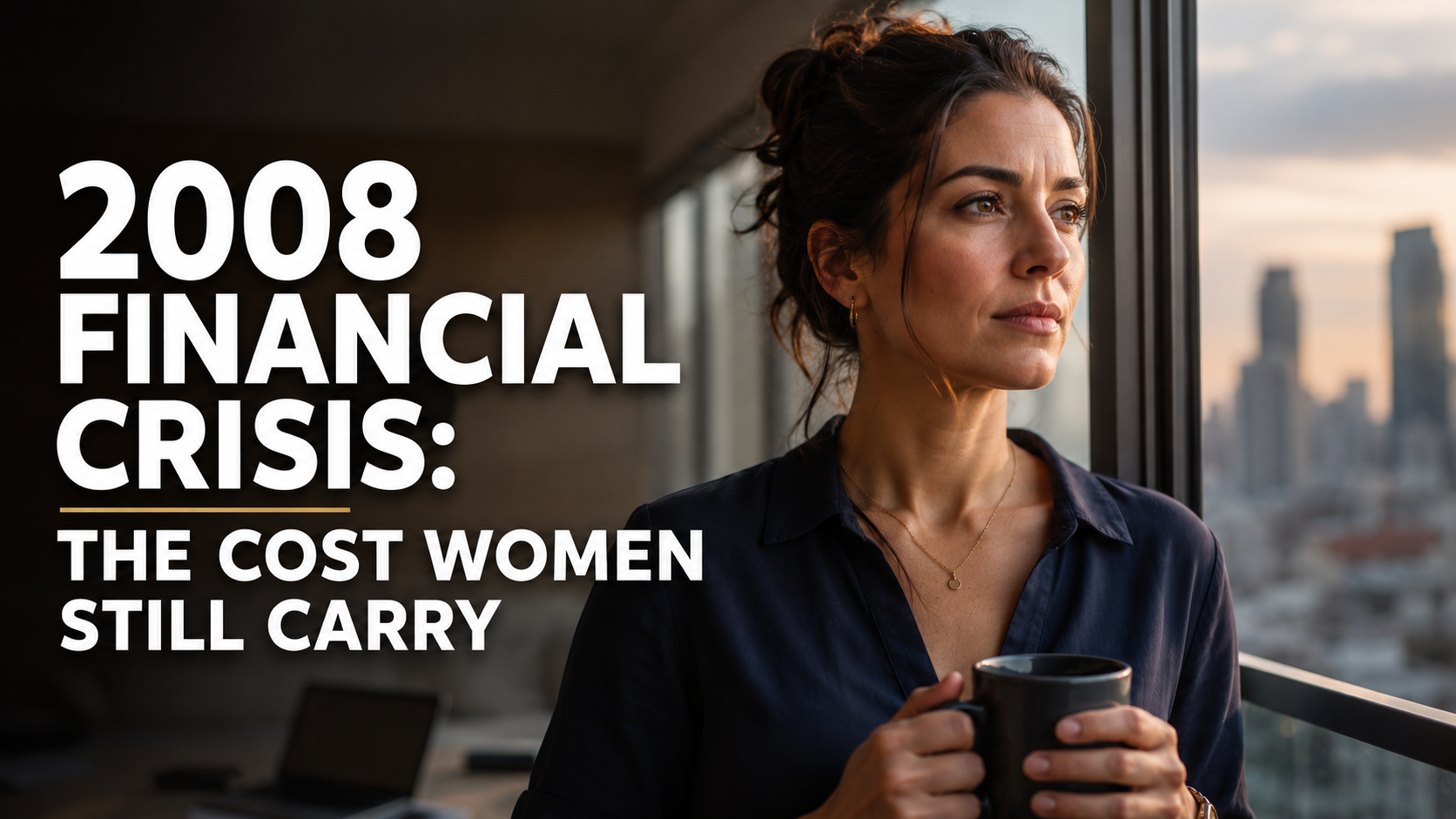
2008 Recession and Women’s Careers: Debt and Resilience

About This Article

This article examines how the 2008 recession affected women beyond the immediate loss of jobs and income. It connects career disruption, household debt, unpaid care responsibilities, financial resilience, and long-term security to explain why recovery remained incomplete for many women even after markets and employment indicators improved.

How the 2008 Recession Reshaped Women’s Careers, Debt, and Financial Security

The 2008 recession did more than eliminate jobs, reduce savings, and damage retirement accounts. For many women, it disrupted career progress, weakened income stability, increased dependence on credit, and changed how financial risk was evaluated long after the economy began to recover.

Some women lost jobs or working hours. Others remained employed but experienced frozen wages, delayed promotions, reduced benefits, heavier workloads, or fewer opportunities to move into more secure positions. These professional setbacks often affected more than current income. They also reduced the ability to save, contribute consistently to retirement accounts, pay down debt, and prepare for future disruptions.

When income became less predictable, credit frequently filled the gap between household needs and available cash. Credit cards, personal loans, and other forms of borrowing helped families cover essential expenses, but short-term financial continuity could create years of repayment pressure. Career instability and debt therefore became connected parts of the same post-crisis experience rather than separate financial problems.

The effects were often intensified by unpaid care responsibilities and household financial management. Many women adjusted work schedules, postponed career changes, or accepted slower professional growth to protect family stability. These decisions were understandable responses to economic pressure, yet they could also narrow future earning potential and reduce the financial margin available for rebuilding.

This is why the end of the official recession did not mark the end of its influence. Economic indicators improved, but many women continued rebuilding from a lower starting point, with less savings, interrupted retirement contributions, accumulated debt, and greater caution about changing jobs, investing, or taking other financial risks.

This article examines how the 2008 recession reshaped women’s careers, debt, resilience, and long-term financial security. Its central question is not only what women lost during the crisis, but how career disruption, household responsibility, and reliance on credit continued to influence financial choices after the headlines faded.

By connecting labor-market changes, household debt, unpaid care, and long-term rebuilding, the analysis reveals a less visible legacy of the crisis: recovery could appear complete in national statistics while remaining unfinished in individual financial lives.

Quick Answer

The 2008 recession reshaped women’s careers by slowing wage growth, interrupting advancement, and increasing pressure to use debt when income became unstable. Even after the economy recovered, many women carried lower savings, weaker retirement contributions, and greater caution about financial risk. The lasting effect was not only lost income, but a narrower margin for rebuilding long-term security.

Key Insight

The hidden legacy of the 2008 recession was not simply that women lost income. It was that career instability, household responsibility, and debt became connected parts of the same financial chain. A disrupted job could weaken savings, increase credit use, delay retirement contributions, and make future career risks harder to take.

This helps explain why recovery statistics never told the whole story. Markets and employment could improve while many women continued rebuilding from a lower financial starting point, with less room to absorb another disruption.

Chapter 1 — The 2008 Recession as a Structuring Event

Beyond the Immediate Shock

From financial collapse to historical inflection point

The 2008 recession is frequently described as an abrupt collapse of the global financial system, marked by institutional failures, credit contraction, and rapid deterioration of the labor market. While accurate in the immediate sense, this description captures only a fraction of its historical significance. Crises of this magnitude do not end when macroeconomic indicators begin to recover. They function as inflection points capable of durably altering the paths through which income, careers, and opportunities develop.

Unlike short-lived cyclical recessions, the 2008 crisis reorganized labor market functioning, credit dynamics, and the role of debt in everyday life. Even after economic growth resumed, the effects of this reorganization continued to operate, creating persistent constraints for certain groups and redefining what came to be considered “normal” in terms of financial stability. This structural character explains why many of the crisis’s consequences only became fully visible years later.

Macroeconomic Recovery Versus Everyday Stability

One of the defining features of the 2008 crisis was the mismatch between market recovery and the reality experienced by households. While monetary and fiscal policies were designed to stabilize the financial system and restore investor confidence, the rebuilding of economic security at the household level occurred more slowly and unevenly. This misalignment created an environment in which improvements in aggregate indicators did not automatically translate into financial relief for workers.

In this context, the notion of the “end of the crisis” became ambiguous. For many families—especially those with limited savings or greater reliance on wage income—instability lasted beyond the official recession. Federal Reserve household research published in 2015, using 2014 survey data, documented continuing concerns about financial fragility, savings, credit, and preparedness during the recovery (Board of Governors of the Federal Reserve System, 2015).

An Event That Redefines Economic Trajectories

The cumulative impact of structuring crises

Structuring crises are distinguished by their cumulative effect. They not only interrupt existing trajectories but also alter the starting point of future ones. In the case of 2008, the initial shock was followed by persistent changes in the rules of the economic game: increased labor precariousness, reduced income predictability, and expanded reliance on credit as a compensatory mechanism. These factors began to influence individual decisions continuously, even during periods of economic growth.

The cumulative impact is particularly evident in career progression. Temporary interruptions, wage freezes, and reduced opportunities for upward mobility do not disappear automatically when employment recovers. They can alter the point from which future earnings and saving resume, and research on labor-market entry and job displacement shows that unfavorable conditions can produce persistent career and earnings effects (OECD, 2020; U.S. Bureau of Labor Statistics, 2018b).

Persistence of Effects Across the Life Cycle

When a crisis alters the beginning or middle of a professional trajectory, its effects tend to extend across the entire economic life cycle. Decisions made under pressure—accepting jobs below qualification, postponing retirement contributions, or relying on credit to maintain living standards—become anchoring points for future choices. As a result, the crisis’s impact ceases to be merely cyclical and begins shaping the structure of opportunities available over time.

For many women, this process was intensified by the combination of family responsibilities, weaker institutional protection, and greater exposure to vulnerable sectors. The 2008 crisis therefore did not merely reduce income at a specific moment but redefined the horizon of economic possibilities, affecting how security and risk came to be perceived and managed in everyday life (International Labour Organization, 2010).

The Invisible Asymmetry of Impacts

Sectors, occupations, and differential exposure

The 2008 recession did not affect women and men in identical ways, but the pattern was more complex than a simple claim that women experienced the largest initial job losses. Construction and manufacturing—industries with higher male employment—sustained especially steep declines. At the same time, women lost more payroll jobs than in prior downturns, and the later recovery exposed different vulnerabilities through public-sector cuts, lower-paid work, reduced hours, and declining labor-force participation (U.S. Bureau of Labor Statistics, 2012; U.S. Bureau of Labor Statistics, 2014; U.S. Bureau of Labor Statistics, 2017).

Even when employment was retained, security could still weaken through reduced hours, slower wage growth, fewer benefits, or limited advancement. These changes are not always visible in headline unemployment figures, yet they directly affect a household’s ability to plan, save, and absorb another disruption (Pew Research Center, 2010; Schanzenbach et al., 2017).

Remaining Employed Did Not Mean Remaining Secure

A recurring misconception in crisis analysis is equating employment retention with preserved financial security. For many women, remaining employed during the recession did not prevent real income loss, professional stagnation, or increased reliance on credit. Insecurity manifested more subtly, through wage compression, work overload, and reduced prospects for advancement.

This less visible form of impact contributed to underestimating the economic costs borne by women in the post-crisis period. Because wage compression, lost mobility, and weaker benefits did not always appear as immediate job losses, they were often treated as private adjustments even though they reflected a slow and uneven labor-market recovery (Elsby, Hobijn, & Şahin, 2010; Schanzenbach et al., 2017).

The Crisis as an Organizer of Future Decisions

When individual adaptations replace collective protections

Institutional responses to the 2008 crisis prioritized stabilizing the financial system but left significant gaps in direct household protection. In this scenario, many decisions that should have been mediated by public policy were resolved at the individual level. Household budget adjustments, longer working hours, and recurrent use of credit became common strategies for dealing with prolonged instability.

This shift of responsibility from the collective to the individual reinforced pre-existing inequalities. Families with less financial slack or heavier unpaid labor burdens had less capacity to absorb the shock without resorting to solutions that compromised the future. The crisis thus began organizing long-term economic decisions even after the macroeconomic context had stabilized.

A Redefined Terrain for Careers, Debt, and Resilience

By operating as a structuring event, the 2008 recession redefined the terrain on which careers, indebtedness, and resilience strategies developed. Choices made in this new environment cannot be understood as isolated decisions or individual failures. They were rational responses to a system offering less predictability, weaker protection, and greater reliance on private solutions.

From this framing, it becomes possible to understand why so many women found themselves on the frontlines of the crisis’s effects. Before analyzing careers, debt, and resilience more specifically, it is essential to recognize that the 2008 recession was not merely an episode to be overcome, but a landmark that reorganized the economic conditions under which these trajectories unfolded.

Chapter 2 — Women on the Frontlines of the Labor Market

Structural Exposure in Female Employment

Sectors more vulnerable to crisis cycles

When the 2008 recession spread into the real economy, its effects did not strike all labor-market segments equally. The steepest initial employment declines occurred in goods-producing industries such as construction and manufacturing, where men held a larger share of jobs. Women’s exposure followed a different pattern: substantial job losses during the downturn, slower recovery in some areas, public-sector cuts, and continued pressure in lower-paid or less protected work (U.S. Bureau of Labor Statistics, 2012; U.S. Bureau of Labor Statistics, 2014).

This distinction matters because women were not uniformly concentrated in industries that collapsed first. Education and health services continued to add employment during the recession, while other service industries and government employment followed different paths. The longer-term risk appeared through uneven recovery, occupational segregation, reduced participation, and fewer routes to higher-quality work (U.S. Bureau of Labor Statistics, 2017; U.S. Bureau of Labor Statistics, 2018a).

Occupational Segmentation as an Invisible Risk Factor

Labor market segmentation acted as a silent amplifier of the crisis. Occupations with higher female participation tend to offer lower wages, weaker institutional protection, and fewer formal advancement mechanisms. In the context of a deep recession, these characteristics increased vulnerability without necessarily producing visible indicators of collapse, such as immediate spikes in female unemployment.

The result could be a diffuse form of risk: a job retained, but with weaker hours, benefits, bargaining power, or advancement. Such deterioration can undermine income stability without producing a visible unemployment event, helping explain why women’s post-recession experience cannot be measured by unemployment rates alone (International Labour Organization, 2010; U.S. Bureau of Labor Statistics, 2017).

Remaining Employed Did Not Mean Remaining Protected

Wage stagnation and compressed opportunities

For many women, passing through the 2008 crisis without job loss did not mean escaping economic loss. Wage stagnation became a persistent feature of the post-crisis period, particularly in sectors where individual bargaining power was already limited. Salary freezes, bonus reductions, and the absence of real wage adjustments became part of everyday work experience.

This income compression had cumulative effects. Wages that fail to keep pace with living costs reduce saving capacity and increase vulnerability to later shocks. Research on recession exposure, weak labor-market entry, and job displacement shows that losses at important career stages can continue affecting earnings after aggregate employment recovers (Boushey et al., 2019; OECD, 2020; U.S. Bureau of Labor Statistics, 2018b).

The Silent Loss of Professional Mobility

Another less visible effect was reduced professional mobility. Delayed promotions, interrupted career paths, and fewer opportunities to transition into more stable positions became more common in the post-crisis environment. For women at decisive stages of their professional trajectory, this loss of mobility represented a structural cost rather than a temporary one.

Accepting a position below one’s qualification, remaining in a role with limited advancement, or postponing a job change can be rational under uncertainty. Yet these decisions may also reduce future earnings and mobility, allowing a temporary defensive choice to become a long-term career constraint (Pew Research Center, 2010; OECD, 2020).

Work, Care, and Overload After the Crisis

The intensification of unpaid labor

The 2008 recession also reconfigured the relationship between paid work and domestic responsibilities. With the contraction of public services, income pressure in many households, and rising economic insecurity, care tasks were increasingly absorbed by families. In many cases, this meant an expansion of unpaid labor performed by women alongside the maintenance of formal employment.

Care and household responsibilities also shaped women’s ability to respond to instability, although the scale and form differed across families. Later evidence from the COVID-19 period is not direct evidence about 2008, but it demonstrates the broader mechanism clearly: when formal services and support networks weaken, unpaid care can expand and restrict time available for paid work, training, and career mobility (UN Women, 2020).

Household Adjustments as a Response to Economic Shock

At the household level, the crisis demanded constant reorganization of budget and time. The combination of pressured income and increased care demands led many women to make difficult choices, such as reducing work hours, declining promotions, or postponing career changes. Although often intended as temporary, these decisions ended up producing lasting effects on income trajectories.

What emerges is a pattern in which household adjustment functions as a buffer for macroeconomic shock. In the absence of sufficient collective protection, individual and family adaptation came to sustain system stability. This mechanism helps explain why the effects of the crisis on women’s work were profound, even when they did not manifest as open unemployment or abrupt declines in labor force participation.

The Crisis’s Legacy in Women’s Professional Trajectories

Long-term penalties across the career cycle

The impacts of the 2008 recession on women’s work did not end with economic recovery. Accumulated penalties—lower wages, reduced mobility, and career interruptions—continued shaping professional decisions in subsequent years. These marks are particularly relevant when considering the full labor life cycle, in which small early deviations become large differences over time.

The post-2008 evidence establishes that weak labor-market conditions and job displacement can leave persistent career scars. Contemporary workplace research adds a separate, later perspective by documenting continued barriers to advancement, flexibility, and senior representation for women; it should be read as context, not as direct proof of what happened to every woman after 2008 (OECD, 2020; McKinsey & Company & LeanIn.Org, 2023).

Connections to Future Financial Security

Labor market consequences connect directly to future financial security. Slower wage growth and more unstable professional trajectories reduce saving capacity, increase reliance on credit, and compromise long-term planning. Thus, the crisis’s effects on women’s work serve as a central link between the initial economic shock and later challenges related to debt and retirement.

This chain helps situate women’s position on the frontlines of the recession not as an isolated phenomenon, but as part of a structural process. The post-2008 labor market became the first space in which these asymmetries materialized, preparing the ground for the debt and resilience patterns examined in the following chapters. For a deeper career-specific analysis, see how the 2008 crisis reshaped women’s careers in America.

Chapter 3 — When Income Fails, Credit Steps In

Credit as a Shock Absorber for the Economic Blow

From social protection to a private solution

During the acute financial crisis, lending standards tightened and access to credit contracted. Yet household income and employment security also weakened, leaving many families dependent on whatever liquidity remained available—existing credit cards, installment debt, informal support, or later renewed access to consumer credit. As recovery proceeded unevenly, borrowing could become a bridge between essential expenses and income that had not fully recovered (Board of Governors of the Federal Reserve System, 2015).

For households with little cash savings, credit could become a mechanism of economic continuity. Medical bills, transportation, education, utilities, and other essential costs sometimes had to be financed when current income was insufficient. Credit was not equally available or equally priced, but for some families it shifted part of an immediate income shortfall into a future repayment obligation.

Credit Expansion in a Pressured-Income Environment

Monetary easing lowered benchmark interest rates after the crisis, but household access to affordable borrowing remained uneven. Consumers with stronger credit profiles could obtain cheaper financing, while financially constrained households often faced higher-cost products or limited options. For families without an emergency cushion, existing revolving credit could still serve as a bridge during a slow recovery.

For many households, borrowing reflected a combination of essential costs, income volatility, and limited savings rather than discretionary spending alone. Later consumer-finance surveys illustrate how difficulty paying bills, unstable income, and low financial reserves can sustain recurring reliance on credit even outside an officially declared recession (Board of Governors of the Federal Reserve System, 2015; Consumer Financial Protection Bureau, 2022).

Women and the Normalization of Everyday Indebtedness

Credit as an Extension of Income

For many women, credit assumed the practical function of an extension of income. In the face of compressed wages, lower predictability of earnings, and expanded household responsibilities, turning to credit cards, personal lines, or short-term financing became a recurring strategy to maintain financial continuity. This practice did not present itself as an exception, but as a rational adaptation to a system that offered few immediate alternatives for protection.

Credit is commonly marketed as flexibility, convenience, and control. Those benefits can be real, but they can also obscure cumulative costs when borrowing repeatedly substitutes for income. Later CFPB research—used here as comparative evidence rather than a direct measure of 2008—shows how difficulty meeting expenses and declining financial well-being can coexist with continued access to consumer credit (Consumer Financial Protection Bureau, 2022).

This dynamic connects directly to the hidden price of credit card debt for women, where short-term relief can quietly become a long-term constraint.

Invisible Debt and the Silent Management of Risk

A large share of post-crisis female indebtedness occurred in fragmented and less visible forms. Small revolving balances, successive installment payments, and occasional loans rarely appeared as “large debts,” but, added up over time, they produced a significant financial burden. This fragmentation made risk harder to perceive and delayed recognition of long-term effects on financial stability.

Managing this risk became a quiet everyday activity. Adjusting payment dates, balancing several accounts, and prioritizing essential bills required constant attention. Federal Reserve Bank of New York data from 2021 concern a later period, not the Great Recession itself, but they provide comparative evidence of how household debt can remain a major part of financial life long after a crisis has ended (Federal Reserve Bank of New York, 2021).

The Institutional Design Behind Post-Crisis Credit

Financial Incentives and Risk Transfer

The post-2008 institutional design favored the expansion of credit as the default solution to instability. Accommodative monetary policies stimulated credit supply, while the absence of robust income-protection mechanisms transferred economic risk to households. In this arrangement, financial institutions carried less direct risk, while individuals took on greater responsibility for their own economic stabilization.

This shift had important distributive implications. Households with less bargaining power, weaker credit profiles, and less access to low-cost products could pay more to preserve the same level of short-term stability. Credit therefore did not merely bridge income gaps; its price and availability could reproduce existing differences in the ability to rebuild savings and plan for the future (Board of Governors of the Federal Reserve System, 2015; Consumer Financial Protection Bureau, 2022).

The Logic of Financial Survival

In everyday life, the logic that sustained credit use was less ideological and more pragmatic. Keeping bills paid, avoiding interruptions in essential services, and ensuring a minimum level of predictability became the priority. Credit offered an immediate solution to urgent problems, even if it implied more burdensome future commitments. This short-term rationality does not indicate a lack of planning, but adaptation to an environment of high risk and limited protection.

Over time, this logic of financial survival consolidated debt patterns that extended beyond the acute crisis period. Even when the economy showed signs of recovery, reliance on credit remained, because the structural conditions of income and work did not change with the same intensity.

From a Temporary Shock Absorber to a Cumulative Effect

The Transformation of Credit Into a Structural Factor

What began as a temporary shock absorber ended up becoming a structural factor in financial life. Recurring credit use changed how risks were distributed over time, converting income instability into lasting financial commitments. This transformation had direct effects on saving capacity, reserve-building, and long-term planning.

What began as a temporary bridge could become part of a longer financial trajectory. Later SHED data do not trace every borrower back to 2008, but they consistently show the importance of emergency savings, income stability, and the ability to cover unexpected expenses. Households with thinner reserves and recurring debt obligations generally have less room to absorb another disruption (Board of Governors of the Federal Reserve System, 2024).

Connections to Career, Resilience, and Financial Future

Dependence on credit cannot be analyzed in isolation. It connects directly to the professional trajectories discussed in the previous chapter and to the resilience strategies explored ahead. Stagnant wages and reduced mobility increased the need for credit, while indebtedness, in turn, limited the ability to take professional risks or invest in the future.

This chain helps explain why credit occupied such a central role in women’s post-crisis experience. It functioned as the link between income failure and the maintenance of everyday stability, at the cost of compromising future safety margins.

Chapter 4 — Resilience as an Economic Cost

The Institutional Construction of “Female Resilience”

When adaptation becomes a structural expectation

After the 2008 recession, resilience became central to economic and social discourse. Rather than remaining an exceptional response to extreme shock, adaptability was increasingly expected, especially from women. Keeping households functioning, adjusting budgets, reorganizing work, and absorbing uncertainty became part of recovery without being fully recognized as a real economic cost.

This shift turned resilience into a silent resource. Once continuous adaptation became expected, extraordinary effort could disappear from the way recovery was measured. The interpretation advanced here is editorial, but it is consistent with research showing that recessions can create persistent labor-market and household costs even after headline indicators improve (Boushey et al., 2019; Schanzenbach et al., 2017).

Erasing the Economic Cost of Adaptation

When resilience is naturalized, its costs stop being counted. Additional work, foregone opportunities, and emotional burdens are treated as individual adjustments rather than economic losses. This underestimates the effect of crises on women’s trajectories and encourages the mistaken idea that successful adaptation eliminates harm.

In practice, resilience can involve economic trade-offs: lower saving, greater reliance on credit, postponed education or training, and delayed long-term plans. Contemporary gender-gap reporting offers a later comparative context for how unequal access to income, time, and opportunity can continue shaping financial outcomes, although it is not direct evidence of the 2008 recession (World Economic Forum, 2021).

The Invisible Work Behind Stability

The Silent Expansion of Responsibilities

Post-2008 recovery coincided with heavier domestic and community responsibilities. As public services and support networks came under pressure, care and household management demanded more time and energy. In many households, these duties expanded without a proportional reduction in professional expectations, creating a persistent overlap of roles.

Unpaid work consumes time and can limit economic choices. Later UN Women research from the COVID-19 period is not evidence about the scale of care work in 2008, but it demonstrates the same underlying mechanism: when care demands increase, time available for paid work, training, networking, or career transitions can shrink (UN Women, 2020).

Time as an Underestimated Economic Resource

Time is one of the scarcest and least measured resources in traditional economic analysis. In the post-crisis context, unequal redistribution of time intensified existing asymmetries. Additional hours devoted to care, financial organization, and uncertainty management reduced the space available for activities that could generate future economic returns.

This gradual subtraction of time can function like an invisible tax on accumulation capacity. Contemporary workplace research documents continuing differences in advancement, flexibility, and leadership representation; used carefully, it helps explain why time constraints and caregiving pressures can matter for long-term earnings without proving a direct causal path from 2008 for every woman (McKinsey & Company & LeanIn.Org, 2023).

Emotional Resilience and Financial Wear

The Ongoing Management of Uncertainty

Resilience after 2008 also involved the emotional management of uncertainty. Unstable income, recurring debt, and difficult financial decisions became part of everyday life. This psychological effort is absent from economic balance sheets, yet it can influence financial behavior, willingness to take risks, and expectations about the future.

The need to keep everything functioning under adverse conditions can reinforce self-restraint and caution. APA surveys from 2022 examine a much later period, but they provide comparative evidence that inflation, uncertainty, and financial pressure can affect stress and future expectations. They should not be read as direct measurement of women’s psychological responses to the Great Recession (American Psychological Association, 2022).

When Apparent Stability Hides Fragility

The ability to manage hardship can create an impression of stability even when the financial base remains fragile. Paid bills and maintained routines do not eliminate vulnerability; they may reflect a delicate balance sustained by continuous effort and little margin for another shock.

Apparent stability can make financial fragility harder to recognize. A household may remain current on bills while lacking emergency savings or relying on repeated adjustments. The Federal Reserve’s 2020 SHED report concerns a later crisis, but it illustrates why headline stability and household resilience are not always the same thing (Board of Governors of the Federal Reserve System, 2021).

The Long-Term Price of Continuous Adaptation

Resilience Today, Constraint Tomorrow

Continuous adaptation takes its toll over time. Strategies that allow households to endure instability—such as recurring credit use, postponing personal investments, or accepting excessive work hours—tend to limit future options. The resilience that ensures short-term survival can restrict the ability to build long-term security.

The effect can accumulate. Lower savings, higher debt, and career interruptions reduce flexibility when a new opportunity or disruption appears. Research on recession scarring and weak labor-market conditions supports the broader conclusion that short-term adaptation can carry long-term costs (Boushey et al., 2019; OECD, 2020).

Connections to Debt, Career, and Crisis Cycles

Resilience connects the article’s central chain. Labor-market pressure increased reliance on credit; debt then required more financial and emotional management, reinforcing adaptation patterns that limited future choices. In this cycle, resilience helped sustain everyday stability while gradually weakening individual financial margins over time.

Understanding this process is essential to avoid simplistic interpretations of women’s post-crisis experience. Resilience did not eliminate the impact of the 2008 recession; it redistributed that impact over time.

Chapter 5 — Persistent Effects in Women’s Trajectories

The Scarring Effect in Careers and Income

Interruptions that do not disappear with recovery

The effects of a major recession do not end when aggregate employment recovers. Interruptions during the crisis—such as wage stagnation, delayed promotions, or forced occupational changes—leave marks that persist over time. Even after economic recovery, these scars continue to influence income trajectories because they redefine the point from which growth resumes.

For many workers, including women whose careers were interrupted or redirected, the post-2008 period could restart from a lower professional base. Recovery did not restore lost time automatically. Research on labor-market conditions at entry and displacement shows that early losses can persist through lower earnings, weaker job matches, or slower progression (OECD, 2020; U.S. Bureau of Labor Statistics, 2018b).

The Asymmetry of “Lost Time”

The impact of lost time is not uniform. At decisive stages of professional life, a few years of stagnation has disproportionate effects on future income. This phenomenon is particularly relevant when considering the combination of family responsibilities and reduced room to take risks after the crisis. The result is a narrower trajectory of opportunities, in which recovery occurs, but without eliminating the deviation created during the recessionary period.

This asymmetry helps explain why employment alone did not guarantee a full sense of recovery. Pew’s 2010 research documented how the Great Recession changed Americans’ assessments of their finances, work, and future, providing direct evidence that the downturn’s effects extended beyond unemployment statistics (Pew Research Center, 2010).

Weakened Saving and Deferred Planning

The Silent Erosion of the Ability to Save

The combination of pressured income and greater reliance on credit had a direct impact on saving capacity. Even small reductions in the monthly margin available to set aside resources produce significant effects over time. After 2008, many households operated under tighter budgets in which saving was treated as an adjustment variable rather than a structural priority.

This silent erosion compromised reserve-building and reduced the ability to absorb new shocks. The Federal Reserve’s 2020 SHED report relates to a later crisis, but it illustrates the continuing importance of emergency savings and the ability to cover unexpected expenses. It is used here as comparative household-finance evidence, not as a direct measure of 2008 (Board of Governors of the Federal Reserve System, 2021).

The same chain also shaped retirement security after the Great Recession, especially for women whose long-term security depended on steady contributions and career continuity.

Long-Term Planning Under Constant Pressure

Long-term financial planning requires a minimum level of income predictability and enough stability for durable commitments. In the post-crisis period, those conditions became harder to achieve. Decisions related to retirement, children’s education, or medium-term investments were repeatedly revised as new uncertainties emerged.

This environment of continuous revision made it difficult to consolidate stable strategies. Instead of moving through a linear plan, households often had to shorten their horizons and revise goals as conditions changed. Research on the lasting damage caused by recessions helps explain why lost income, unemployment, and delayed investment can continue affecting security after growth resumes (Boushey et al., 2019).

Financial Confidence and Economic Behavior

A Shift in Risk Perception

Prolonged experiences of instability tend to change how risk is perceived and managed. After 2008, many women began associating financial security with avoiding mistakes more than with actively pursuing opportunities. This shift influenced decisions related to career, consumption, and investing, privileging choices perceived as “safe,” even if they offered lower potential returns.

Heightened caution is not necessarily an individual flaw. It can be a rational response to a period in which the cost of error rose and financial margins narrowed. Pew’s research on the Great Recession and later APA research on economic stress support the broader connection between economic shocks, uncertainty, and more defensive expectations, while representing different periods and methods (Pew Research Center, 2010; American Psychological Association, 2022).

The Impact of Prolonged Uncertainty in Daily Life

Prolonged uncertainty also affects everyday relationships with money. Planning expenses, dealing with debt, and balancing financial commitments require constant attention, which can generate decision fatigue over time. This wear influences economic behavior, favoring choices that prioritize immediate predictability over future gains.

While a defensive stance may preserve control in the short term, it can also limit flexibility when conditions improve. APA’s 2021 survey concerns the pandemic period, not 2008, but it offers comparative evidence that prolonged uncertainty can continue influencing stress and future-oriented decisions after the initial shock (American Psychological Association, 2021).

The Chaining of Effects Over Time

From Isolated Shocks to Cumulative Trajectories

The persistent effects of the 2008 crisis should not be analyzed as isolated events, but as a chain of decisions and constraints that accumulate over time. Initial labor market pressures affected income; pressured income reduced saving; lower saving increased reliance on credit; and credit limited future options. This cycle turned isolated shocks into structured trajectories of relative vulnerability.

Over time, this chain can produce meaningful differences in the ability to build financial security. Recession research shows that unemployment, weak labor-market entry, and lost earnings can create persistent effects, especially when households have little room to rebuild savings or invest for the future (Boushey et al., 2019; OECD, 2020).

Preparing the Ground for the Next Cycles

Understanding these persistent effects is essential to situate women’s experience within the broader context of economic cycles. The marks left by 2008 influenced how later shocks were absorbed, from regional crises to the pandemic. Already narrowed trajectories offer less room for adaptation, making each new shock potentially more severe.

This understanding helps explain why the 2008 recession remains relevant to current analyses. Its effects do not belong only to the past; they structure the present and condition the future.

Next Step: Rebuild the Financial Margin the Crisis Exposed

The experience of 2008 shows why financial security depends on more than keeping a job. When income becomes unstable, the combination of limited savings and expensive debt can narrow future choices long after the immediate crisis has passed.

For a practical continuation, explore how women can build a stronger emergency fund and how credit card debt can drain women’s long-term financial freedom.

Chapter 6 — What the Crisis Revealed About the System

The Invisible Architecture of Risk Transfer

When collective protection becomes individual adaptation

The 2008 recession exposed an asymmetry between rapid financial stabilization and the slower rebuilding of everyday security. Institutions received support through monetary policy and liquidity mechanisms, while protection for household income and work remained fragmented. As a result, individual adaptation absorbed part of the shock that collective mechanisms did not.

This shift was not the result of one policy decision. It emerged from a crisis response that stabilized financial markets and supported aggregate recovery while household rebuilding remained uneven. Research on the Great Recession’s policy response and long-term damage shows why restoring growth does not automatically repair employment, earnings, or household balance sheets (Schanzenbach et al., 2016; Boushey et al., 2019).

The Normalization of Risk as a Permanent Condition

Over the following years, risk increasingly appeared as a permanent part of economic life. Variable income, recurring credit, and reduced predictability became normalized. This changed the relationship between individuals and institutions, reinforcing the idea that stability depended less on systemic guarantees and more on continuous personal adaptation.

When risk is experienced as a continuing condition, financial decisions are made with smaller margins and stronger assumptions about possible loss. Research on weak labor-market entry and persistent recession effects supports the conclusion that an early shock can shape later choices even after the broader economy improves (OECD, 2020; Boushey et al., 2019).

Women as the System’s Silent Shock Absorber

The Unrecognized Frontline of Stability

Throughout the recession and its uneven recovery, women absorbed instability through both labor-market exposure and household management. Reorganizing budgets, balancing income, managing credit, and sustaining care networks became essential tasks for keeping families functioning, even when this work remained largely invisible in recovery measures.

This role functioned as an invisible household shock absorber. Budget management, care, and schedule changes helped families continue functioning, but those efforts were rarely counted in recovery measures. The claim is an editorial interpretation supported by broader evidence on unequal economic participation and opportunity, including later comparative gender-gap research (World Economic Forum, 2021).

Resilience as an Uncounted Economic Resource

Resilience, when analyzed only as a personal trait, loses its economic dimension. In the post-2008 context, it operated as a resource that allowed the system to keep functioning despite structural failures. This resource, however, is not inexhaustible. It consumes time, energy, future income, and financial safety margins.

Treating resilience as a natural virtue can obscure the resources it consumes. Later UN Women research from the COVID-19 period demonstrates how unpaid care can expand during a shock and affect paid work, although it should not be treated as direct evidence of conditions in 2008. It is included here to clarify a recurring mechanism across crises (UN Women, 2020).

The Recovery Narrative and Its Gaps

Aggregate Growth, Distributed Fragility

The post-crisis narrative emphasized growth, employment recovery, and normalized credit. These indicators mattered, but they captured only part of economic reality. Pressured income, defensive financial strategies, and reduced predictability remained part of everyday life. Recovery occurred, but unevenly and incompletely.

This disconnect between aggregate growth and household security reveals an important limit of headline recovery measures. The Federal Reserve’s 2021 SHED report concerns a later period, but it illustrates how employment or aggregate improvement can coexist with unequal savings, bill-paying capacity, and financial resilience (Board of Governors of the Federal Reserve System, 2022).

The Persistence of Insecurity in Growth Environments

Even during periods of economic expansion, insecurity persisted as an everyday experience. Fear of setbacks, memory of recent losses, and the absence of robust guarantees shaped financial decisions in durable ways. Stability came to be perceived as fragile, always subject to new shocks.

This perception influences choices related to work, consumption, and long-term planning. The slow closing of the jobs gap and the persistence of recession damage show why a return to aggregate growth may not restore security at the same speed for every household (Schanzenbach et al., 2017; Boushey et al., 2019).

A Structural Pattern That Extends Beyond 2008

The Repetition of Mechanisms in Later Crises

The mechanisms revealed in 2008 reappeared in later shocks through risk transfer, credit dependence, and reliance on individual adaptation. Each new disruption reached households whose financial trajectories and available margins had already been shaped by earlier crises.

The recurrence of risk transfer, debt pressure, and uneven household recovery across later shocks suggests a broader pattern, but comparisons must be made carefully because each crisis has different causes and policy responses. The central lesson from recession research is that scarring can persist and reduce the margin available before the next disruption (Boushey et al., 2019; Schanzenbach et al., 2016). This broader pattern is developed further in why financial crises happen in cycles.

How Past Experience Conditions the Future

Trajectories shaped in the post-2008 period began to condition how new risks are evaluated and faced. Earlier experiences of instability influence expectations, reduce willingness to take on long-term commitments, and reinforce defensive behavior. The recent past becomes a central reference for future decisions.

When the financial base is already weakened, each new shock requires greater adaptive effort and may produce deeper effects. The 2008 crisis therefore revealed system failures while also shaping part of the terrain on which later disruptions would operate.

Chapter 7 — The Ongoing Shock in Economic Life

Decisions Shaped by the Crisis Experience

Defensive choices that become permanent

During the 2008 recession, many economic decisions were made under intense pressure. Prioritizing liquidity, avoiding professional risks, and postponing long-term commitments were rational responses to an environment of acute instability. However, as the crisis extended over time, these choices stopped being merely circumstantial reactions and began shaping lasting patterns of economic behavior.

The deeper effect was not the decision itself, but its permanence. Defensive strategies adopted to get through a difficult period became a reference point for future decisions, even when the macroeconomic context had already changed. The crisis experience began to guide expectations, redefining what seemed acceptable or safe in terms of economic risk (OECD, 2020).

Economic Memory as a Decision Filter

Economic memory functions as a filter through which new opportunities and threats are evaluated. Experiences of loss, instability, or frustration tend to remain active in how the future is perceived. For many women, the memory of 2008 is not limited to numbers or headlines; it translates into persistent caution toward promises of growth or rapid stability.

This filter does not necessarily represent resistance to change. It can be adaptation based on historical experience. The Federal Reserve’s 2020 SHED report examines a different crisis, but it provides comparative evidence that households’ expectations and financial choices are shaped by recent instability and available financial margins (Board of Governors of the Federal Reserve System, 2021).

The Normalization of Uncertainty as an Everyday Context

Living Under Risk Without an Explicit Crisis Event

One of the most enduring legacies of the 2008 recession was the transformation of uncertainty into a structural condition. Even during periods of economic growth, the sense of full predictability did not return. Less stable income, more flexible contracts, and recurring reliance on financial adjustments became part of daily life, requiring constant attention to budget management and economic decision-making.

This form of instability may not appear as an open crisis. It can instead become a state of ongoing vigilance in which plans are repeatedly reviewed against uncertain income, costs, and obligations. Later APA research on economic stress offers comparative evidence for this connection, not a direct measurement of the post-2008 period (American Psychological Association, 2022).

The Ongoing Management of Financial Vulnerability

When uncertainty becomes normalized, managing vulnerability becomes part of routine. Monitoring obligations, adjusting expenses, and balancing multiple financial commitments become constant practices. Although these strategies help maintain immediate stability, they reinforce the perception that security depends exclusively on continuous individual effort.

This scenario can contribute to internalizing risk. Rather than seeing vulnerability only as the result of labor-market conditions, policy design, or unequal access to affordable credit, individuals may experience it as a personal responsibility. Pew’s direct research on the Great Recession helps show how economic shocks can reshape household expectations and behavior (Pew Research Center, 2010).

Intergenerational Effects and Shared Expectations

The Crisis as a Reference in Building Expectations

Post-2008 economic experiences did not affect individuals only in isolation; they influenced expectations built within families. Cautious strategies, prioritizing immediate stability, and distrust toward promises of rapid growth began to guide conversations, advice, and collective choices. The crisis thus became an implicit reference in how the future came to be imagined.

An intergenerational effect does not require every family to describe the recession in the same way. It can be transmitted through repeated habits, advice, and expectations about work, borrowing, and security. Pew’s 2010 findings support the conclusion that the Great Recession changed how many Americans viewed economic life and the future, while individual experiences remained diverse (Pew Research Center, 2010).

The Silent Transmission of Economic Caution

Economic caution learned in crisis contexts tends to be transmitted indirectly. It appears in conservative decisions, valuing predictability, and preferring options perceived as safe. This process does not require explicit discourse about crisis; it operates through the normalization of defensive behaviors.

Over time, cautious expectations can influence education, career, and financial choices within families. The long recovery of the jobs gap provides a structural context for why lessons learned during a recession may remain relevant years later, even as aggregate employment improves (Schanzenbach et al., 2017). This generational dimension is also explored in what millennial women learned from the 2008 crash.

The Pattern Repeating in Later Shocks

Already-Narrowed Trajectories Facing New Shocks

When more recent economic shocks occurred, they met trajectories already shaped by the 2008 experience. Reduced saving margins, greater reliance on credit, and defensive behavior limited the ability to absorb new impacts. Thus, subsequent events did not begin from a neutral point, but from a base already weakened by earlier crises.

A later shock does not meet every household at the same starting point. Families carrying lower savings, interrupted careers, or debt obligations may have less capacity to absorb a new disruption. The Federal Reserve’s 2021 SHED report concerns the pandemic period, but it offers comparative evidence of how preexisting financial margins shape resilience during a crisis (Board of Governors of the Federal Reserve System, 2022).

The System Reinforcing Defensive Logic

Over the years, the economic system itself began reinforcing defensive behaviors learned after 2008. More flexible contracts, fragmented protection policies, and a constant supply of credit as a short-term solution signal that responsibility for stability remains decentralized. This environment validates cautious choices, even when they restrict growth opportunities.

The result is a cycle in which past experiences shape present behavior, and that behavior adapts to a system that has not meaningfully changed its foundations. The continuity of the shock does not appear as a permanent crisis, but as a structural decision-making pattern that persists over time.

Chapter 8 — Rebuilding Without Returning to the Starting Point

Economic Rebuilding on Altered Ground

Recovering does not mean restoring

Rebuilding after a crisis is often imagined as a return to normal. After 2008, however, recovery unfolded on altered ground, with changed rules, expectations, and safety margins. Rebuilding meant adapting to new conditions rather than fully restoring the previous balance.

For many women, rebuilding occurred on altered ground: changed job matches, interrupted advancement, lower savings, or debt obligations accumulated during instability. Research on career effects and the slow closing of the jobs gap supports the conclusion that recovery can resume without restoring the original trajectory (OECD, 2020; Schanzenbach et al., 2017).

The Hidden Cost of Prolonged Adaptation

Rebuilding on altered ground carries costs that are not immediately visible. Prolonged adjustments consume money, time, and emotional energy, reducing the margin for strategic choices and making recovery feel open-ended.

This hidden cost helps explain why a sense of full recovery could remain distant. Even after macroeconomic indicators improved, lost earnings, delayed saving, and weaker job matches could continue affecting household options. These are among the persistent costs emphasized in research on recession damage (Boushey et al., 2019).

New Strategies in a Context of Narrower Limits

Planning Under Expanded Constraints

Rebuilding required new financial strategies under tighter constraints. Unstable income, weaker saving capacity, and recent losses encouraged greater caution. Planning shifted from expansion toward protecting what had already been rebuilt.

This shift affected how priorities were set. Later Federal Reserve research from the 2020 crisis illustrates how households revise spending, saving, and financial expectations when uncertainty rises. It is used here as comparative evidence, not as a direct account of the post-2008 recovery (Board of Governors of the Federal Reserve System, 2021).

Selectivity as a Rational Response

Faced with narrower limits, selectivity emerged as a central strategy. Choosing where to invest time, energy, and resources became a constant exercise in which not every opportunity could be pursued. This selectivity does not indicate aversion to change, but rationality in an environment where mistakes became more costly.

Over time, this pattern could reinforce more cautious trajectories. The long process required to close the jobs gap demonstrates that aggregate recovery can take years and may leave important scars unresolved even after employment totals improve (Schanzenbach et al., 2017).

Emotional Rebuilding and Financial Confidence

The Slow Recomposition of Confidence

Rebuilding economic life after a crisis involves more than restoring income or employment; it involves rebuilding confidence. In the post-2008 period, this recomposition was particularly slow. The memory of prolonged instability and the perception of institutional fragility made it difficult to resume a confident relationship with the economic future.

Persistent caution can shape long-term commitments, but the evidence should not be overstated. APA’s 2021 pandemic-era survey offers a later comparison showing how prolonged uncertainty can affect stress and expectations; it is not direct evidence that every woman responded to the 2008 recession in the same way (American Psychological Association, 2021).

The Impact of Internalized Insecurity

Internalized insecurity influences how everyday choices are made. Even in relatively stable contexts, decisions continue to be evaluated based on the possibility of loss. This pattern reinforces defensive behaviors and reduces willingness to explore alternatives that could expand long-term opportunity.

A defensive posture may reduce immediate exposure while also narrowing the range of opportunities a household feels able to pursue. Later APA research on economic stress helps illustrate this mechanism across a different period, while the direct evidence for recession scarring comes from labor-market and household studies of the Great Recession (American Psychological Association, 2022; Boushey et al., 2019).

What Rebuilding Reveals About the System

Recovering Without Transforming

The experience of rebuilding after 2008 shows that the economic system was able to recompose itself without fully transforming its foundations. Mechanisms that transfer risk to the individual level remained active, and dependence on private adaptations continued to sustain stability. Rebuilding occurred, but without meaningfully rebalancing the distribution of risks and protections.

The persistence of these vulnerabilities reflects the difference between restoring aggregate activity and repairing individual trajectories. Research on the Great Recession shows that lost employment, earnings, and time can continue producing damage after the official downturn ends (Boushey et al., 2019; Schanzenbach et al., 2017).

Rebuilding as Part of a Larger Cycle

When rebuilding is viewed within the context of broader economic cycles, it becomes clear that it does not represent an endpoint. Trajectories rebuilt after 2008 became the base for absorbing later shocks, carrying accumulated fragilities with them. Each cycle builds on the previous one, expanding or narrowing margins according to past experience.

This reading helps situate women’s rebuilding not as individual failure, but as a rational response to a system that recomposes itself without fully redistributing adjustment costs. Rebuilding was real, but conditioned by an institutional design that maintained the need for continuous adaptation.

Chapter 9 — Resilience Without Heroism: The Invisible Cost of Adaptation

The Social Construction of Female Resilience

Resilience as an expectation, not a choice

After 2008, female resilience was often treated as a natural trait. Under prolonged instability, adaptation became an implicit expectation, and the ability to “manage” was praised without equal attention to the conditions that made such effort necessary.

This framing produces ambiguous effects. It recognizes adaptability while risking the normalization of unpaid effort and private risk absorption. UN Women’s 2020 research concerns the COVID-19 period, not the Great Recession, but it provides comparative evidence of how care burdens can expand during crises and remain economically undercounted (UN Women, 2020).

The Symbolic Shift of Responsibility

Celebrating resilience as an individual trait can shift responsibility for stability. Structural problems begin to look like personal challenges solvable through effort or discipline, leaving less space to question the institutions producing recurring vulnerability.

In everyday life, this can translate into decisions made under the premise that adaptation is inevitable. Contemporary gender-gap research provides a broader, later context for the continuing inequality of economic opportunity, but it should not be treated as direct evidence of the 2008 recession (World Economic Forum, 2021).

The Accumulated Price of Continuous Adaptation

Gradual and Hard-to-Notice Sacrifices

Continuous adaptation usually appears through gradual sacrifices: postponed decisions, smaller safety margins, and repeated short-term solutions. Each adjustment may seem manageable, but together they narrow future possibilities.

This process helps explain why apparently stable trajectories can hide fragility. Research on labor-market conditions and recession scarring shows that an individual may remain employed while carrying lower earnings, weaker job matches, or reduced room for future movement (OECD, 2020; Boushey et al., 2019).

The Silent Impact on Long-Term Planning

When adaptation becomes continuous, long-term planning becomes conditioned by persistent uncertainty. Decisions that require prolonged commitment are evaluated with heightened caution, not because of an intrinsic aversion to risk, but because of accumulated experience with instability. The priority becomes maintaining the balance achieved, even if that implies giving up potential advances.

This pattern can shape economic trajectories by preserving short-term continuity while limiting the rebuilding of savings and options. The Federal Reserve’s 2021 SHED report offers later comparative evidence that household financial well-being depends on more than remaining current on immediate obligations (Board of Governors of the Federal Reserve System, 2022).

Resilience and Emotional Wear

The Overlap Between Economic Stability and Emotional Burden

Continuous economic adaptation does not occur in isolation; it overlaps with a significant emotional burden. Managing uncertainty, anticipating risks, and keeping everyday functioning going requires constant attention, which generates wear over time. Even in the absence of explicit crises, the need for permanent vigilance affects the relationship with work, consumption, and the future.

This wear is difficult to measure directly. APA’s 2021 survey concerns the pandemic period, but it provides comparative evidence that prolonged uncertainty and financial pressure can affect stress, attention, and expectations. It is included to explain a recurring mechanism, not to diagnose individual readers or retroactively measure 2008 (American Psychological Association, 2021).

Internalizing Insecurity as Normality

Over time, insecurity stops being perceived as a transient state and becomes internalized as normality. This internalization shapes expectations and redefines what is considered acceptable in terms of stability. The goal stops being to prosper and becomes to avoid significant losses, which profoundly changes the relationship with the future.

Economic recovery does not automatically produce a uniform sense of relief. Pew’s later analysis of income and wealth inequality helps place this interpretation within a broader context: households can participate in the same recovery while holding very different resources and safety margins (Pew Research Center, 2020).

The Structural Limit of Resilience as a Solution

When Adaptation Replaces Transformation

The analysis of post-2008 resilience reveals an important limit: individual adaptation does not replace structural transformation. Although it allowed people to get through periods of instability, it did not correct the mechanisms that make crises so costly for certain groups. By depending on private absorption capacity, the system perpetuates vulnerabilities that reappear with every new shock.

This limit becomes more evident when shocks accumulate. Recession research shows that lost employment, earnings, and investment can narrow future options, making adaptive capacity less sustainable when the same households repeatedly absorb the cost (Boushey et al., 2019).

Reinterpreting Resilience in the Context of Economic Cycles

Reinterpreting resilience does not mean denying it, but situating it correctly within the context of economic cycles. It is a rational response to an unstable environment, not evidence that the system functions adequately. By recognizing the invisible cost of continuous adaptation, it becomes possible to understand resilience as a symptom of structural imbalances rather than a definitive solution.

Closing this analysis means recognizing that women’s resilience sustained the system’s functionality in critical moments, but at a high and largely unrecognized price. Understanding this cost is essential for interpreting long-term economic trajectories and for placing future crises within a recurring pattern rather than treating them as isolated events.

Frequently Asked Questions

How did the 2008 recession affect women’s careers?

The recession affected women through layoffs, reduced hours, wage stagnation, delayed promotions, and slower professional mobility. Even women who remained employed often experienced weaker benefits, heavier workloads, and fewer opportunities to rebuild earnings quickly.

Why did some women rely more heavily on credit after the financial crisis?

Credit often filled the gap between unstable income and essential household expenses. When wages recovered slowly and savings were limited, credit cards and other borrowing tools could provide short-term continuity while creating longer-term repayment pressure.

Did women fully recover financially after the Great Recession?

Recovery varied widely. Employment and markets improved, but career interruptions, reduced earnings, debt balances, lost savings, and delayed retirement contributions could continue affecting financial security for years.

How did the recession affect women’s retirement security?

Job loss, lower wages, caregiving interruptions, and debt repayment could reduce or delay retirement contributions. Missing contributions during important career years also reduced the amount of time available for long-term investment growth.

Why does the 2008 recession still influence financial decisions today?

Major economic shocks can change how people evaluate risk. Women who experienced prolonged instability may remain more cautious about changing jobs, investing, borrowing, or making long-term commitments even after economic conditions improve.

Conclusion

The 2008 recession was often treated as an event closed in time, associated with macroeconomic indicators that, at some point, stabilized again. However, the analysis developed throughout this article shows that its effects extended far beyond the formal period of the crisis. More than a one-time shock, 2008 acted as a structuring landmark, redefining professional trajectories, indebtedness patterns, and forms of economic adaptation that continue to influence decisions in the present.

For women, this impact was not limited to immediate income or job loss. It appeared in the ongoing need to absorb risks transferred by the system, to reorganize financial strategies under narrower constraints, and to sustain everyday stability in an environment of prolonged uncertainty. Economic recovery, while real in aggregate terms, did not fully rebuild security at the level of individual trajectories.

Across the chapters, it became clear that so-called female resilience operated as an uncounted economic resource. This resilience allowed the system to remain functional even amid structural failures, but it did so at the cost of cumulative sacrifices—financial, professional, and emotional. Treating it only as an individual virtue obscures its systemic role and prevents a more accurate reading of the real costs of continuous adaptation.

This article proposes neither solutions nor prescriptions. Its objective was to reveal patterns: the asymmetry between macroeconomic recovery and everyday security, the normalization of uncertainty as a structural condition, and the repetition of these mechanisms across successive cycles. Understanding these patterns is essential to interpret why so many women’s trajectories, even marked by effort, qualifications, and financial discipline, remain exposed to fragility after major crises.

Recognizing the structural nature of these effects does not diminish individual agency; it contextualizes it. The post-2008 experience reveals less about personal failures and more about the design of a system that depends on private adaptation to absorb recurring shocks. In that recognition lies the analytical value of this trajectory: not to close the crisis in the past, but to understand how it continues to organize decisions, limits, and possibilities in the present.

Research Context

This article synthesizes institutional and academic research on the Great Recession, labor-market recovery, household credit, unpaid care, financial well-being, and long-term economic insecurity. Sources from different periods are used to identify recurring patterns rather than to suggest that every woman experienced the crisis in the same way.

Evidence concerning later economic shocks is included only when it helps clarify how career disruption, household responsibility, debt, and financial caution can continue interacting after a recession. Those later sources should not be interpreted as direct evidence of conditions in 2008 unless the underlying research explicitly makes that connection.

References

The sources below include research that directly examines the Great Recession and later studies used only for longitudinal or comparative context. Pandemic-era evidence is identified as such in the article and should not be interpreted as direct evidence of conditions during the 2007–2009 recession.

  • American Psychological Association. (2021). Stress in America™ 2021: One year later, a new wave of pandemic health concerns.
    Official source.
  • American Psychological Association. (2022). Stress in America™ 2022: Concerned for the future, beset by inflation.
    Official source.
  • Board of Governors of the Federal Reserve System. (2015). Report on the economic well-being of U.S. households in 2014.
    Official report.
  • Board of Governors of the Federal Reserve System. (2021). Economic well-being of U.S. households in 2020.
    Official report.
  • Board of Governors of the Federal Reserve System. (2022). Economic well-being of U.S. households in 2021.
    Official report.
  • Board of Governors of the Federal Reserve System. (2024). Economic well-being of U.S. households in 2023.
    Official report.
  • Boushey, H., Nunn, R., O’Donnell, J., & Shambaugh, J. (2019). The damage done by recessions and how to respond. The Hamilton Project, Brookings Institution. Official source.
  • Consumer Financial Protection Bureau. (2022). Making ends meet in 2022: Insights from the CFPB Making Ends Meet survey.
    Official report.
  • Elsby, M. W. L., Hobijn, B., & Şahin, A. (2010). The labor market in the Great Recession.
    Brookings Papers on Economic Activity, 2010(1), 1–48. Official source.
  • Federal Reserve Bank of New York. (2021). Quarterly report on household debt and credit: Third quarter 2021.
    Official source.
  • International Labour Organization. (2010). Women in labour markets: Measuring progress and identifying challenges.
    Official report.
  • McKinsey & Company, & LeanIn.Org. (2023). Women in the workplace 2023.
    Official report.
  • Organisation for Economic Co-operation and Development. (2020). The career effects of labour market conditions at entry. OECD Productivity Working Papers. Official paper.
  • Pew Research Center. (2010). How the Great Recession has changed life in America.
    Official report.
  • Pew Research Center. (2020). Trends in U.S. income and wealth inequality.
    Official analysis.
  • Schanzenbach, D. W., Bauer, L., Nunn, R., & Breitwieser, A. (2017). The closing of the jobs gap: A decade of recession and recovery. The Hamilton Project, Brookings Institution. Official source.
  • Schanzenbach, D. W., Nunn, R., Bauer, L., Boddy, D., & Nantz, G. (2016). Nine facts about the Great Recession and tools for fighting the next downturn. The Hamilton Project, Brookings Institution. Official source.
  • UN Women. (2020). Whose time to care? Unpaid care and domestic work during COVID-19.
    Official brief.
  • U.S. Bureau of Labor Statistics. (2012). The recession of 2007–2009.
    Official report.
  • U.S. Bureau of Labor Statistics. (2014). The rise in women’s share of nonfarm employment during the 2007–2009 recession: A historical perspective.
    Monthly Labor Review.
    Official article.
  • U.S. Bureau of Labor Statistics. (2017). Women in the workforce before, during, and after the Great Recession.
    Official analysis.
  • U.S. Bureau of Labor Statistics. (2018a). Great Recession, great recovery? Trends from the Current Population Survey.
    Monthly Labor Review.
    Official article.
  • U.S. Bureau of Labor Statistics. (2018b). Leaving a job during the Great Recession: Evidence from the National Longitudinal Survey of Youth 1979.
    Monthly Labor Review.
    Official article.
  • World Economic Forum. (2021). Global gender gap report 2021.
    Official report.

Editorial Disclaimer

This article is provided for educational, informational, and analytical purposes only. It examines historical economic conditions, institutional research, and broader patterns related to the 2008 recession, women’s careers, household debt, financial resilience, and long-term financial security.

Nothing in this article constitutes financial, investment, legal, tax, credit, employment, retirement, or other professional advice. The content should not be interpreted as a recommendation to buy, sell, borrow, invest, change employment, modify retirement contributions, or take any other financial action.

The analysis is based on institutional publications, academic research, historical data, and other sources considered credible at the time of preparation. However, economic research, financial conditions, regulations, source materials, and interpretations may change over time. HerMoneyPath does not guarantee that all information is complete, current, error-free, or applicable to every reader’s circumstances.

Historical events and economic patterns do not predict future market conditions, employment outcomes, investment performance, debt consequences, or personal financial results. Individual experiences may differ substantially depending on income, location, employment, family responsibilities, debt obligations, access to financial services, and other personal circumstances.

Any financial or personal decision made after reading this article remains the sole responsibility of the reader. To the fullest extent permitted by applicable law, HerMoneyPath, its owners, authors, editors, contributors, affiliates, and service providers shall not be held responsible or liable for any direct, indirect, incidental, consequential, or other financial loss, debt, missed opportunity, investment loss, loss of income, or other damage arising from reliance on, interpretation of, or actions taken based on the information presented in this article.

Readers should independently evaluate all information and consult appropriately qualified financial, legal, tax, credit, employment, or other professionals before making decisions that may affect their finances, career, retirement, or long-term economic security.

Are you enjoying the content? Share it!

HerMoneyPath
Privacy Overview

This website uses cookies so that we can provide you with the best user experience possible. Cookie information is stored in your browser and performs functions such as recognising you when you return to our website and helping our team to understand which sections of the website you find most interesting and useful.