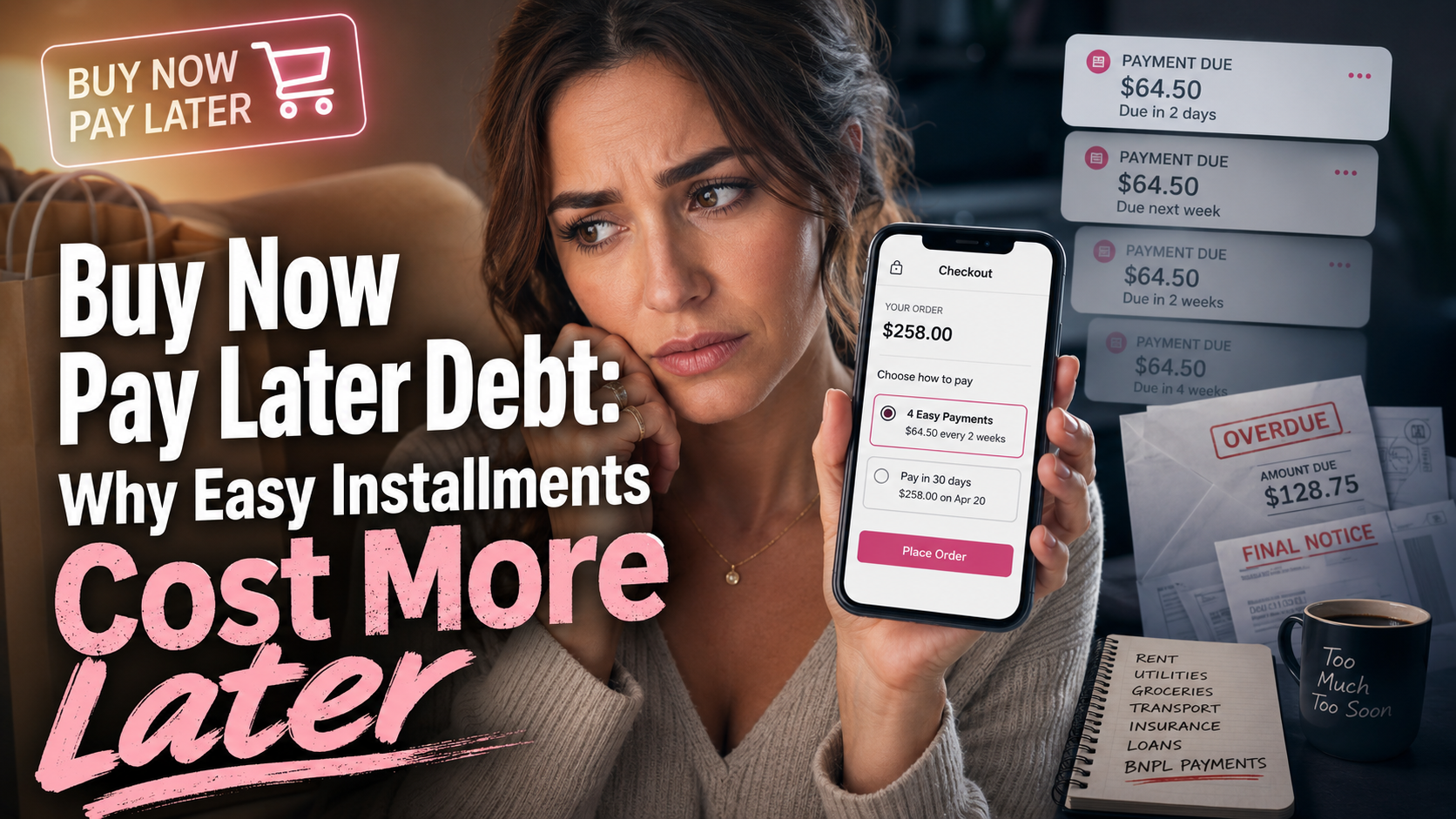
Article #48 — The Hidden Costs of “Buy Now, Pay Later” Financing
Editorial Note
This article is part of HerMoneyPath’s analytical series dedicated to understanding how financial decisions, economic structures, and behavioral factors influence everyday financial life, consumption, credit, and the building of economic autonomy over time.
The analysis combines contributions from behavioral economics, household finance research, and institutional studies to explain how the Buy Now, Pay Later model changes cost perception, reorganizes the shopping experience, and turns credit into an increasingly integrated layer of digital consumption.
HerMoneyPath content is produced based on academic research, institutional studies, and economic analysis applied to the context of real financial life. The goal of this content is to present, in an educational and analytical way, the mechanisms that structure consumer credit, everyday debt, and its relationship with financial planning, budgeting clarity, and economic autonomy.
Research Context
This article draws on insights from behavioral economics, household finance research, consumer credit studies, and institutional reports from organizations such as the Consumer Financial Protection Bureau, the Federal Reserve, the Bank for International Settlements, the OECD, and leading academic researchers in decision-making, mental accounting, payment behavior, and debt literacy.
Short Summary / Quick Read
Buy Now, Pay Later seems simple because it turns payment into small, fast, visually light installments inside the checkout. But that lightness can hide an important change: the purchase is no longer felt through the total price and starts being evaluated through the immediate installment.
This article analyzes the hidden costs of BNPL as a contemporary form of credit embedded in consumption. The focus is not only on interest, fees, or late payments, but on how the model reduces the pain of paying, normalizes micro-commitments, and can make debt harder to perceive when several installment purchases accumulate.
The central reading is that BNPL should not be seen only as a modern payment option. It works as a new language of everyday credit: softer, faster, more integrated with financial technology and, precisely for that reason, more capable of making future commitments emotionally discreet in the present.
Key Insights
- BNPL does not only delay payments; it can delay the real perception of cost.
- Small installments may seem manageable in isolation, but they become heavier when several obligations compete for the same budget.
- Checkout convenience reduces psychological friction and can weaken the moment of pause before a purchase.
- Credit embedded in digital consumption makes financing feel less like debt and more like a normal step in the purchase.
- AI, scoring, and embedded finance make credit faster and more contextual, but they can also make it less visible as a financial commitment.
- The hidden cost of BNPL is not only in fees or late payments; it is in how it changes behavior, the perception of limits, and budgeting clarity.
Editorial Introduction
Buy Now, Pay Later debt often begins before it feels like debt. At checkout, the full price becomes a smaller installment, the purchase feels easier to accept, and the future payment looks less serious than the total cost behind it.
That is why BNPL can feel modern, practical, and even responsible in a tight month. It may seem better than using a high-interest credit card, paying the full amount at once, or giving up something that feels necessary. But the hidden cost appears when easy installments reduce the emotional weight of a real financial commitment.
BNPL does not only change when payment happens. It changes how cost is perceived. By turning a purchase into small future payments, the model reduces the immediate pain of paying and makes the obligation feel smaller than it really is. The total price still exists, but its emotional presence becomes weaker.
This is the central tension of this article: BNPL looks like flexibility, but it can function as invisible credit. It appears at checkout, speaks the language of convenience, and integrates into digital consumption as if it were just another payment option. But when several installments accumulate, what seemed light can begin to occupy margin, reduce budgeting clarity, and expand financial vulnerability.
The following analysis does not treat BNPL as an absolute villain, nor does it turn every installment plan into a financial mistake. The goal is to observe the mechanism more precisely: when paying seems too easy, the consumer may accept future commitments before fully feeling the weight of the present decision.
Chapter 1 — Why Buy Now, Pay Later Debt Feels So Different From Traditional Credit
H3.1 — Why Buy Now, Pay Later feels less threatening than traditional credit even when it functions similarly
When paying feels too light, the cost is usually only delayed.
The Buy Now, Pay Later (BNPL) model gained strength precisely because it turns credit into silent convenience: it reduces the feeling of spending while expanding exposure to debt. To understand the real risk of BNPL, it is necessary to look beyond the promise of flexibility and observe how reduced friction changes perception, behavior, and financial discipline.
The first reason BNPL feels less threatening than traditional credit lies in its appearance. It rarely presents itself as a “loan” at the moment of purchase. In many digital checkouts, it appears as a simple choice: pay everything now or split it into a few smaller installments. The word debt almost never occupies the center of the experience. What appears is flexibility, control, access, and convenience.
That detail changes a lot. A credit card still carries a recognizable financial identity: limit, statement, interest, history, due date. A personal loan also carries symbolic weight: contract, analysis, formal obligation. BNPL, by contrast, enters more softly, almost as a natural extension of the purchase. The decision stops sounding like “I am taking on debt” and starts sounding like “I am choosing a lighter way to pay.”
The Consumer Financial Protection Bureau, in 2022, described BNPL as a modality generally structured in short payments, often interest-free, offered at the point of sale. The same report pointed to risks linked to consumer overextension, data use, late payments, returns, and automatic payment mechanisms. This institutional reading is important because it shows that the product may seem simple on the surface, but it operates within the universe of consumer credit.
The invisible mechanism begins exactly there: when credit stops looking like credit, the consumer may evaluate it with less resistance. The financial product does not appear separate from the purchase; it appears inside it. The decision stops sounding like “I am taking on a future obligation” and starts sounding like “I am making this purchase easier.” This change in language reorganizes the emotional perception of the commitment.
Behavioral economics helps explain why this matters. Drazen Prelec and George Loewenstein, in 1998, analyzed the relationship between consumption, debt, and the so-called “pain of paying,” showing that the discomfort associated with payment functions as a form of consumption self-regulation. When this discomfort is reduced or separated from the experience of consuming, the purchase can seem more pleasant and less limited by the immediate cost.
BNPL operates precisely in that separation. The reader does not feel the total price at the moment she decides. She feels the installment. And the installment, in isolation, seems more manageable. A purchase of US$120 may stop being felt as US$120 and start being felt as four payments of US$30. Formally, the amount still exists. Psychologically, it has changed size.
This is the most important point: BNPL does not need to deceive the consumer to alter her decision. It only needs to reorganize how the cost appears. The total price moves to the background; the installment comes forward. The future debt becomes diffuse; the present gratification becomes concrete. The obligation exists, but it enters the mind in a lighter way.
In real life, this can appear in common purchases: an outfit for a special occasion, a necessary household item, a gift, a beauty purchase, a small emergency, a replacement for something broken. None of these decisions necessarily seems irresponsible. Many are understandable. The problem begins when the tool turns each of them into a future obligation too small to trigger an immediate alert.
That is why BNPL can seem less threatening than traditional credit even when it performs a similar function: it anticipates consumption with future payment. The difference is in the emotional packaging. The card may remind someone of debt. The loan may remind someone of obligation. BNPL reminds them of convenience.
This shift is especially important within Cluster 4 of HerMoneyPath because it connects everyday consumption, small decisions, and household stability. The article The Hidden Cost of Credit Card Convenience for Women in America already explores how credit convenience can soften the weight of spending; BNPL takes this logic to an even more discreet layer because it incorporates the installment plan into the very moment of purchase.
The structural reading, therefore, is not that every use of BNPL is automatically bad. The point is more subtle: when a financial product presents itself with a less heavy appearance than traditional debt, it can reduce the emotional resistance that would normally protect the budget. The hidden cost begins before the late payment, before the fee, and before delinquency. It begins when the future commitment seems too small to be treated as a commitment.
H3.2 — How convenience changes the emotional meaning of borrowing at checkout
Convenience changes the emotional meaning of credit because it changes the moment when the decision happens.
In traditional credit, the consumer usually perceives some separation between wanting, financing, and paying. Even with a credit card, there is some awareness that the purchase will enter a statement. With BNPL, that separation decreases. The offer appears in the same space as the purchase, at the moment when desire has already been activated and the decision is close to being completed. Credit does not interrupt consumption. It helps consumption continue.
The Bank for International Settlements, in 2023, observed that BNPL schemes allow consumers to pay for purchases in interest-free installments instead of paying the full amount at checkout, and highlighted that this model has expanded both in online commerce and in physical stores through codes, apps, and integrated digital experiences.
This data matters because BNPL is not only growing as a financial product. It is growing as a shopping infrastructure. The more integrated it is into checkout, the less credit looks like an external decision. The consumer does not need to leave the experience, seek financing, fill out a long application, or face a visually heavy contract. Credit appears where consumption is already happening.
This reduction in friction changes the emotion of the choice. Instead of “I am taking credit,” the feeling may be “I am making this purchase easier.” The language of debt is replaced by the language of experience: simple, fast, interest-free, in four payments, without a larger immediate impact. The promise is not only financial. It is emotional. It says: you do not need to feel all the weight now.
This kind of convenience is powerful because it reaches the most sensitive point of the decision: the interval between wanting something and giving it up because of the price. In many purchases, the total price works as a brake. It forces the person to pause, compare, wait, or step back. BNPL weakens that brake by turning the price into a smaller sequence of payments. The purchase stops seeming like a decision that requires sacrifice and starts seeming like a choice adjusted to the budget.
But this feeling can be misleading. Adjusting the payment does not necessarily mean adjusting real financial capacity. The installment may fit in isolation and still contribute to an uncomfortable future sum. Convenience resolves the friction of the moment, but it does not eliminate the obligation that will come later.
The Federal Reserve’s own research, published in 2025 with data from 2024, shows why this tension deserves attention. The report states that 15% of adults in the United States used BNPL in the previous 12 months, up from 10% in 2021. The same survey reports that almost a quarter of BNPL users had made at least one late or missed payment in the previous year.
These numbers do not mean that BNPL is always harmful. They indicate something more specific: a tool designed to feel light can become heavy for some users when real financial life meets accumulated payments. The convenience that seemed to solve the present can create pressure in the future.
In everyday life, this mechanism often appears very simply. The consumer sees a moderately priced purchase. Paying in full feels uncomfortable. The installment seems reasonable. The checkout offers the option at the exact moment when she has already imagined the product in her routine. The decision becomes easier. But later, that installment meets other installments, other bills, other due dates, and other choices already made.
It is at this point that the emotional meaning of credit changes. BNPL is not experienced as “debt assumed.” It is experienced as a “purchase made possible.” This difference in perception is central. When credit appears as enablement, it can be evaluated by the relief it offers, not by the commitment it creates.
The problem is not only in the button. It is in the emotional environment around the button. Modern checkout is fast, clean, optimized, and designed to reduce hesitation. BNPL fits perfectly into this environment because it offers a bridge between desire and purchase completion. It does not need to pressure; it only needs to remove the most visible obstacle: the full cost now.
This is why financial convenience needs to be read carefully. It can be useful, yes. It can help with a necessary purchase, avoid a concentrated expense, or offer an alternative to higher interest rates. But when convenience reduces the feeling of commitment too much, it also reduces the chance that the consumer will stop and ask: does this fit only today, or will it also fit in the month when the installments arrive?
The cognitive closing of this point is direct: the convenience of BNPL changes credit because it makes it seem less like a financial choice and more like a natural step in the purchase. When debt enters without looking like debt, the decision can become emotionally easier than financially safe.
H3.3 — Why women may perceive BNPL as flexibility rather than obligation
Many women may perceive BNPL as flexibility, not as obligation, because everyday financial life rarely happens under ideal conditions.
This is an important nuance. The article should not treat the consumer as impulsive by nature, nor reduce BNPL use to a lack of discipline. In many cases, BNPL enters a routine marked by limited income, family expenses, caring for others, household costs, price pressure, necessary purchases, and the constant attempt to balance the present with the future.
When the budget is already tight, flexibility has real emotional value. Splitting a purchase can seem like a way to breathe. Instead of committing a larger amount now, the consumer distributes the impact. This reasoning is not absurd. It can seem rational, especially when the alternative is delaying a need, using a high-interest credit card, or giving up something important.
The problem is that BNPL turns this feeling of flexibility into an experience that is very easy to repeat. The first purchase may seem controlled. The second one too. The third, in isolation, may still seem small. The risk appears when the consumer begins to deal with several scattered obligations, each one born from a decision that felt light at the moment.
Research by Joanna Stavins, published by the Federal Reserve Bank of Boston in 2024, observed that BNPL use was higher among financially vulnerable consumers and disproportionately high among women, Black consumers, and Latino consumers. The research also frames BNPL as a short-term credit option, often interest-free, used in retail purchases.
This point requires careful reading. It is not about saying that women use BNPL because they do not know how to decide. It is about recognizing that softened-credit tools tend to gain strength precisely where there is tension between need, income, access, and stability. If a person lives with little margin, any mechanism that promises to distribute the cost may seem less like debt and more like survival management.
Here, the human conflict of the article becomes clearer: immediate gratification versus future debt does not only mean superficial desire versus responsibility. Often, it means real life versus limited budget. The purchase may involve comfort, care, professional appearance, children, home, health, transportation, food, or an attempt to maintain normality in a difficult month.
BNPL becomes emotionally attractive because it offers a simple answer to a difficult question: how can I buy something now without feeling all the weight now? The tool’s answer is: split it. The answer seems practical. But the consequence may be less visible: the future budget begins to carry decisions that were emotionally softened in the present.
That is why language matters so much. “Flexibility” sounds positive. “Future obligation” sounds heavy. “Four interest-free payments” sounds manageable. “Short-term debt linked to consumption” sounds more serious. The same financial structure can generate different reactions depending on how it appears.
In everyday experience, this difference can change behavior. A woman who would refuse a loan to buy a fashion item may accept BNPL because she does not perceive it as a loan. A mother who would avoid increasing her credit card balance may accept installments at checkout because they seem separate from the main statement. A consumer who considers herself careful with money may use BNPL precisely because she believes she is avoiding a more dangerous form of credit.
And, in some cases, she may be right in the short term. BNPL can cost less than certain expensive credit products, especially when paid on time. The Consumer Financial Protection Bureau itself, in 2022, recognized that BNPL products can offer competitive benefits compared with traditional forms of credit, including the absence of interest in many cases and a simple payment structure. But the same agency also highlighted risks related to overextension, data, and specific consumer harms.
The ambiguity is exactly there. BNPL can seem useful because, sometimes, it really is useful. But its usefulness does not eliminate its invisible mechanism. The tool can be convenient and still change cost perception. It can be interest-free and still stimulate accumulation. It can be simple and still reduce budgeting clarity.
For the reader, the most important question is not only “does this installment fit?” It is also: “how many small versions of this commitment already exist in my financial future?” The risk of BNPL rarely appears in a single purchase. It appears in the whole. And the whole is exactly what the fragmented experience makes harder to see.
This first chapter reorganizes the reading of the issue. BNPL does not expand only because it is useful, but because it makes debt less visible, less painful, and easier to accept at the moment of purchase. When this logic appears, the product stops seeming neutral and starts being read as a new language of credit: a soft, convenient, and emotionally discreet language, but still capable of creating real obligations.
Chapter 2 — How Checkout Installments Reduce the Feeling of Real Cost
H3.1 — How reduced friction weakens the brain’s sense of immediate spending pain
The first transformation caused by BNPL does not happen on the statement. It happens earlier, at the moment when the purchase stops feeling like a heavy decision and starts feeling like a simple checkout choice.
In a traditional purchase, the total price often works as a small psychological barrier. It forces the consumer to pause, compare priorities, and feel, even for a few seconds, the impact of money leaving. That pause is not merely bureaucratic. It is part of the financial decision. When payment requires more attention, more confirmation, or more contact with the total cost, the mind encounters a point of resistance.
BNPL reduces precisely that resistance. It replaces the feeling of “I am going to pay this full amount” with the feeling of “I can divide this into smaller pieces.” The product still costs the same, but the mental experience of the cost changes. Friction does not disappear only from the technical process; it also disappears from the emotional experience of the purchase.
Classic behavioral economics literature helps explain this change. Drazen Prelec and George Loewenstein, in 1998, developed the idea that paying can generate psychological “pain,” especially when the cost is perceived clearly and close to the moment of consumption. When that pain is reduced, separated, or delayed, consumption tends to feel less limited by the immediate price.
This concept is essential for understanding BNPL. The tool does not need to hide the price to alter the decision. It only needs to change how the price is felt. A purchase of US$160 can remain a purchase of US$160, but when it appears as four installments of US$40, the brain does not react in the same way. The total amount loses emotional force. The installment takes center stage.
Dilip Soman, in 2001, also showed that payment mechanisms influence consumption behavior because they affect the memory of previous payment and the intensity with which a person feels money leaving. In simple terms: the less transparent and immediate the feeling of payment is, the weaker the link between purchase and financial consequence can become.
At checkout, this dynamic gains particular strength. The consumer has already chosen the product. She has already imagined its use. She has already moved through the digital storefront, the description, the image, and the emotional promise of the purchase. When she reaches payment, BNPL appears as a way to remove the final obstacle. It does not only say “pay later.” It suggests: “you do not need to feel everything now.”
That is the difference between real cost and perceived cost. The real cost remains. The perceived cost is softened.
In everyday life, this appears when a woman decides to buy something that, if paid in full, would seem too expensive for that month. But when divided into smaller installments, the same item begins to feel reasonable. She may think: “it is not that much.” And perhaps, in isolation, it really does not seem like much. The problem is that the budget does not live in isolation. It receives all small decisions at the same time.
That is why BNPL needs to be read alongside other modern mechanisms of convenient credit. The article The Hidden Cost of Credit Card Convenience for Women in America explores how credit convenience can reduce the perception of the pain of paying. BNPL moves this logic into an even more integrated environment: the checkout itself.
The cognitive closing of this point is simple: when friction decreases, the decision feels lighter. But the lightness of the experience does not automatically reduce the financial commitment. It only makes the commitment easier to accept before the consumer feels its full weight.
H3.2 — Why installment framing makes purchases feel smaller than they actually are
Installment framing changes the way the price appears to the mind.
This is one of the most important mechanisms of BNPL: it replaces the total price with a narrative of smaller payments. The purchase stops being perceived as a single outflow of money and starts being interpreted as a sequence of small commitments. The amount does not disappear. It is reorganized.
This reorganization seems technical, but it is deeply psychological. When the consumer sees the full price, she evaluates the entire impact. When she sees only the installment, she may evaluate the purchase through a smaller question: “does this installment fit?” The question should be broader: “does this entire purchase fit into my current and future budget?” But the checkout format shifts attention to the most acceptable part of the answer.
The Consumer Financial Protection Bureau, in 2022, observed that the BNPL model can create risks of overextension, including “loan stacking,” when consumers take on multiple financings in a short period, and sustained use, when frequent BNPL purchases begin to affect the ability to meet other financial obligations.
This point is crucial because the risk does not arise only from the individual installment. It arises from multiplication. One small installment may be manageable. Three or four small installments, on different dates, can begin to reduce monthly margin. What seemed flexible in each purchase can become rigid in the aggregate.
This mechanism is similar to looking at only one piece of a puzzle. The piece seems small, simple, almost irrelevant. But the budget does not see one piece at a time. It feels the whole image. When several small obligations arrive together, the consumer may discover that she has committed more future income than she imagined.
Installment framing also changes the judgment of necessity. A purchase that would seem “better to wait” at the full price can seem “possible now” when divided. This does not mean the consumer is being irrational. It means the decision environment was designed to highlight the least painful aspect of the choice.
Here, Soman’s behavioral evidence from 2001 remains relevant: payment forms that reduce the transparency or immediacy of payment can weaken the connection between past spending and future decisions. When a person does not fully feel the financial impact at the moment of purchase, it can become harder to use that spending as a brake on new decisions.
In BNPL, this fragility appears because each purchase seems to have its own logic. One installment for clothing. Another for a household item. Another for a gift. Another for an unexpected expense. Each one may have a justification. But the budget does not separate the justifications. It only adds the due dates.
That is why the word “small” can be misleading. Small does not mean irrelevant. Small can also mean difficult to perceive. And what is difficult to perceive tends to accumulate before it is treated as a problem.
For many women, this accumulation can hit exactly the most sensitive area of financial life: margin. Margin is the space between what comes in and what is already committed. It is where emergencies, transportation, food, medicine, family care, small joys, and attempts to save come from. When BNPL fragments purchases into future installments, it can occupy that margin silently.
The cognitive closing of this section is that installment plans do not only divide payment. They also divide perception. And when perception becomes fragmented, the consumer may see each commitment as too light, until the whole becomes too heavy to ignore.
H3.3 — How easy checkout financing can disconnect desire from financial consequence
Easy checkout financing can separate desire from financial consequence because it appears at the exact moment when the urge to buy is most active.
This is one of the reasons BNPL is so powerful. It does not appear before the purchase, when the consumer is still evaluating priorities from a greater distance. It appears at the end of the journey, when the product has already been chosen, desire has already been built, and giving up feels like a loss. At that moment, a quick installment option can feel less like credit and more like permission.
The Bank for International Settlements, in 2023, described BNPL as a form of payment that allows purchases to be split without paying the full amount at checkout, highlighting its growing integration into online and physical environments. This integration is important because it turns credit into part of the consumption journey, not a separate financial decision.
When credit appears as a natural part of the journey, the consequence becomes less visible. The consumer sees the product now. She sees the benefit now. She sees the relief now. Payment, on the other hand, is distributed into the future. This asymmetry favors the present. Desire is concrete; debt is abstract.
Prelec and Loewenstein’s 1998 theory helps explain this separation between pleasure and payment. When consumption and payment are decoupled, the pleasure of the purchase can be felt earlier, while the financial discomfort is pushed later. In BNPL, this decoupling is organized visually: the experience presents the purchase as immediate and the cost as installment-based.
In practice, this can lead to a form of decision-making in which the main question stops being “is this purchase financially healthy?” and becomes “can I handle this installment?” The second question seems rational, but it is incomplete. It evaluates only one slice of the consequence. It does not consider other installments, income changes, emergencies, fixed bills, or the simple emotional strain of tracking several small commitments.
The Federal Reserve, in a report published in 2025 with data from 2024, stated that 15% of adults in the United States had used BNPL in the previous 12 months, and that almost a quarter of users reported at least one late or missed payment during the period analyzed. This data shows that, although the model may seem simple at the moment of purchase, some users encounter difficulty when the obligations reach the real budget.
This is not an argument for demonizing BNPL. It is an alert about decision architecture. The problem is not only the existence of installments. It is the way checkout can turn a future obligation into an emotionally small detail at the moment of purchase.
In real life, the process can be almost invisible. A woman adds something to the cart, hesitates at the price, and finds an installment alternative. Resistance falls. The purchase moves forward. Relief appears. Only later, on another day, in another month, in another emotional context, does the installment enter the account. The decision was made in one mental state; the payment will be faced in another.
This mismatch is one of the most important hidden costs of BNPL. It allows the consumer to say “yes” in the present based on a feeling of control that may not exist in the same way in the future. And the simpler the checkout, the less time there is to notice that difference.
The turning point of this chapter is that the problem is not only in the installments, but in how checkout design reorganizes the experience of spending. When credit presents itself as an extension of the click, it weakens the mental space between desire and decision. And without that space, financial discipline has to compete with a system designed to make the purchase more fluid than reflection.
The cognitive closing is this: BNPL does not only allow consumers to pay later. It can make the consequence feel distant enough for desire to seem more responsible than it really is. When that happens, debt does not begin on the installment due date. It begins at the instant when the purchase feels too light to be questioned.
Chapter 3 — What BNPL Really Sells Beyond the Product: Relief, Access, and Continued Consumption
H3.1 — Why BNPL often sells emotional relief as much as financial flexibility
BNPL does not only sell installments. It also sells relief.
This is one of the most important keys to understanding why the model has grown so much within everyday consumption. The visible promise is financial: split the payment, ease the immediate amount, allow access without full upfront payment at the moment of purchase. But the emotional promise is even stronger: reduce the tension of having to choose between wanting something now and protecting the month’s budget.
When the consumer encounters a BNPL option at checkout, she is not only evaluating numbers. She is dealing with a feeling. Perhaps the full price feels uncomfortable. Perhaps the item seems necessary. Perhaps the purchase is associated with work, professional appearance, home, family care, a gift, routine, or belonging. At that point, the installment plan does not appear only as credit. It appears as a way not to interrupt life.
This is the invisible mechanism: BNPL transforms financial tension into a temporary sense of continuity. It says, implicitly, that the purchase can move forward without the budget feeling everything at that instant. Relief comes before the full analysis. The consequence is left for later.
Behavioral economics helps explain this emotional force. Drazen Prelec and George Loewenstein, in 1998, analyzed how consumption and payment interact emotionally. The central point is that paying is not merely a financial operation; it is a psychological experience that can reduce the pleasure of consuming. When payment is delayed, fragmented, or softened, the purchase can feel less painful in the present.
In BNPL, this separation becomes very clear. The consumer receives the emotional benefit of the purchase now, but feels the cost in parts, later. The product arrives whole. The debt arrives fragmented. This difference between immediate pleasure and installment payment helps explain why the model can feel less heavy than other forms of credit.
The Consumer Financial Protection Bureau, in 2022, observed that BNPL products often offer competitive benefits compared with traditional forms of credit, such as the absence of interest in many cases, a simple payment structure, and operational ease. But the same report also pointed to risks of overextension, recurring use, and harms linked to late payments, returns, and autopay. This ambiguity is central: the product can be useful and, at the same time, create an environment in which the financial commitment becomes too emotionally discreet.
In real life, this appears when a purchase does not seem exactly unnecessary, but also does not fit comfortably into the immediate budget. A woman may use BNPL to buy clothes for an interview, a household item, something for her children, a self-care purchase, or an expense she feels she should not postpone. The installment plan reduces the feeling of conflict. Instead of “I cannot,” “maybe it fits” appears.
That “maybe it fits” is powerful because it does not seem irresponsible. It seems like a solution. It seems like adaptation. It seems like a way to keep the routine functioning in a context of high prices, pressured income, and little financial margin. For this reason, the article should not treat BNPL use as simple impulsiveness. Often, it functions as an emotional response to a tight financial life.
Research by Joanna Stavins, published by the Federal Reserve Bank of Boston in 2024, observed that BNPL users tend to show greater financial vulnerability, and that use was disproportionately higher among women, Black consumers, and Latino consumers. This data should not be read as individual blame. It suggests that soft credit finds fertile ground precisely where financial margin is smaller and the promise of flexibility has greater emotional value.
This is where the interlink with Cluster 2 becomes natural. The article The Psychology of Money: Why We Spend, Save, and Struggle With Debt and Financial Decisions explores precisely this layer: financial decisions are rarely only mathematical. They pass through fear, relief, pressure, desire, guilt, urgency, and the attempt to control. BNPL fits into this field because it offers an emotional solution before requiring a complete financial reading.
The cognitive closing of this section is that BNPL sells flexibility, but often delivers a sense of relief first. And when relief arrives before full awareness of the cost, the purchase can seem lighter than it really is.
H3.2 — How installment access keeps consumption moving without triggering the same resistance as debt
BNPL keeps consumption moving because it reduces the moment of interruption.
In a traditional purchase, the full price can function as a pause. The consumer looks at the amount, compares it with other bills, feels the money leaving, and perhaps decides to wait. That hesitation has an important financial function: it creates distance between desire and action. BNPL reduces that distance. It offers a bridge between wanting and completed purchase.
The mechanism is simple: instead of requiring the consumer to accept the total cost now, the checkout offers a path of lower resistance. The purchase continues. Desire does not need to be interrupted. The decision seems less definitive because the payment has been divided. But the commitment exists, even if the experience makes it less perceptible.
The Bank for International Settlements, in 2023, described BNPL as a model that allows purchases to be split into installments, often interest-free, and observed its growing integration into online and physical commerce. This integration matters because installment payment stops being a separate step and becomes part of the very experience of shopping.
This integration changes psychological resistance. The consumer does not need to look for credit. Credit appears. She does not need to interrupt the journey. The journey incorporates the offer. She does not need to reframe the purchase as debt. Checkout reframes it as a payment option.
The difference may seem small, but it is structural. When credit is separate from the purchase, it requires a more conscious decision. When it is embedded, it may seem like just a variation of payment. The consumer does not necessarily feel that she is “taking credit.” She feels that she is choosing a more convenient way to finish.
This continuity of consumption has an important consequence: it can weaken the resistance that would normally arise in the face of the full price. BNPL does not need to convince someone to want more. Often, the desire already exists. It only reduces the friction that could have turned desire into waiting.
The literature on the “pain of paying” helps explain why this matters. Prelec and Loewenstein, in 1998, showed that the discomfort of paying can limit consumption because it connects present pleasure to financial cost. When that connection is weakened, the purchase can seem easier to justify. In BNPL, the product appears in the present, while the cost is distributed into the future.
In real life, this logic can appear in very common decisions. A woman puts something in the cart and hesitates. The full amount seems high. The installment option appears just below, with smaller numbers. The purchase stops looking like a single impact and starts looking like an adjustment. Resistance falls. Completion happens.
This does not mean every decision is bad. BNPL can be useful when used consciously, with a clear budget and without accumulated obligations. The problem is that the tool is designed to operate exactly at the point when the consumer is closest to buying. It does not appear in the cold moment of financial organization. It appears in the hot moment of decision.
The Federal Reserve, in a report published in 2025 with data from 2024, indicated that 15% of adults in the United States used BNPL in the previous 12 months, a higher share than observed in 2021. The same report stated that almost a quarter of users had at least one late or missed payment. This data shows that the easy continuity of the purchase can turn, for some consumers, into later difficulty tracking commitments.
The central point is not that BNPL creates desire out of nowhere. It facilitates the maintenance of an already existing desire. It prevents the total price from functioning as a clear brake. And by doing this repeatedly, it can transform delayed consumption into anticipated consumption.
That is the difference between access and expansion. BNPL can expand access to useful products. But it can also expand purchases that would have been postponed if the total cost were more present. The boundary between the two effects is not always visible at checkout. It only appears later, when the installments enter the financial routine.
The cognitive closing of this section is that BNPL keeps consumption flowing because it softens the interruption that the price could cause. It does not eliminate the cost. It only reduces the emotional resistance that would help the consumer see it more clearly before accepting the commitment.
H3.3 — Why frictionless credit makes desire easier to maintain than to question
Frictionless credit makes desire easier to maintain than to question.
This sentence summarizes the central rupture of this chapter. BNPL does not act only on payment. It acts on the mental space between “I want this” and “should I buy this now?” The smaller that space, the smaller the chance that the consumer will calmly review the decision.
In digital environments, the shopping journey is often fast, visual, and emotionally stimulating. Images, discounts, urgency, reviews, recommendations, and simplified checkout work together to reduce hesitation. BNPL enters this sequence as a final layer of fluidity: if price is the obstacle, it can be split; if full payment feels heavy, it can be shifted; if doubt appears, the smaller installment can seem like an answer.
The CFPB, in 2022, highlighted that ease of access and the simple payment structure are part of the operational benefits of BNPL products, but also pointed out that this same ease can contribute to risks of overextension and sustained use. This tension is exactly at the center of the article: the same simplicity that makes the product useful can make it difficult to perceive as debt.
The psychological mechanism is clear. Questioning a purchase requires pause. Pause requires friction. Friction requires some discomfort. BNPL reduces part of that discomfort by turning the cost into something smaller, delayed, and visually more acceptable. So instead of asking “is this necessary?”, the consumer may focus on “is this installment small enough?”
This change in question changes the quality of the decision. The first question evaluates priority. The second evaluates only immediate viability. Priority requires a view of the whole. Immediate viability can be decided based on an isolated installment.
Dilip Soman, in 2001, analyzed how payment mechanisms affect memory and the perception of spending, showing that less transparent forms of payment can weaken the connection between consumption and financial consequence. This contribution helps explain why frictionless credit can be so effective: it does not only make the purchase easier; it can also reduce the psychological force of cost as a regulatory memory.
In practice, this means that BNPL can create a kind of emotional continuity of desire. The consumer wanted the product. The price threatened to interrupt. The smaller installment restored the feeling of possibility. The purchase continued. Reflection became smaller than the impulse organized by the checkout environment.
This mechanism is especially relevant for women who manage multiple financial pressures. Often, the purchase is not only individual consumption. It may be linked to care, professional presentation, family, home, or an attempt to maintain emotional stability amid constant demands. BNPL may seem like a way to solve the now without admitting that the future is being committed.
It is at this point that the tool becomes more than installment payment. It becomes a technology of continuity. Continuity of the cart, of intention, of the purchase, of the feeling of access. The problem is that financial life does not happen only in the flow of desire. It happens at the meeting point between desire, limit, and consequence.
When several decisions are made within low-friction environments, the consumer can accumulate commitments without experiencing, at the moment of each purchase, the same weight she would experience in the face of a formal loan or an already high credit card statement. Debt is born distributed. For that reason, it is also born less visible.
The moment of deep identification in this chapter appears when the purchase seems too small to worry about, the installment plan seems too light to weigh, and the accumulation only becomes clear when several “painless” promises begin competing for the same budget. What looks like flexibility may simply be a pulverized advance of future pressure.
The cognitive closing of this section is that BNPL makes it easier to maintain desire because it reduces the moment when the purchase could have been questioned. When credit enters as an automatic answer to the discomfort of price, it turns reflection into continuity — and it is precisely in that continuity that debt can begin to feel invisible.
Chapter 4 — How AI, Scoring, and Embedded Finance Make Credit Faster, More Contextual, and Less Visible
H3.1 — How algorithmic risk scoring expands approval pathways inside everyday purchases
The technological layer of BNPL does not begin with the shine of the interface. It begins with the way credit is assessed, offered, and authorized quickly enough to feel like a natural part of the purchase.
The central point of this chapter is not to turn the article into a technical text about fintech. The issue is more concrete: when digital systems can assess risk, eligibility, and shopping behavior in a few seconds, credit stops feeling like a separate process. It begins to appear at the exact moment when the consumer is deciding whether to complete a purchase.
This is the structural role of algorithmic scoring. Instead of relying only on a traditional, slow, and visibly financial analysis, automated models can combine transactional data, payment history, identity information, behavioral signals, and internal risk criteria to decide whether an offer will be shown, under what conditions, and with what limit. For the consumer, this process can be almost invisible. What she sees is only the option: pay now or split.
The OECD, in 2021, analyzed the use of artificial intelligence, machine learning, and big data in the financial sector and observed that these technologies were already being applied in areas such as credit decision-making, risk management, fraud prevention, compliance, and customer relationships. The relevant point for BNPL is that these systems can make financial decisions faster and more scalable, but they also require regulatory attention and consumer protection when they affect access, risk, and data handling.
This evidence is important because it shows that AI, scoring, and automation are not futuristic accessories. They are already part of the contemporary financial environment. In BNPL, this technological layer helps credit become instant enough not to interrupt the purchase. The process that once might have required pause, a form, and visible analysis is compressed into the consumption experience.
The invisible mechanism, therefore, is double. First, scoring reduces the time between desire and approval. Second, that speed reduces the feeling that a relevant financial decision has taken place. The consumer does not see the system assessing risk. She sees a simple payment alternative. The more fluid the approval, the less credit looks like credit.
In real life, this can appear in an ordinary purchase. A woman chooses an item, reaches checkout, and finds the option to pay in installments. In seconds, the platform informs her whether she can use BNPL. There is not the same feeling of entering a bank, asking for credit, or negotiating a financing line. The experience feels light because the heaviest part of the decision has been shifted to an invisible infrastructure.
This shift has consequences. When credit appears too quickly, the mind may treat it as availability, not as risk assessment. The consumer may interpret approval as a sign that the purchase is financially acceptable. But approval is not the same as suitability. A system can authorize a purchase without knowing all the tensions of the household budget: rent, family care, transportation, food, emergencies, old debts, and unstable income.
The Consumer Financial Protection Bureau, in 2022, pointed out that the BNPL model can create risks related to data use, loan accumulation, and consumer overextension. The report also indicated that the product’s operational ease can be a benefit, but that this same ease needs to be analyzed within the context of consumer protection.
This tension is essential. Technology can expand access and convenience. But it can also increase the frequency with which credit appears before the consumer has time to mentally reorganize the cost. The risk is not only in the existence of scoring. It is in the experience created when scoring, checkout, and desire work together to reduce pause.
In human terms, this means that the consumer may be facing a credit offer without feeling that she is facing a credit decision. She does not need to look for financing; financing finds her. She does not need to ask for an alternative; the alternative appears. She does not need to make a major financial gesture; she only needs to click.
This is where the discussion about AI needs to remain free of hype. It is not about imagining algorithms as hidden characters deciding everything on their own. It is about recognizing that automated systems can reorganize the environment in which financial decisions happen. When approval is fast, contextual, and visually simple, the boundary between purchase and credit becomes less clear.
The cognitive closing of this section is that algorithmic scoring does not make BNPL invisible by completely hiding the offer. It makes it invisible in another way: by making credit feel available, natural, and timely within consumption. The faster the authorization, the smaller the feeling may be that the consumer has assumed a real financial obligation.
H3.2 — Why embedded finance makes borrowing feel like a natural part of shopping rather than a separate financial choice
Embedded finance is one of the reasons BNPL seems so different from other forms of credit.
The expression may sound technical, but the idea is simple: financial products stop appearing only in banks, banking apps, or separate contracts and begin to be incorporated into nonfinancial experiences. In the case of BNPL, credit is embedded in the purchase. It does not appear as a separate destination. It appears in the normal flow of consumption.
This is a decisive point for the reader’s perception. When credit is outside the purchase, it requires a change of context. The person leaves desire and enters the financial decision. When credit is inside the purchase, that shift almost disappears. The consumer remains in the same environment, looking at the same product, using the same cart, only choosing a payment method that seems lighter.
The Bank for International Settlements, in 2023, described the growth of BNPL as part of a transformation in the payments market, in which consumers can split purchases into installments, often interest-free, with growing integration in online and physical stores. This reading helps situate BNPL not only as a credit product, but as a layer incorporated into retail and digital shopping journeys.
The relevance of this lies in the change of setting. Traditional credit has its own aesthetic: contract, bank, limit, analysis, statement, collection. Embedded credit has another aesthetic: button, option, installment, checkout, confirmation. The financial obligation continues to exist, but its appearance has changed. And when appearance changes, the emotional reaction also changes.
In BNPL, the loan does not seem to be “outside” the purchase. It seems to be part of it. This integration softens the symbolic weight of debt. Instead of feeling that she is seeking credit to buy, the consumer feels that the store is offering a payment alternative. The psychological difference is enormous.
This is what makes BNPL different from older conversations about consumer debt. The issue is not only that people borrow to buy. The deeper shift is that borrowing is now presented as part of the shopping interface itself. Debt no longer waits inside a bank, a credit card statement, or a formal loan application. It appears inside the cart, beside the product, at the exact moment when the consumer is deciding whether to continue. That is the original role of BNPL in the HerMoneyPath ecosystem: it shows how modern debt can become invisible not because it is hidden, but because it looks like convenience.
In everyday life, this means that the consumer can encounter credit when buying clothes, beauty items, furniture, electronics, children’s products, tickets, courses, services, or even recurring expenses. Credit does not require a trip to the bank. It appears as part of digital life. This constant presence can make financing feel less serious than a traditional loan, even when it creates a future commitment.
The World Bank, in its 2022 financial development report, analyzed the expansion of digital finance and highlighted that financial innovation can expand access, but can also bring new risks when credit and financial services expand rapidly without adequate consumer protection. The connection with BNPL lies precisely in this ambiguity: inclusion and convenience can coexist with opacity, overindebtedness, and difficulty assessing risk at the moment of decision.
This ambiguity needs to be preserved in the article. BNPL should not be presented as an absolute villain. For some consumers, it may be a less expensive alternative than revolving credit, overdraft, or high-cost loans. It can help distribute a necessary expense. It can avoid a concentration of payment in a difficult month. But this usefulness does not eliminate the fact that embedded credit changes the mental experience of the purchase.
The problem appears when the act of financing stops triggering the same pause it would trigger in another context. If a person needs to request a loan, she tends to perceive the weight of the decision. If the same person simply chooses a checkout option, the decision may seem smaller. This difference is not only in the financial amount. It is in the architecture of the experience.
The interlink with Cluster 4 enters naturally here. The article Consumer Spending, Well-Being, and Sustainability: The Everyday Choices That Shape the Economy explores how apparently ordinary consumption choices participate in larger economic structures. BNPL is a contemporary example of that logic: a small choice at checkout can be part of a broad transformation in the relationship between consumption, credit, and financial well-being.
When embedded finance turns credit into part of the purchase, it also turns debt into part of the environment. The consumer does not encounter only products. She encounters ways to anticipate access. She does not encounter only price. She encounters a softened version of price. She does not encounter only checkout. She encounters an architecture that allows consumption to keep moving.
The cognitive closing of this section is that BNPL becomes powerful because it does not ask the consumer to enter a credit experience. It brings credit into the shopping experience. And when the loan seems like only a natural step in consumption, the future obligation may seem smaller than it really is.
H3.3 — How automated models and optimized checkout journeys make BNPL harder to perceive as debt
Automated models and optimized checkout journeys make BNPL harder to perceive as debt because they reduce the time, friction, and discomfort between wanting and buying.
This is the point where technology meets psychology. Automation does not act only behind the scenes of approval. It also supports a visual and behavioral experience designed to feel simple. A few clicks, light language, small installments, quick confirmation, and absence of bureaucracy form a set that turns a financial decision into an everyday gesture.
The invisible mechanism works like this: the more optimized the checkout, the less room there is for financial reflection. The consumer does not need to stop for very long. She does not need to recalculate the entire budget. She does not need to confront the total price with the same intensity. The experience offers a solution at the moment when doubt might appear.
The OECD, in 2021, observed that AI, machine learning, and big data can increase efficiency in the financial sector, including in credit and risk management, but also raise issues related to transparency, explainability, model governance, and consumer protection. These points matter because the fluid BNPL experience can hide complex decision-making processes that the consumer does not see, but that shape her exposure to credit.
In everyday life, this invisibility does not appear as “algorithm.” It appears as ease. The platform shows the installment. The language suggests flexibility. The button allows the consumer to continue. The purchase seems resolved. But behind this fluidity, there may be risk analysis, segmentation, anti-fraud automation, offer personalization, and eligibility decisions.
The risk is not only that the consumer does not know every technical detail. It is that the entire experience may seem too simple for her to treat the decision as debt. The complexity is in the system; the lightness is in the interface. This separation between structural complexity and visual simplicity is one of the hidden costs of BNPL.
The CFPB, in 2022, highlighted concerns related to the use of data by BNPL providers, including the ability to collect and monetize consumer information and create commercial relationships that go beyond the immediate granting of credit. This observation is relevant because BNPL does not live only from installment payments. It also participates in a digital ecosystem in which data, behavior, and the shopping journey can reinforce the expansion of credit.
This data dimension needs to be handled carefully. It is not necessary to turn the text into a technological exposé. The point is to show that, in the digital environment, credit is not only a decision between the consumer and the store. It may involve platforms, providers, risk models, behavioral data, retailers, and checkout systems designed to reduce cart abandonment.
For the reader, the practical effect is direct: the decision can feel simple because the interface was made to feel simple. But visual simplicity does not mean financial simplicity. A clear installment on the screen can hide multiple layers: when it will be charged, how it will affect the budget, how many other installments already exist, what happens in case of delay, how returns are handled, and how recurring use influences future offers.
The Federal Reserve, in 2025, reported that BNPL use among adults in the United States rose from 10% in 2021 to 15% in 2024, and that almost a quarter of users reported at least one late or missed payment. This data reinforces that initial simplicity does not prevent later difficulty for some users.
In real life, the consumer may not perceive the decision as debt because everything around it communicates normality. The store offers it. The platform approves it. The installment seems small. The process is fast. None of these steps, in isolation, seems alarming. But together, they reduce the emotional distance between wanting and committing.
This is where the inevitable consequence of the chapter gains strength: when this mechanism becomes normalized, the impact goes beyond immediate consumption. It reduces margin, fragments the budget, increases the risk of late payment, and can turn recurring convenience into recurring vulnerability. BNPL is not only a modern payment method. It is a new aesthetic of indebtedness.
The cognitive closing of this section is that automated models and optimized checkouts do not make debt nonexistent. They make debt easier to accept before it is recognized as debt. And when the financial obligation arrives dressed as convenience, the consumer may only perceive its weight after several light decisions have already become real commitments.
Chapter 5 — Why BNPL Debt Feels Small in Each Purchase and Big When Seen Together
H3.1 — How small installments hide the total burden when obligations multiply across purchases
BNPL debt seems small because it almost never appears in full at the moment when the decision is made.
This is the center of the mechanism. The consumer does not first look at the set of future commitments. She looks at a specific installment, tied to a specific purchase, at a specific moment. The reduced amount creates the feeling that the decision is manageable. And perhaps it is, when viewed alone. The problem begins when several “manageable” decisions start existing at the same time.
The Consumer Financial Protection Bureau, in 2022, drew attention to two risks directly connected to this pattern: the accumulation of multiple financings in a short period, known as “loan stacking,” and sustained BNPL use over months or years, which can affect the consumer’s ability to meet other financial obligations. This reading is important because it shows that the risk is not only in the isolated purchase, but in the repetition of small commitments that overlap.
In practice, an installment of US$25 may seem light. Another of US$18 may also seem light. A third of US$32 may still seem manageable. But the budget does not feel each installment as a separate story. It feels the sum. And when those installments fall near rent, groceries, transportation, insurance, medicine, school, cellphone, or credit card payments, what seemed small begins to occupy real space.
This is the difference between perceived cost and financial burden. Perceived cost is what appears at checkout: a smaller installment, a promise of flexibility, a purchase that seems possible. Financial burden is what appears later: distributed commitments, different dates, multiple charges, and less margin to deal with the rest of life.
BNPL is powerful because it fragments perception before it fragments payment. The consumer sees the purchase as an emotional unit — the dress, the home item, the gift, the care product, the small emergency. But the debt appears as an administrative sequence. This separation reduces the initial psychological weight and increases the risk of underestimating the total committed amount.
The literature on debt helps give this point depth. Annamaria Lusardi and Peter Tufano, in a study published in 2015 in the Journal of Pension Economics and Finance, analyzed the relationship between debt literacy, financial experiences, and overindebtedness. The work shows that understanding how debt works is an essential part of the ability to assess financial exposure, especially when obligations accumulate and become difficult to compare.
This evidence speaks directly to BNPL because the tool does not require the consumer only to understand one installment. It requires her to understand the sum of installments that have not yet arrived. The challenge is not knowing whether one payment fits today. It is knowing whether all future payments will fit when they meet other expenses and other decisions.
In real life, this mechanism can be silent. A woman may use BNPL to buy something for a specific occasion. Then she uses it again for a household item. Then for a gift. Then for a purchase that seems necessary because the month is tight. Each decision has a justification. None seems serious. But the future budget begins to carry several past decisions.
This is where the interlink with Cluster 4 becomes essential. The article Household Debt and Economic Stability: Why Growth Alone Tells the Wrong Story explores how household debt should not be read only as an aggregate number, but as concrete pressure on stability, margin, and the ability to choose. BNPL enters this same logic: small distributed debts may seem smaller than a large loan, but they still reduce the flexibility of the household.
The perceptual trap lies in the fact that BNPL often seems like a solution to the weight of the present. But when used repeatedly, it can transfer that weight to several points in the future. The consumer feels relief now, but the budget encounters obligations later. And when those obligations multiply, what seemed light in each purchase can become heavy in the aggregate.
The cognitive closing of this section is that small installments are not dangerous only because of their individual value. They become problematic when they prevent the consumer from seeing the total committed amount. BNPL does not only divide payments; it can divide financial awareness until the full debt appears too late.
H3.2 — Why fragmented repayment weakens people’s sense of overall financial exposure
Fragmented repayment weakens the perception of financial exposure because it distributes debt into pieces that seem independent.
This is a different mechanism from simply “spending too much.” The problem does not arise only from the volume of consumption, but from the difficulty of seeing the full map of obligations. When each installment belongs to a different purchase, made on a different day, through a different platform, or with a different due date, the consumer may lose track of how much of the future has already been committed.
The Federal Reserve, in a report published in 2025 with data from 2024, stated that 15% of adults in the United States used BNPL in the previous 12 months, up from 10% in 2021. The same report indicated that almost a quarter of users were late or missed at least one payment, and that some late users paid additional charges for it. This data shows that, for a share of consumers, the initial simplicity of the model does not prevent later difficulty in managing commitments.
This difficulty can be explained by fragmentation. A credit card statement, for example, concentrates purchases in a more visible document. A traditional loan usually has a defined installment and a specific contract. BNPL, by contrast, can appear as several small obligations spread out, sometimes linked to different platforms. The risk is that the person tracks each payment in isolation, without perceiving the total exposure.
In everyday life, this total exposure is what really matters. A woman may look at an installment of US$20 and consider it harmless. But perhaps she already has four other similar installments. Perhaps some are due before the next paycheck. Perhaps a purchase made weeks ago is still active. Perhaps a return has not yet been processed. Perhaps an unexpected expense arrives before the next charge.
The problem is that the household budget is not a perfect spreadsheet. It is crossed by unforeseen events, fatigue, family care, schedules, variable income, inflation, emergencies, and emotional pressure. The more fragmented the commitments are, the greater the need for tracking. And the greater the need for tracking, the greater the risk of losing clarity.
Research by Joanna Stavins, published by the Federal Reserve Bank of Boston in 2024, observed that BNPL use is higher among financially vulnerable consumers and disproportionately high among women, Black consumers, and Latino consumers. This information is relevant because fragmented payment tends to weigh more precisely on those who have less margin to absorb error, delay, or accumulation.
This point needs to be handled carefully. It is not about blaming women or vulnerable consumers for using BNPL. It is about recognizing that a tool that promises flexibility can be especially attractive to those living on a tight budget. If income is already pressured, installment payment may seem like a way to keep life functioning. But when several installments occupy the future, initial flexibility can turn into later rigidity.
Financial exposure is not only how much is owed. It is also how much of future income is already without freedom. When the consumer assumes several small installments, she reduces the space to decide later. The money that has yet to come in already meets destinations defined by past purchases. And the less visible this process is, the harder it becomes to adjust behavior before pressure appears.
That is why BNPL can weaken budgeting clarity. It does not necessarily create one large debt. It creates several small promises of payment. Each promise seems simple. The whole can be confusing. And confusion, in personal finance, often costs dearly — not only in fees, but in anxiety, delay, loss of control, and reactive decisions.
The connection with Lusardi and Tufano, in 2015, also helps here. When understanding of debt is limited, consumers may underestimate how different obligations accumulate and affect their financial situation. In BNPL, this difficulty is intensified because the very structure of the product presents the cost in small parts, and not as a consolidated view of the commitment.
In practice, the most dangerous question is: “does this installment fit?” It seems prudent, but it can be incomplete. The safer question would be: “does this installment fit together with all the other obligations I have already accepted and the ones that may still appear?” The first question sees a purchase. The second sees the budget.
The cognitive closing of this section is that fragmented payment reduces the perception of total exposure. The consumer may not feel indebted because no single installment seems large. But invisible debt does not need to look large to limit choices. It only needs to occupy, little by little, the margin that once gave the budget flexibility.
H3.3 — How women can become overcommitted even when no single BNPL purchase feels serious
A woman can become financially overcommitted even when no individual purchase seems serious.
This is one of the most important hidden costs of BNPL. The tool rarely creates a sense of danger in a single decision. On the contrary: it often creates a sense of control. The installment seems small. The term seems short. The purchase seems justified. The checkout seems simple. Everything communicates that the decision is manageable.
But overcommitment does not necessarily arise from one large purchase. Often, it arises from several small decisions that were not seen together. The consumer does not need to do anything extreme to lose margin. It is enough to accept many light commitments before realizing that they will compete for the same money.
The CFPB, in 2022, highlighted that the BNPL model can encourage overextension precisely through multiple simultaneous financings and recurring use. This analysis is important because it shifts the focus from final delinquency to the earlier process: the formation of several commitments that seem too small to trigger an immediate alarm.
Overcommitment works like a house full of half-open doors. No door, on its own, blocks the passage. But when many are in the way, movement becomes difficult. With BNPL, each installment may seem like a small door. The problem is the whole hallway: the future budget.
For women, this risk may have an additional layer because many consumption decisions are not only individual. They can involve caring for children, maintaining the home, professional appearance, family well-being, gifts, household emergencies, and the attempt to preserve normality during periods of pressure. BNPL may seem like a way to distribute that care over time. But if used repeatedly, it can turn present care into future tightness.
Stavins’s 2024 research helps contextualize this vulnerability by indicating disproportionately high BNPL use among women and financially vulnerable consumers. This does not prove that women are less responsible; it indicates that the tool may concentrate among groups for whom the promise of flexibility has greater practical and emotional value.
The difference between flexibility and overcommitment can be very thin. Flexibility is when the consumer distributes an expense without losing control of the whole. Overcommitment is when several distributed expenses begin to control the budget before she notices. BNPL can begin as the first thing and end as the second, especially when there is no consolidated view of all future payments.
In real life, this can appear in an ordinary month. One installment is due on the 5th. Another on the 12th. Another on the 18th. Another on the 27th. None of them seems huge. But together, they reduce the money available for gas, groceries, medicine, school, emergencies, or savings. The consumer may not feel “indebted” in the traditional sense, but part of the future is already committed.
The Federal Reserve, in 2025, reported an increase in BNPL use and significant growth in the share of users with late payments, with almost a quarter reporting a late or missed payment. This information shows that the initial lightness of the model can become concrete difficulty when payments enter the financial routine.
The emotional aspect also needs to appear. Overcommitment does not weigh only on the balance. It weighs on the mind. The consumer begins tracking dates, notifications, automatic charges, returns, possible delays, and fear of not being able to honor everything. What began as relief can become permanent vigilance.
This is where the article needs to preserve its structural reading. The problem is not only “buying too much.” It is living in an environment where credit appears at the exact moment of purchase, in a light format, with the language of convenience and a low-risk feeling. The system makes the commitment easy to accept before the budget has a chance to respond.
The decisive point of this chapter is that the sum is invisible until it becomes heavy. And when it becomes heavy, the consumer may blame herself for decisions that, at the moment they were made, seemed small, rational, and compatible with real life.
The cognitive closing of this section is that BNPL can lead to overcommitment without any purchase seeming alarming. The hidden cost lies precisely in the sum of commitments that were softened individually. When debt is distributed into pieces too small to frighten, it can grow before being recognized as debt.
Chapter 6 — How BNPL Reorganizes the Relationship Between Desire, Limits, and Recurring Consumption
H3.1 — How easier borrowing changes the perceived boundary between “can buy” and “should buy”
BNPL changes one of the most important questions in everyday financial life: the difference between “can I buy?” and “should I buy now?”
This difference seems small, but it is central. “Can I buy?” is usually a question of access. It looks at immediate possibility: is there a way to pay, split, approve, divide, or postpone? “Should I buy now?” is a question of priority. It requires a view of the whole: does this purchase align with the budget, future commitments, safety margin, and other financial goals?
BNPL shifts attention to the first question. By presenting a small installment at checkout, it turns the financial limit into something more flexible. The total price stops functioning as a clear barrier. The consumer does not need to decide whether that entire amount fits into the month. She needs to decide whether part of it feels acceptable now. This shift changes the perceived limit.
The theory of mental accounting, developed by Richard Thaler in 1985, helps explain this mechanism. Thaler showed that people do not treat all money as perfectly interchangeable; they organize gains, losses, expenses, and budgets into different “mental accounts.” This form of organization influences how a purchase is perceived, especially when the cost is framed differently.
In BNPL, the cost can be mentally shifted into a lighter account: not “large expense now,” but “small distributed obligation.” The purchase stops competing with the total budget and begins competing only with tolerance for the installment. This change weakens the natural limit that the full price could have imposed.
Prospect theory, by Daniel Kahneman and Amos Tversky in 1979, also helps explain this point. The authors showed that people evaluate gains and losses in relation to reference points, and that losses tend to weigh more heavily than equivalent gains. When BNPL reduces the feeling of immediate loss, it changes the reference point of the decision: the consumer may feel less of the loss from paying now and more of the gain from immediate access to the product.
This is where the mechanism becomes more visible. The total price could create a greater sense of loss: “if I pay this now, my budget gets tight.” The smaller installment softens that loss: “it is not that heavy.” Desire remains concrete, while the financial limit becomes more malleable.
In real life, this change can appear in common decisions. A woman sees an item she would like to buy, but the total price creates hesitation. When she sees the installment option, the purchase begins to seem less incompatible with her routine. She does not feel that she has crossed a limit; she feels that she has found a way around it. The boundary between “can” and “should” becomes less clear.
This point is important because BNPL does not eliminate the need for limits. It only changes their appearance. The limit stops being the total price and becomes the subjective feeling that the installment fits. But an installment fitting does not mean the purchase is financially healthy when viewed within the whole.
The Consumer Financial Protection Bureau, in 2022, pointed out that BNPL products can bring benefits, such as simple payments and the absence of interest in many cases, but also highlighted risks of consumer overextension, especially when multiple financings accumulate. This institutional reading reinforces that the problem is not necessarily in an isolated purchase, but in the ease with which the limit can be lowered repeatedly.
The behavioral risk appears when the consumer begins treating access as a sign of suitability. If the platform approved it, if the installment seems small, if checkout offers the option, the purchase may seem acceptable. But approval is not a budget. An offer is not a recommendation. A small installment is not a synonym for correct priority.
The issue is not to blame the consumer. It is to understand that the environment was designed to make the purchase possible. And when the environment emphasizes possibility, the question of priority can lose strength.
The cognitive closing of this section is that BNPL changes the boundary between “can buy” and “should buy” because it turns financial limit into a feeling of access. It does not remove the cost; it only reorganizes it in a way that makes desire easier to justify before priority is truly examined.
H3.2 — Why recurring access to soft credit makes restraint feel less urgent
Recurring access to soft credit makes restraint feel less urgent because it offers a quick answer to the discomfort of limits.
When a purchase feels heavy, the financial limit creates an interruption. This interruption can be frustrating, but it is also protective. It forces a pause. It requires the consumer to consider waiting, substituting, postponing, or giving something up. BNPL reduces this moment of restraint by offering an alternative that seems less painful: split, delay, soften.
Repetition changes everything. Using BNPL once may seem like a specific decision. Encountering BNPL repeatedly in several checkouts turns the tool into a constant possibility. And when soft credit is always available, restraint loses part of its urgency. The consumer may think: “I do not need to decide now whether this fully fits; I can distribute it.”
This is the central mechanism: the limit stops being a barrier and becomes an ongoing negotiation with the future. The problem is that the future also has bills, unforeseen events, and commitments. Every time restraint is postponed, part of the pressure is transferred to the following months.
The Federal Reserve, in a report published in 2025 with data from 2024, observed that BNPL use in the United States reached 15% of adults, while almost a quarter of users reported being late on at least one payment. This information shows that, for some consumers, the initial ease of the model may meet concrete difficulty when commitments repeat in the real budget.
This repetition is the key point. The first installment purchase may seem like an exception. The second, a solution. The third, a normal tool. At some point, BNPL stops being an occasional alternative and begins participating in how the consumer interprets the possibility of buying.
Prelec and Loewenstein’s 1998 research on the pain of paying also helps explain why restraint loses strength. If paying in an immediate and visible way generates discomfort, that discomfort can limit consumption. But when payment is delayed or fragmented, the discomfort decreases in the present. This reduces the emotional brake that would help a person reconsider the purchase.
In practice, restraint depends on feeling the limit. If the limit is softened, restraint seems less necessary. The consumer does not feel that she is ignoring the budget; she feels that she is using a tool to manage it. This perception can be true in some situations, especially when there is clear planning. But it can become fragile when recurring use replaces evaluation of the whole.
The risk increases because soft credit often seems less serious than other forms of debt. A person may avoid loans, try to control the card, and still accept BNPL because the experience feels smaller, cleaner, and less threatening. The problem is that the budget does not distinguish the aesthetics of debt so much. It feels the obligation.
In real life, this can appear when the consumer stops postponing purchases she would have postponed before. Not because she has more income, but because she has more ways to anticipate consumption. The limit does not disappear; it is pushed forward. And when that push is repeated, the future budget begins to carry decisions that seemed too small to require restraint.
This dynamic connects directly to the article The Psychology of Money: Why We Spend, Save, and Struggle With Debt and Financial Decisions, because BNPL acts precisely in this space between emotion, perception, and financial decision. It does not only change the way of paying. It changes the way the limit is felt.
Financial restraint is not a flaw. It is a form of protection. It helps preserve margin, reduce regret, and keep the budget connected to real priorities. When BNPL makes that restraint less urgent, the consumer may gain relief in the present, but lose clarity about the future.
The cognitive closing of this section is that recurring access to soft credit makes restraint less urgent because it turns the limit into something negotiable at checkout. But a postponed limit is still a limit. And when restraint is replaced by successive installment plans, the future can become the place where all light decisions meet.
H3.3 — How BNPL can normalize debt-friendly habits inside ordinary shopping behavior
BNPL can normalize debt-friendly habits because it turns credit into a common part of shopping behavior.
This is the most delicate point of the chapter. The risk of BNPL is not only in a larger purchase, an occasional fee, or a specific delay. It is in the repetition of a logic: desire, split, buy, move on. When this sequence becomes common, the consumer may begin to interpret short-term debt as a normal part of ordinary consumption.
Normalization happens when something stops feeling exceptional. A traditional loan still carries the appearance of exception. A large debt draws attention. A renegotiation feels uncomfortable. But BNPL enters with the opposite aesthetic: small, fast, clean, integrated, apparently controllable. It does not seem like a rupture. It seems like routine.
The CFPB, in 2022, highlighted the risk of sustained BNPL use, when consumers repeatedly turn to the product over time. This point is fundamental because it shows that the concern is not only with final delay, but with the formation of a use pattern that can expand financial exposure without immediate alarm.
Habit formation can also be read through behavioral economics. Thaler, in 1985, when developing the notion of mental accounting, showed that the way people classify expenses influences future decisions. If BNPL begins to be mentally classified as a “normal payment method” instead of “credit,” resistance to using it may decrease.
This change in classification is powerful. The consumer may not see herself as someone taking credit. She sees herself as someone using a modern payment option. The difference in financial identity matters. No one likes to feel that they are going into debt. But many people accept feeling that they are being practical.
In real life, this can appear in small and frequent purchases. A beauty product, a piece of clothing, an item for the home, a purchase for children, a subscription, a gift. Each decision seems ordinary. The problem is that the habit formed around these decisions can reduce resistance to committing future income.
This is where BNPL becomes more than a tool. It begins to participate in the invisible education of financial behavior. With each use, it teaches that price can be softened. That waiting can be avoided. That the limit can be worked around. That debt does not need to look like debt to exist.
This normalization can be especially dangerous because it mixes with real needs. Women who manage home, care, work, and family pressures may find in BNPL a way to keep the routine functioning. The article should not turn this reality into moral judgment. The point is structural: when the system offers soft credit as a recurring solution to recurring tensions, indebtedness can become a habit before it is recognized as a problem.
The inevitable consequence is the erosion of clarity. If each financed purchase seems normal, the budget loses its function of showing limits. The consumer begins to deal with future payments as if they were a natural part of the month. Little by little, debt stops being an event and becomes an environment.
This process speaks to the Federal Reserve’s 2025 analysis, which pointed to growth in BNPL use and an increase in the share of users who reported late payments. The data matters because it shows that normalization of use does not eliminate the possibility of difficulty; on the contrary, it can expand the number of points where the financial routine becomes vulnerable.
The point is not that BNPL always leads to problematic indebtedness. The point is that it can make debt-friendly habits easier to repeat. And habits are not formed only by major decisions. They are formed by the repetition of small choices that seem coherent at the moment.
This is the essential transition to the next chapters. From here, the article needs to move away from apparent convenience and toward a broader structural reading: invisible credit, fintech, behavior, scoring, systemic risk, and purchase architecture are connected. BNPL is not only a modern form of payment. It is part of an environment in which debt can become more fluid, more everyday, and harder to perceive.
The cognitive closing of this section is that BNPL can normalize debt-friendly habits because it turns credit into common shopping behavior. When paying in installments stops feeling like an exception and starts feeling like routine, indebtedness becomes less visible precisely because it becomes more familiar.
Chapter 7 — What Changes When Easy Installments Become Part of the Routine
H3.1 — How routine exposure makes financing feel like default behavior rather than a special choice
When easy installment payment appears repeatedly, it stops seeming like an exception.
This is one of the most important changes caused by BNPL: credit begins to occupy a common place within the shopping experience. It does not appear only in extraordinary moments, large purchases, or clearly financial decisions. It appears in clothing, beauty products, furniture, electronics, household items, gifts, short trips, services, and small everyday needs.
The invisible mechanism is repetition. An option that appears once may be perceived as an alternative. An option that appears in many checkouts may start to feel like the default. The consumer stops interpreting installment payment as a special decision and begins to see it as a normal part of the purchase: choose product, choose delivery, choose payment, choose to split.
The Consumer Financial Protection Bureau, in 2022, described BNPL as a form of credit that allows retail purchases to be divided into smaller installments, generally interest-free, paid over time. The report also pointed out that this model expanded rapidly and highlighted risks such as overextension, recurring use, and accumulation of multiple financings. This institutional reading helps explain that BNPL is not only an isolated option, but a credit modality increasingly incorporated into everyday consumption.
This growth changes the psychological meaning of the choice. When credit is always available, the question “should I finance?” can lose strength. The consumer begins asking only “which payment option is more convenient?” The shift seems small, but it is profound: credit stops being evaluated as an exception and begins to be treated as a normal variation of checkout.
Behavioral economics helps explain why repetition matters. Richard Thaler, in 1985, developed the notion of mental accounting, showing that people organize money, expenses, and choices into psychological categories. When a form of payment is repeatedly classified as “convenient” instead of “debt,” internal resistance to using it can decrease. The habit is not born only from the act of buying; it is born from the mental category in which the purchase is placed.
In BNPL, that category tends to be light. The consumer may not think: “I am taking short-term credit.” She may think: “I am using a modern payment option.” This difference in language changes the perception of risk. The financial commitment continues to exist, but its emotional identity changes.
In real life, this can appear almost imperceptibly. The first time, the consumer uses BNPL because the month is tight. The second, because the installment seems small. The third, because it worked before. The fourth, because the option is there, ready, familiar. Little by little, installment payment stops requiring justification. It becomes part of the routine.
This point is essential so the issue is not reduced to individual blame. Normalization happens because the consumption environment helps normalize it. Checkout offers it. The store highlights it. The platform approves it. The language softens it. The installment seems small. None of these steps, alone, seems alarming. But together, they teach that financing ordinary purchases is something ordinary.
The Federal Reserve, in a report published in 2025 with data from 2024, reported that BNPL use in the United States reached 15% of adults, up from 10% in 2021. The same report observed that almost a quarter of users had been late on at least one payment, compared with 18% the previous year. This data shows that routine use can coexist with growing difficulty for some consumers.
The consequence is that BNPL can turn credit into default behavior before the consumer notices the change. She does not need to make a major financial decision. It is enough to repeat small decisions that seem practical. The risk is exactly in this softness: what seems like mere routine may be reorganizing the relationship with limit, waiting, and future commitment.
This normalization also speaks to the broader logic of everyday consumption. The article Consumer Spending, Well-Being, and Sustainability: The Everyday Choices That Shape the Economy explores how small and recurring decisions shape financial well-being and stability over time. BNPL enters this same structure: an apparently small decision at checkout can participate in a larger economic pattern when repeated many times.
The cognitive closing of this section is that recurring exposure to BNPL makes financing feel less like a special choice and more like default behavior. When credit becomes a common part of the purchase, debt can become invisible precisely because it has stopped seeming exceptional.
H3.2 — Why normalized borrowing becomes harder to notice precisely because it feels ordinary
Normalized borrowing becomes harder to notice because it does not look like a relevant financial event.
This is the difference between a debt that frightens and a debt that blends into the routine. A large, formal, signed debt, with a contract and fixed installment, usually draws attention. BNPL, by contrast, enters through small purchases, with light language and distributed due dates. It does not necessarily create one large moment of decision. It creates a sequence of small acceptances.
The invisible mechanism is that what seems ordinary tends to receive less vigilance. The consumer pays more attention to what seems out of the ordinary: a high bill, an unexpected charge, a heavy statement, an emergency. BNPL, by contrast, can seem too small to deserve strict tracking. Precisely for that reason, it can escape the view of the whole.
Research by Joanna Stavins, published by the Federal Reserve Bank of Boston in 2024, observed that BNPL use tends to be more frequent among financially vulnerable consumers and is disproportionately higher among women, Black consumers, and Latino consumers. Stavins also analyzed BNPL as short-term credit used in retail purchases, highlighting that its adoption connects to liquidity needs, access, and financial conditions.
This evidence matters because normalization does not happen in a vacuum. It happens within real financial lives. If the consumer has little margin, pressured income, or many responsibilities, a form of credit that seems common and light can be especially attractive. The problem is that the more common its use becomes, the less it seems to require special attention.
In everyday life, this can manifest as a sense of familiarity. The consumer already knows the platform approves it. She already knows the installment is small. She already knows the process is fast. She has done it before. Nothing seems new enough to trigger an alert. The brain saves energy: if something seems routine, it tends to be treated as less dangerous.
This pattern also connects to the idea of the “pain of paying” discussed by Drazen Prelec and George Loewenstein in 1998. The authors analyzed how the proximity and clarity of payment can influence the consumption experience. When the cost is less salient, more distant, or more separated from the pleasure of the purchase, payment can be felt with less intensity. In BNPL, normalization reinforces this effect: the person not only feels the cost less; she also gets used to feeling it less.
This is a delicate point. Repetition can reduce discomfort. What bothered someone the first time begins to seem manageable. What seemed like an exception begins to seem like a method. What seemed like debt begins to seem like a tool. And when the language of credit changes, financial vigilance also changes.
BNPL becomes difficult to notice because it rarely requires a major internal renegotiation. It does not force the consumer to say: “I am going into debt.” She simply accepts a payment alternative. The decision seems operational, not structural. But in the budget, the effect is structural: part of future income becomes committed.
This is one of the reasons why BNPL risk should not be measured only by fees or late payments. Fees and late payments appear when the problem has already become visible. Before that, there is a more subtle stage: the normalization of commitment. The consumer begins to live with future payments as if they were a natural part of consumption.
In real experience, this can generate a kind of emotional confusion. The person does not feel “indebted,” but feels without space. She does not identify one major mistake, but notices the month is tighter. She does not find one single purchase to blame, but feels the sum. This is the mark of invisible debt: it weighs without clearly presenting itself as the cause.
The cognitive closing of this section is that BNPL becomes harder to perceive as debt precisely when it seems normal. Familiarity reduces alertness. And when credit blends into everyday life, the consumer may lose the chance to question it before it begins to limit her financial freedom.
H3.3 — How women can lose budgeting clarity when credit becomes woven into everyday checkout decisions
Budgeting clarity begins to be lost when credit stops appearing as an exception and becomes part of common checkout decisions.
A budget depends on visibility. The consumer needs to know what comes in, what goes out, what is already committed, and how much margin still exists. BNPL can make this vision more difficult because it turns ordinary purchases into distributed future obligations. The problem is not only paying later. It is tracking many “laters” at the same time.
The mechanism is simple, but powerful: each installment purchase creates a small obligation that belongs to the future. When these obligations are spread across different dates, platforms, amounts, and consumption categories, the budget becomes less legible. The consumer may know she has installments, but not feel precisely how much they already occupy of income she has not yet received.
The Federal Reserve, in 2025, observed that BNPL use grew and that almost a quarter of users had been late on at least one payment in 2024. This data is relevant because delay does not always come from irresponsibility. Often, it comes from lack of margin, excess commitments, unstable income, or difficulty tracking fragmented obligations.
Budgeting clarity is also affected because BNPL can separate the purchase from the memory of the cost. The consumer remembers the product, the need, the relief, or the occasion. But she may not remember, with the same force, all future installments. The cost continues to exist, but its mental presence weakens.
This dynamic speaks to studies on digital payment. M. C. Broekhoff and coauthors, in 2022, when analyzing electronic payment methods and the pain of paying, observed that less tangible forms of payment can reduce perceived discomfort and, with that, influence spending. The relevance for BNPL lies in the combination of digital payment, low friction, and installment cost: three elements that can make money leaving feel less salient at the moment of decision.
In real life, loss of clarity can appear in a very common way. A woman opens the banking app and realizes the balance is lower than expected. There was no large recent purchase. There was no obvious emergency. The tightness came from several small charges: an installment for a household item, another for clothing, another for a gift, another for a purchase made weeks earlier. The budget seems to “leak” through small points.
This kind of leakage is especially dangerous because it does not have the appearance of a major crisis. It does not arrive as a shock. It arrives as a gradual reduction of margin. The consumer still pays the bills, but less is left over. She still manages the month, but with more anxiety. She still feels in control, but with less room. Fragility grows without always being named.
This is where BNPL connects to the broader theme of household debt. The article Household Debt and Economic Stability: Why Growth Alone Tells the Wrong Story explores how family debts and recurring commitments can reduce stability even when they seem manageable in isolated numbers. BNPL adds a contemporary layer to this discussion: debt does not only grow; it fragments into shopping experiences.
The loss of clarity also affects future decisions. When the consumer does not have a consolidated view of the installments, she may accept new purchases believing there is still space. The question “how much can I spend?” becomes distorted, because part of future money has already been committed by earlier decisions. The present budget seems freer than it really is.
This is one of the quietest forms of financial vulnerability. It is not necessarily immediate delinquency. It is loss of sharpness. The person begins making decisions based on an incomplete image of her own budget. And an incomplete image can be enough to create new obligations before old ones have been absorbed.
The cognitive closing of this section is that BNPL can reduce budgeting clarity by spreading credit across common checkout decisions. When each installment seems small and each purchase seems normal, the consumer may not realize that her financial margin is being occupied little by little. Invisible debt does not begin when everything falls apart. It begins when the budget stops showing, clearly, how much future has already been committed.
Chapter 8 — What BNPL Reveals About Consumption, Financial Technology, and Invisible Debt
H3.1 — Why BNPL is part of a broader shift toward invisible consumer finance
BNPL reveals a shift larger than the installment payment of a single purchase. It shows how consumer credit is becoming less visible, more embedded in everyday life, and harder to separate from the consumption experience itself.
For a long time, credit seemed like a distinct step. A person bought, paid, financed, or requested a loan. There was some boundary between consuming and taking credit. In BNPL, that boundary becomes weaker. Financing appears at checkout, within the same journey, with the same aesthetic as the purchase and with the language of convenience. The result is a form of credit that does not interrupt consumption; it accompanies it.
This is the central mechanism of the invisible financialization of consumption: financial products begin to be inserted into ordinary moments of everyday life, without necessarily looking like financial products. The consumer does not enter a bank. She does not look for a contract. She does not visit a credit institution. She simply buys something and finds, along the way, the option to turn the price into installments.
The Bank for International Settlements, in 2023, analyzed BNPL across different countries and observed that these schemes allow consumers to split spending into generally interest-free installments, often not reported to credit bureaus. The study also highlighted that BNPL users tend, on average, to be younger, have more debt, lower credit scores, and higher delinquency rates than traditional credit users. This reading is important because it places BNPL within a broader transformation of consumer credit, not merely as a payment innovation.
Invisibility does not mean absence of information. In many cases, the installment is visible. What becomes less visible is the financial nature of the decision. When a future obligation appears as a payment method, it may be perceived as an operational choice, not as credit. The difference seems subtle, but it changes the way the consumer evaluates risk.
Financial technology intensifies this process because it makes credit more contextual. Instead of appearing only when the person seeks financing, it appears when the person is closest to buying. Timing matters. Desire is already active. Hesitation has already been reduced by images, promotional pricing, recommendations, urgency, and personalization. BNPL enters this environment as the solution to the final obstacle: the immediate cost.
This pattern also connects to the broader debate on digital finance. The OECD, in 2021, observed that artificial intelligence, machine learning, and big data are already used in finance for credit, risk management, fraud prevention, and customer relationships. The institution also highlighted concerns about transparency, explainability, model governance, and consumer protection. For BNPL, the relevance lies in showing that contemporary digital credit is not only faster; it can also be more opaque for the person making the decision.
In real life, this appears as normality. The consumer buys a beauty product, a home item, a piece of clothing, a gift, a ticket, or an electronic device. Credit appears in the same visual environment as the purchase. It does not seem like a category change. It seems like an option. And the more this option repeats across different platforms, the less credit seems like an exception.
This is an important shift for HerMoneyPath because it connects everyday consumption, financial well-being, and household stability. The article Consumer Spending, Well-Being, and Sustainability: The Everyday Choices That Shape the Economy explores precisely how apparently small consumption choices participate in larger structures. BNPL reveals an additional layer of that logic: modern consumption does not only offer products; it offers embedded credit to keep the purchasing flow moving.
The systemic risk is not only in one woman accepting one installment. It is in an environment where millions of small installment decisions begin to be treated as normal shopping behavior. The household budget feels the result later, but the system offers the decision earlier, at the most emotional moment of the journey.
The cognitive closing of this section is that BNPL is part of a larger shift: the transformation of credit into silent infrastructure of consumption. When financing stops seeming like a separate choice and begins to seem like a natural part of the purchase, debt can grow precisely because it has become less visible as debt.
H3.2 — How fintech convenience can intensify risk by hiding it inside ordinary behavior
Fintech convenience can intensify risk not because all technology is harmful, but because it can hide risk inside ordinary behaviors.
This point needs to be handled with precision. Financial convenience can be useful. It reduces bureaucracy, expands access, facilitates payments, improves experience, and can offer less expensive alternatives than traditional forms of credit. The problem begins when convenience makes the obligation so easy to accept that the consumer does not feel the need to analyze it as debt.
In BNPL, risk enters dressed as simplicity. The interface is clean. The language is friendly. The installments seem small. Approval can be fast. The purchase continues without rupture. Everything communicates lightness. But visual lightness is not the same as financial safety.
The Consumer Financial Protection Bureau, in 2022, observed that BNPL products can offer competitive benefits, such as simple payments and, in many cases, the absence of interest. At the same time, the agency pointed to risks of overextension, accumulation of multiple financings, harms linked to late payments, disputes and returns, as well as concerns about data collection and use. This ambiguity is central: the same structure that makes the product convenient can also make its risks less salient.
The question is not only what BNPL charges. It is what it makes easy. It makes it easy to turn a purchase into a future obligation. It makes it easy to accept credit without changing environments. It makes it easy to evaluate a purchase by the installment instead of the total cost. It makes it easy to repeat decisions that, in isolation, seem small.
This is the point where fintech convenience becomes a behavioral mechanism. When a financial decision is turned into a simple gesture, it can lose part of the emotional weight that would help regulate it. The consumer does not necessarily feel indebted. She feels efficient, practical, modern, or organized. The platform’s language reinforces this reading.
The OECD, in 2025, when discussing short-term online credit and BNPL, observed that these products can help consumers smooth consumption or deal with temporary needs, but they can also contribute to negative outcomes when used without adequate understanding of the risks, especially in digital environments. This reading shows that convenience must be analyzed together with financial literacy, clarity of information, and consumer protection.
In everyday life, the risk hidden inside ordinary behavior may appear like this: an installment purchase to solve a real need; then another to take advantage of a promotion; then another to avoid touching the balance; then another because “it is only a small installment.” No decision seems extreme. The pattern, however, changes. The consumer begins to use credit as an extension of everyday shopping.
This is where BNPL differs from more visible debt. A large debt usually draws attention. A small installment can create relief. And if the tool turns several purchases into small moments of relief, the person can accumulate obligations without the same sense of alert she would have in the face of a formal loan.
The Federal Reserve, in a report published in 2025 with data from 2024, indicated that 15% of adults in the United States had used BNPL in the previous 12 months, up from 10% in 2021, and that almost a quarter of users reported a late or missed payment. These numbers indicate that the simple experience of the product can coexist with real payment difficulty for some users.
This data needs to be read carefully. It does not say that every BNPL user will have a problem. It indicates that when a tool spreads as an everyday solution, its risks also spread in an everyday way. Delay does not arise only on the due date. It can begin at the moment when several small decisions were made without a view of the whole.
Fintech convenience can also make it harder to assign responsibility correctly. When something goes wrong, the consumer may blame herself individually: “I should have controlled it better.” But a structural reading shows that the decision was made inside an environment designed to reduce friction, accelerate approval, and preserve the flow of consumption. Individual responsibility exists, but it does not explain the mechanism on its own.
The cognitive closing of this section is that fintech convenience intensifies risk when it turns credit decisions into behaviors too ordinary to be questioned. BNPL does not need to look dangerous to create vulnerability. It only needs to seem simple enough to be repeated before the budget can respond.
H3.3 — Why invisible debt is one of the defining financial challenges of digital consumption
Invisible debt is one of the great financial challenges of digital consumption because it does not announce itself as a crisis. It accumulates as routine.
This is the structural point the article needs to consolidate. BNPL does not reveal only a new way to pay in installments. It reveals a new form of everyday indebtedness: more distributed, lighter in appearance, more integrated into consumption, and often less evident to the consumer herself.
In the past, debt often had more recognizable signs. A formal loan, a high statement, a revolving balance, a visible collection, a renegotiation. These signs still exist. But digital consumption has added a more subtle layer: small obligations, spread out, automated, and incorporated into ordinary decisions. The challenge is not only paying. It is perceiving early how much has already been committed.
The Federal Reserve, in 2025, when tracking the financial well-being of American households, included BNPL among credit and household finance topics and reported growth in use and late payments among users. This framing matters because it places BNPL inside the real financial life of households, not only within the payments sector.
Invisible debt is difficult to face because, at the beginning, it does not create a proportional sense of danger. A large debt can frighten. Many small installments may only bother. The problem is that recurring discomfort also reduces freedom. It reduces margin, increases vigilance, pressures decisions, and weakens the ability to handle unforeseen events.
Research by Joanna Stavins, published by the Federal Reserve Bank of Boston in 2024, observed that BNPL use is more frequent among financially vulnerable consumers, including women and certain racial and ethnic groups. This data is relevant because invisible debt tends to be more dangerous for those who have less room for error. A small installment weighs much more when the monthly margin is already narrow.
This reading needs to be human. For many women, BNPL may appear as a way to manage pressure, not as a careless decision. It may help buy something necessary, distribute an expense, or avoid an immediate impact. But when the tool becomes recurring, it can transform flexibility into the silent occupation of the financial future.
The challenge of digital consumption is that it compresses the time of decision. The consumer sees, wants, compares, receives an offer, splits the payment, and completes quickly. The consequence spreads out afterward. This mismatch between the speed of the purchase and the duration of the commitment is one of the reasons invisible debt defines the digital era.
The OECD, in 2021, when analyzing AI, machine learning, and big data in finance, highlighted that the growing use of these technologies requires attention to transparency, governance, and consumer protection. In the context of BNPL, this means that invisible debt is not only a matter of individual choice; it is also born from digital environments that make credit fast, personalized, and less separate from the purchase.
In real life, the consumer may not realize she is in a fragile situation until the budget feels tight without a single cause. There was no large purchase. There was no formal loan. There was no dramatic moment. There was a series of small decisions, all justifiable, all light at the moment, all carrying some piece of the future.
This is the true hidden cost: debt becomes less visible because it has been too distributed to look like a single debt. And when the problem finally appears, it may come as anxiety, delay, loss of margin, difficulty saving, or the feeling that money “disappears” before the end of the month.
The cognitive closing of this section is that invisible debt is a central challenge of digital consumption because it forms inside normality. BNPL shows that contemporary debt can be more effective precisely when it seems less threatening. It does not need to arrive as a large obligation. It can arrive as several small conveniences, repeated until the financial future is already partially occupied.
Chapter 9 — Why “Buy Now, Pay Later” Can Mean “Feel Little Now, Carry More Later”
H3.1 — Why low-friction credit often shifts pain forward instead of reducing it
Low-friction credit does not necessarily eliminate financial pain. Often, it simply shifts that pain forward.
This is the most important synthesis of BNPL. At the moment of purchase, the experience feels lighter: less immediate outflow, less hesitation, less contact with the full price, less feeling of loss. But the obligation does not disappear. It only changes time, format, and emotional intensity. The consumer feels less now, but may carry more later.
The central mechanism is the postponement of perception. The tool allows the pleasure of the purchase to be experienced in the present, while the cost is distributed into the future. This separation can be useful in some situations, especially when there is clear planning and sufficient margin. But it can become dangerous when the softness of the present prevents the reader from clearly feeling the real weight of the commitment.
Drazen Prelec and George Loewenstein, in 1998, formulated the idea of the “pain of paying” by explaining how payment can reduce the pleasure of consumption when the cost is felt closely and clearly. The contribution of these authors is essential to understanding why BNPL feels so light: it reduces the emotional proximity between buying and paying. When the cost is fragmented, the pleasure of the purchase is freer in the present, while the financial discomfort is pushed to another date.
That is why the promise of BNPL needs to be read carefully. “Pay later” does not mean “weigh less.” It may only mean “feel less now.” The problem is that future financial life may not be lighter when the installment arrives. It may be full of other bills, other purchases, other emergencies, and other decisions that were also delayed.
The Consumer Financial Protection Bureau, in 2022, described BNPL as a form of credit that divides a retail purchase into smaller installments, generally interest-free, and warned about risks such as overextension, accumulation of multiple financings, and recurring use that can affect the ability to pay other obligations. This institutional reading supports the central thesis of the article: the hidden cost is not only in the fee, but in the displacement of pressure into the future.
In real life, this appears when a purchase seems to fit perfectly at checkout, but later begins to compete for space with expenses that did not exist at the moment of decision. The consumer may have accepted the installment on a day of relief and encounter it weeks later on a day of tightness. The commitment is the same. The emotional and financial context has changed.
This change of context is part of the risk. BNPL is often accepted at the moment when desire is active and the cost seems domesticated. The installment, however, will be paid in another state of life: perhaps after a medical bill, an increase in groceries, lower income, a family expense, or another purchase also paid in installments. Low-friction credit reduces the initial tension, but it does not control the future scenario.
The OECD, in 2025, observed that short-term online credit and BNPL can help consumers smooth consumption or deal with temporary income shortfalls, but can also contribute to overindebtedness and more impulsive purchases when there is not enough understanding of digital and financial risks. This ambiguity is exactly the point: the tool can relieve the present and still expand vulnerability if the future is being committed without full visibility.
For the reader, the decisive question is not only whether the installment seems small. It is whether financial pain was truly reduced or only transferred to a month when there may be less room to absorb it. This difference changes the reading of the product. BNPL may seem like a solution to the cost when, in practice, it is reorganizing the moment when the cost will be felt.
The cognitive closing of this section is that low-friction credit often shifts financial pain instead of eliminating it. BNPL can make the purchase lighter in the present, but that lightness should not be confused with absence of cost. When the weight is pushed forward, debt may arrive later — and find a financial life less prepared to receive it.
H3.2 — How modern borrowing works best when it does not feel like borrowing at all
Modern credit becomes more effective when it stops feeling like credit.
This sentence summarizes the invisible logic of BNPL. The product works precisely because, at the moment of purchase, it does not carry the emotional appearance of a loan. It does not require a major rupture. It does not feel like going to the bank. It does not feel like a renegotiation. It does not feel like heavy debt. It only seems like a softer option to complete the purchase.
This is the mechanism of invisibility: the less credit looks like credit, the lower the consumer’s resistance may be. The decision is not perceived as “I am borrowing money to consume.” It is perceived as “I am splitting this conveniently.” The future obligation continues to exist, but its psychological identity has been softened.
The Bank for International Settlements, in 2023, described BNPL as a model that allows spending to be split into generally interest-free installments and, in many cases, not reported to credit bureaus. The study also observed that BNPL users tend to be younger, more indebted, have lower credit scores, and have higher delinquency rates than traditional credit users. This reading is important because it shows that, even when the product seems less formal, it still operates within a real ecosystem of risk and consumer credit.
In practice, this means that the aesthetic of debt has changed. Traditional credit came with recognizable signs: contract, bank, statement, limit, interest, collection. BNPL comes with another language: simple, fast, interest-free, in four payments, approved at checkout. This new aesthetic does not erase the commitment. It makes it more palatable.
This palatability is powerful because it reduces internal conflict. No one likes to feel that they are going into debt. But many people accept feeling that they are being practical, flexible, or organized. BNPL replaces the narrative of debt with the narrative of convenience. And when the narrative changes, the decision changes as well.
Research by Joanna Stavins, published by the Federal Reserve Bank of Boston in 2024, observed that consumers with lower credit scores were significantly more likely to use BNPL than consumers with higher scores; the study also identified greater use among financially vulnerable consumers. This data reinforces that the product’s light appearance may connect precisely to contexts in which financial margin is already limited.
This point needs to be read with humanity. The consumer who uses BNPL may be trying to avoid higher interest, manage a difficult month, distribute a necessary purchase, or preserve some control over the budget. The tool can be rational in certain situations. The problem is that its functioning depends on an experience that reduces the emotional weight of credit at the moment when it should be examined with more attention.
The interlink with Cluster 6 enters naturally here. The article The Hidden Price of Credit Card Debt for Women in America: How to Cut Interest, Escape Traps, and Build Financial Freedom explores how debts that seem manageable can erode financial freedom when they become recurring. BNPL broadens this conversation because recurrence can happen before the consumer even recognizes the pattern as debt.
In real life, credit that does not look like credit can be accepted with fewer defenses. A woman who would refuse a loan for a consumption purchase may accept a BNPL option at checkout. A consumer who worries about credit cards may feel she is choosing a more controlled alternative. A person who does not see herself as indebted may still carry several short-term obligations.
This is the invisible effectiveness of the model. BNPL works best when the consumer feels she is merely organizing payment, not taking on debt. But organizing future payment is, in practical terms, committing future income. The difference lies in language, not in the existence of the obligation.
The cognitive closing of this section is that modern credit can be more powerful precisely when it does not present itself as credit. BNPL turns debt into interface, obligation into convenience, and future commitment into a checkout detail. And when debt stops looking like debt, it can be accepted before it is fully understood.
H3.3 — What Buy Now, Pay Later reveals about women, consumption, algorithmic finance, and the hidden psychology of debt accumulation
BNPL reveals that contemporary debt does not depend only on high interest rates, large loans, or extreme decisions. It can also be born from small repeated conveniences, accepted in digital environments designed to reduce friction.
This is the final answer to the central question of the article. The hidden costs of BNPL are not only in fees, late payments, or penalties. They are in the way the model changes the experience of buying: it reduces the immediate pain of payment, turns price into installment, normalizes micro-commitments, integrates credit into checkout, and makes debt emotionally discreet at the moment the decision is made.
The consumer is not only choosing a payment method. She is entering a decision architecture. This architecture combines digital retail, financial technology, data, scoring, fast approval, soft language, and checkout design. The result is an environment in which credit appears as a natural part of consumption, not as a separate financial decision.
The Federal Reserve, in 2025, reported that BNPL use in the United States reached 15% of adults in 2024 and that almost a quarter of users reported being late on at least one payment, compared with 18% the previous year. This data shows that adoption of the tool grew alongside signs of payment difficulty for some users.
The OECD, also in 2025, highlighted that short-term online credit products, including BNPL, require specific digital financial literacy competencies, such as understanding future commitments, evaluating costs, comparing alternatives, and recognizing risks before debt becomes a burden. This reading broadens the argument: the challenge is not only knowing how to “use” the tool, but understanding how the digital environment shapes the decision before the consumer perceives the full commitment.
This is where AI, scoring, and embedded finance return as a structural environment. They do not need to be treated as technological spectacle. Their importance lies in how they help credit appear in the right place, at the right time, and with the least friction possible. When the offer is contextual, approval is fast, and the interface is simple, debt can be accepted with the same naturalness as a click.
This point also reveals why the theme is especially important for women. Many women manage not only their own consumption desires, but also family needs, household care, professional appearance, purchases for children, gifts, emergencies, and maintaining routine. BNPL may look like flexibility within this set of pressures. But if used without a consolidated view, it can turn several understandable decisions into accumulated commitments.
Stavins’s 2024 research, by observing greater BNPL use among financially vulnerable consumers and certain demographic groups, reinforces that the product needs to be interpreted within real inequalities of margin, access, and income. The problem is not moral. It is structural: soft credit tends to be more attractive when financial life already requires constant flexibility.
The psychology of accumulated debt also needs to be named. BNPL can produce an emotional distance between the pleasure of the purchase and the weight of the commitment. The purchase is concrete, immediate, and visual. The debt is small, future, and fragmented. This asymmetry favors the present. The future becomes responsible for organizing what checkout made easy to accept.
The literature of Prelec and Loewenstein, from 1998, on the pain of paying, and Richard Thaler’s mental accounting, from 1985, help explain why this design matters. When the cost is framed in a less painful way and mentally separated from the total price, the decision can seem lighter. BNPL does not only change payment; it changes the psychological category of the purchase.
For this reason, the deepest hidden cost of BNPL is perceptual. It alters what the consumer feels as debt. It alters what seems urgent. It alters the difference between “can I buy” and “should I buy now.” It alters the way the future budget is occupied by present decisions. And when these small commitments repeat, debt can grow without the traditional appearance of indebtedness.
The final closing needs to be firm, but not alarmist. BNPL is not automatically bad. It can be useful, especially when there is clarity, planning, and real ability to pay. But it should not be interpreted as a neutral tool. It is part of a new language of credit: softer, faster, more contextual, and more integrated into consumption.
The reader should leave this article with one central idea: the danger is not only in paying later. It is in feeling little now. When the purchase feels too light, the cost may not have disappeared — it may only have been pushed into a future where several small decisions may already be waiting.
BNPL ultimately reveals that modern debt becomes more effective when it seems less threatening. It does not need to arrive as a large obligation. It can arrive as flexibility, convenience, and relief. It can enter through a clean interface, a small installment, and a promise of control. And precisely because it feels so light, it can be accepted before its real weight is seen.
Editorial Conclusion
The hidden cost of Buy Now, Pay Later is not only in interest, fees, late payments, or penalties. Those elements matter, but they appear after the financial decision has already been made. The deeper point comes earlier: BNPL changes how cost is felt at the moment of purchase.
By turning the total price into smaller installments, the model softens the immediate pain of paying. By appearing inside checkout, it reduces the feeling that the consumer is taking on credit. By being offered in a fast, contextual way that is integrated into the shopping journey, it makes debt feel like an operational step, not a future obligation.
This is the great ambiguity of BNPL. It can offer real flexibility in some situations, especially when used with clarity, planning, and the ability to pay. But it can also create a form of indebtedness that is harder to perceive because it does not arrive with the traditional appearance of debt. It arrives as convenience. It arrives as relief. It arrives as an installment too small to frighten.
The problem is not only buying now and paying later. It is feeling little now and carrying more later.
When several installment purchases begin to compete for the same budget, the initial lightness turns into pressure. The consumer may not identify a single wrong decision, but feel her margin shrink, the month tighten, and financial clarity disappear. This is the effect of fragmented debt: it weighs without always presenting itself as the cause.
That is why BNPL needs to be understood as part of a larger shift in contemporary consumption. Credit is less separate from the purchase, more integrated with financial technology, and more present in everyday decisions. AI, scoring, embedded finance, and optimized checkouts do not need to be seen as technological spectacle; they form the environment in which credit becomes faster, more contextual, and less visible.
The final reading should not be alarmist. BNPL is not automatically bad. But it is not neutral either. It reorganizes perception, desire, limit, and future commitment. Its most important cost may lie precisely in its softness: when debt seems too light to be questioned, it can be accepted before it is fully understood.
In the end, the central question is not only whether the installment fits. It is whether the financial future is already being occupied by small decisions that seemed harmless in the present.
Editorial Disclaimer
This article is for educational and informational purposes only. The content presented seeks to explain economic, behavioral, and institutional mechanisms related to consumer credit, digital consumption, financial planning, and payment decisions over time.
The information discussed does not constitute investment advice, financial consulting, legal guidance, or individualized professional advice.
Financial decisions involve risks and should consider each individual’s personal circumstances, financial goals, income, family obligations, planning horizon, ability to pay, and risk tolerance. Whenever necessary, consulting qualified professionals in financial planning, credit, household budgeting, or economic consulting is recommended.
HerMoneyPath is not responsible for any financial losses, damages, debts, late payments, charges, credit decisions, consumption decisions, or financial planning decisions made based on the information presented in this content. Each reader is responsible for evaluating her or his own financial circumstances before making decisions related to credit, installment payments, consumption, payment, or financial organization.
Past results from investments, financial markets, credit products, or consumption experiences do not guarantee future results.
Bibliographic References — APA 7th edition
Cornelli, G., Gambacorta, L., & Pancotto, L. (2023). Buy now, pay later: A cross-country analysis. BIS Quarterly Review, December 2023, 63–75. Bank for International Settlements. https://www.bis.org/publ/qtrpdf/r_qt2312e.pdf
Board of Governors of the Federal Reserve System. (2025). Economic well-being of U.S. households in 2024. https://www.federalreserve.gov/publications/files/2024-report-economic-well-being-us-households-202505.pdf
Consumer Financial Protection Bureau. (2022). Buy now, pay later: Market trends and consumer impacts. https://files.consumerfinance.gov/f/documents/cfpb_buy-now-pay-later-market-trends-consumer-impacts_report_2022-09.pdf
Kahneman, D., & Tversky, A. (1979). Prospect theory: An analysis of decision under risk. Econometrica, 47(2), 263–291. https://doi.org/10.2307/1914185
Lusardi, A., & Tufano, P. (2015). Debt literacy, financial experiences, and overindebtedness. Journal of Pension Economics and Finance, 14(4), 332–368. https://doi.org/10.1017/S1474747215000232
OECD. (2021). Artificial intelligence, machine learning and big data in finance: Opportunities, challenges, and implications for policy makers. OECD Publishing. https://doi.org/10.1787/98e761e7-en
OECD. (2025). Supporting informed and safe use of short-term online credit and buy now pay later through digital financial literacy. OECD Publishing. https://doi.org/10.1787/37d47be4-en
Prelec, D., & Loewenstein, G. (1998). The red and the black: Mental accounting of savings and debt. Marketing Science, 17(1), 4–28. https://doi.org/10.1287/mksc.17.1.4
Soman, D. (2001). Effects of payment mechanism on spending behavior: The role of rehearsal and immediacy of payments. Journal of Consumer Research, 27(4), 460–474. https://doi.org/10.1086/319621
Stavins, J. (2024). Buy now, pay later: Who uses it and why (Current Policy Perspectives No. 24-3). Federal Reserve Bank of Boston. https://www.bostonfed.org/publications/current-policy-perspectives/2024/buy-now-pay-later-who-uses-it-why.aspx
Thaler, R. H. (1985). Mental accounting and consumer choice. Marketing Science, 4(3), 199–214. https://doi.org/10.1287/mksc.4.3.199
