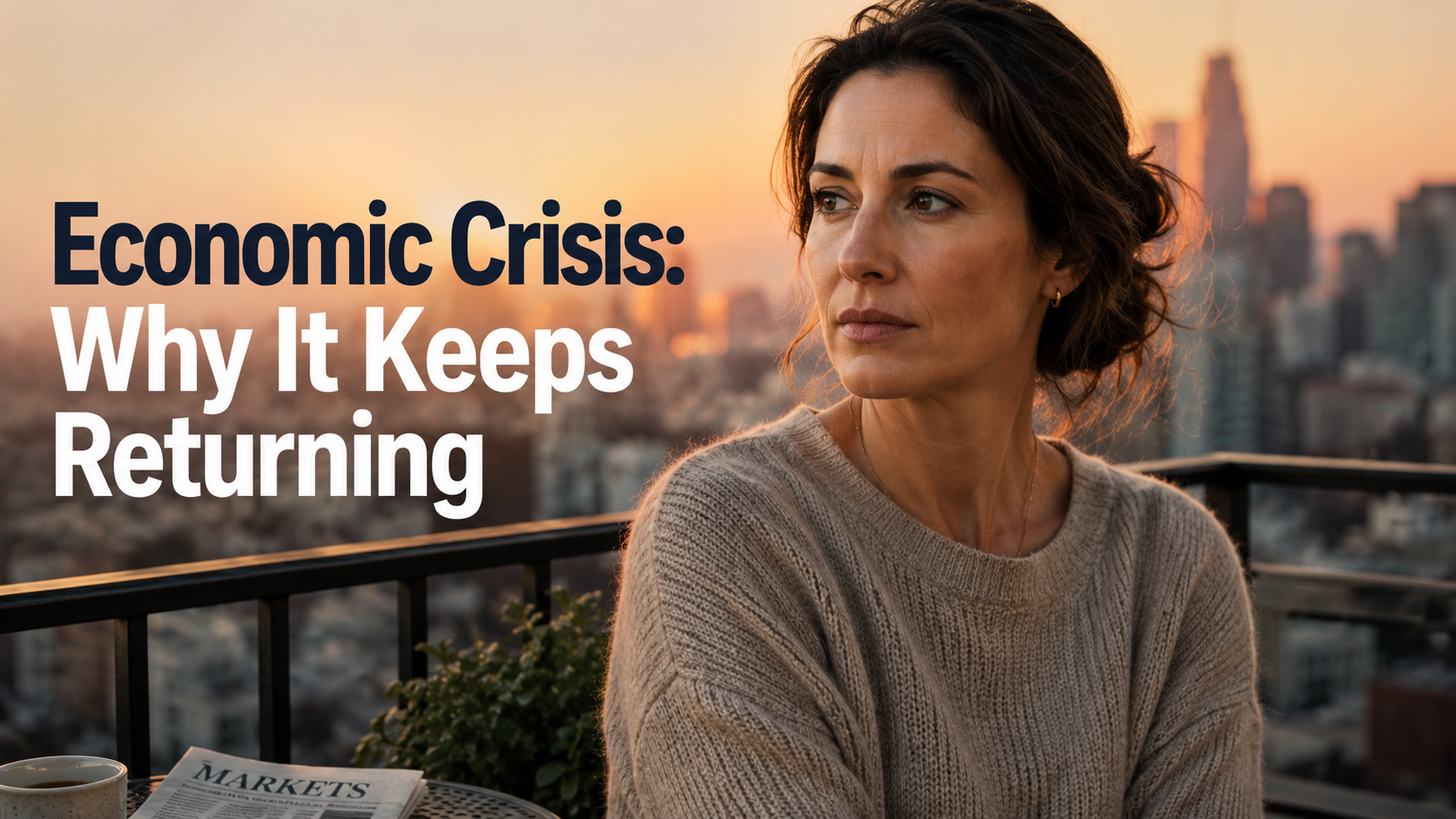
Why Financial Crises Always Come Back — Historical Patterns and Lessons for Women
Expanded Abstract
Why Financial Crises Always Return — and What History Reveals About Women’s Experience
Financial crises are not isolated accidents but recurring cycles that have shaped economies for centuries. From the Great Depression to the 2008 housing collapse and the COVID-19 recession, downturns emerge from familiar patterns of speculation, debt accumulation, and systemic fragility.
While economic headlines focus on markets and institutions, the human consequences often unfold more quietly—and disproportionately affect women. Job insecurity, unpaid caregiving, household financial strain, and heightened exposure to consumer debt are recurring features of every major downturn.
By examining historical crises across different eras, this article explains why financial instability repeatedly returns and why women tend to carry a heavier share of its burden. Understanding these patterns helps illuminate not only how economies fail, but how social and financial structures shape unequal outcomes.
Beyond numbers and charts, financial crises also leave emotional and psychological marks. Stress, anxiety, and decision fatigue intensify during periods of uncertainty, particularly for women balancing work, family, and financial responsibility.
History does not tell us exactly when the next crisis will arrive—but it does reveal clear lessons about vulnerability, resilience, and recurring risk. For women, recognizing these historical patterns is a critical step toward understanding the forces that continue to shape financial insecurity across generations.
Quick Read — Article #56
Why Financial Crises Always Come Back — Historical Patterns and Lessons for Women
Quick Read — The Historical Pattern You Need to Understand
Financial crises are not accidents — they are recurring cycles shaped by speculation, debt, and fragile systems. Across centuries, downturns have followed familiar paths, even as their triggers evolve.
For women, the pattern is especially consistent: job insecurity rises faster, household pressure intensifies, and reliance on high-interest credit becomes more common in every major crisis.
History shows that vulnerability is rarely random. It emerges where financial buffers are thin, income is unstable, and social protections are weak. At the same time, past crises reveal something equally important: women repeatedly adapt, reorganize, and stabilize households and businesses through disciplined planning and resilience.
Understanding these historical cycles does not predict the next crisis — but it does explain why preparedness matters more than timing. The lesson history offers women is clear: crises return, but informed readiness can dramatically reduce their long-term damage.
Introduction – Why Financial Crises Always Return (and Why Women Pay the Hidden Price)
Every generation hopes to be the one that finally escapes the cycle of collapse. Yet history keeps repeating itself: financial crises always return. From the Great Depression to the 2008 housing crash and the COVID-19 recession, downturns are not random accidents—they are recurring patterns born from speculation, debt, and fragile systems (Reinhart & Rogoff, 2009; IMF, 2023).
For most Americans, crises are narrated through stock tickers, unemployment charts, and breaking headlines about Wall Street. But behind those numbers lies a quieter truth: women consistently bear the heavier cost. They are the ones stitching together part-time jobs, stretching grocery budgets, caring for families under stress, and turning to high-interest credit cards that begin as lifelines but soon become chains (McKinsey & LeanIn.Org, 2022; OECD, 2021).
This article is not simply about economics—it is an exploration of the recurring forces that shape financial instability and women’s lived experiences within these cycles. By revisiting the past—from Weimar hyperinflation to the European Debt Crisis—we uncover how every downturn left scars, revealed weaknesses, and taught enduring lessons. For women, that lesson is urgent: crises are inevitable, but devastation is not.
Here, we explore how women in America uniquely experience financial crises—the emotional labor, the hidden costs of debt, and the unequal impact on households and small businesses. More importantly, it examines how these challenges repeatedly emerge across crises, shaping women’s financial roles, responsibilities, and long-term security across generations.
Because surviving is not enough. Women deserve more than endurance—they deserve to lead, to prepare, and to thrive.
Summary
Why do financial crises feel like déjà vu—storms we’ve endured yet that keep returning? Each crash reshapes the economy, each downturn rewrites personal dreams, and women are often left carrying the heaviest burden.
These crises are not random. History explains their recurrence: speculation, debt bubbles, and weak regulation. Politicians may promise stability, but the real question remains—how can women prepare for the next financial crisis in everyday life, not in theory?
For women—whether managing a household or running a small business—the stakes extend beyond money. Survival means security, dignity, and confidence. Knowing how to protect one’s finances during a recession is not merely a tactic; it is a lifeline.
This article reveals why financial crises always return and explains how history helps clarify women’s unique vulnerabilities and sources of resilience across economic cycles. Because resilience is not about fearing the storm—it’s about walking through it with a plan strong enough to protect wealth, reduce risk, and secure independence for the future.
Curiosities
- Since 1970, the world has faced over 150 banking crises—proof that financial instability is not the exception but the rule (World Bank).
- A major crisis tends to occur every 8–12 years, fueled by speculation, debt bubbles, and weak oversight—cycles that repeatedly resurface.
- Women-owned small businesses in the U.S. are 30% more likely to close during recessions than male-owned ones, underscoring the need for gender-focused resilience strategies (NWBC, 2023).
- Women’s conservative investment style often outperforms men’s during volatile markets, showing that discipline can be a hidden advantage (Warwick Business School, 2018).
- Nearly 60% of Americans believe another financial crisis is inevitable within the next decade—reinforcing why preparation, not panic, is the smartest path (Pew Research Center, 2022).
CHAPTER 1 — The Cycle of Crisis: Why Downturns Are Inevitable
Understanding the Economic Patterns Behind Financial Crises
How Booms and Busts Shape the Global Economy
There’s a reason financial crises feel like déjà vu. The headlines may change, the dates move forward, yet the rhythm remains painfully familiar. Banks collapse. Markets plunge. Layoffs surge. And women, more often than not, absorb the invisible costs. History seems to press rewind, replaying the same pain with new faces (UN Women, 2022).
[Interlink → Article #53: The Emotional Weight of Being Strong: Women and Financial Stress]
Economists describe it as a cycle — periods of expansion inevitably followed by correction. Debt grows, speculation intensifies, and eventually reality intervenes (Lusardi & Mitchell, 2014). That’s the structural explanation. But behind the academic jargon lies a truth many women recognize: when money systems fail, women’s lives absorb the shock first. For those living paycheck to paycheck, the phrase “macroeconomic correction” means little compared to the fear of not covering rent or groceries (OECD, 2021; 2023).
[Interlink → Article #83: Women on the Frontlines of the 2008 Recession: Careers, Debt & Resilience]
Imagine standing on a beach. The tide retreats — calm, promising, deceptively safe. Then, without warning, the waves return stronger and more unforgiving. That’s how financial crises unfold: patterns of excess followed by collapse. They return because the forces that drive them are woven into the foundations of modern economies (OECD, 2021; 2023). Like seasons, they follow one another — inevitable yet always disruptive.
Why Markets Repeat the Same Mistakes
Picture a single mother in 2008, balancing two part-time jobs and raising three children. For a while, things felt manageable. Then the crisis hit. One job vanished, the other cut her hours. She turned to credit cards to survive — but what began as relief became a chain of debt (McKinsey & LeanIn.Org, 2022). Her story isn’t rare; it’s a symbol of how each downturn multiplies vulnerability.
[Interlink → Article #49: Credit Cards as Lifelines: How Women Coped During the 2008 Crisis]
Acknowledging this truth is not enough. The crucial question isn’t whether another crisis will come — it will. The question is why societies keep rebuilding the conditions that make downturns predictable and recurring (Fidelity Investments, 2017; 2021). What looks like ‘surprise’ in headlines is often repetition in disguise.
What History Tells Us About the Next Crisis
For women entrepreneurs — running a bakery, a beauty salon, or a home-based store — the stakes are brutally high. Data from the National Women’s Business Council show that women-owned firms are nearly 30 percent more likely to close during recessions than male-owned ones (World Bank, 2022). The margins are smaller, access to credit tighter, and safety nets thinner. A downturn doesn’t just erase profits — it threatens dreams built from scratch, often at the cost of sleepless nights and quiet sacrifice.
For mothers managing households, the burden doubles. Rising prices and shrinking paychecks translate into daily anxiety: stretching groceries, cutting utilities, explaining to children why something once affordable is now out of reach (OECD, 2021; 2023). Surviving a downturn isn’t about numbers on a spreadsheet; it’s about preserving dignity in front of those who depend on you most.
Why do crises always return? Because societies rebuild on fragile promises. Because profit is chased faster than prudence. Because we forget too quickly the lessons of the last collapse (Barber & Odean, 2001). In 2008, it was subprime mortgages. In 2000, the dot-com bubble. In the 1990s, the savings-and-loan crisis. Different names, same pattern. Each time, women are told to “tighten the belt,” while carrying households, debt, and invisible labor uncounted in GDP.
Yet here’s the overlooked truth: while women are often hardest hit, they also tend to display financial behaviors shaped by caution, continuity, and long-term priorities. Research shows women tend to invest more conservatively, save more steadily, and prioritize long-term security over short-term gain (Fidelity Investments, 2021; Vanguard, 2019). During volatility, these “cautious” approaches often outperform aggressive ones. That’s the essence of women’s financial resilience — the ability to endure storms not because the waves stop, but because the foundation holds.
Predicting the next downturn’s exact form is impossible — but history shows that crises tend to punish fragility and reward stability over time (Harvard Business Review, 2019). The repeated lesson is that households and small businesses with fewer buffers and tighter credit constraints absorb more damage when conditions suddenly tighten.
Most importantly, it means rewriting the narrative. Women are not just background characters in economic cycles; they are often the stabilizers of households and communities when systems break down (Sandberg, 2013). Recognizing that role changes how we interpret every crisis: not only as a market event, but as a lived, gendered experience.
Another wave will come. The question isn’t if but when. The difference between being swept away and standing firm often comes down to how exposed a household is when credit tightens, jobs vanish, and costs rise (UN Women, 2022).
[Interlink → Article #71: Retirement After the Great Recession: How Global Financial Crises Reshape Women’s Long-Term Security]
CHAPTER 2 — The Human Cost: How Crises Weigh Heavier on Women
The Unequal Impact of Recessions on Women
Job Losses and the Gender Pay Gap in Downturns
Financial crises don’t strike evenly. The headlines often center on Wall Street losses, bank failures, or national unemployment rates. Yet behind those statistics lies a persistent truth: women carry a disproportionate share of every downturn’s weight. Whether as entrepreneurs, employees, caregivers, or heads of households, women absorb both the financial and emotional shocks that recessions unleash (UN Women, 2022).
[Interlink → Article #53: The Emotional Weight of Being Strong: Women and Financial Stress]
During the 2008 financial crisis, millions lost their jobs—but women’s roles placed them at the front line of vulnerability. Retail, service, and part-time positions—fields dominated by women—were among the first to disappear. Studies show that when households downsized, it was women who reduced their hours, sacrificed promotions, or took multiple informal jobs to keep food on the table (McKinsey & LeanIn.Org, 2022; OECD, 2021; 2023). This is why women’s financial vulnerability during recessions isn’t theoretical—it shows up in work patterns, caregiving demands, and household stability.
[Interlink → Article #83: Women on the Frontlines of the 2008 Recession: Careers, Debt & Resilience]
Emotional Labor and Family Pressures During Crises
The emotional toll is equally profound. Imagine explaining to your child why the refrigerator is emptier, or why a birthday gift must wait another year. These aren’t abstract symptoms of GDP decline—they’re lived moments of heartbreak. Research directly connects economic downturns to higher rates of anxiety, depression, and stress among women, particularly mothers (OECD, 2021; 2023). To speak about “family impact” in economic crises is, in truth, to describe the quiet sacrifices women make daily and alone.
Take the story of a young woman who owned a small neighborhood bakery. Before the crisis, her mornings smelled of fresh bread and possibility. As the downturn deepened, customers vanished, bills grew, and her loan request was dismissed—too small, too risky (World Bank, 2022). Her story has repeated itself thousands of times, illustrating why women-owned small businesses are among the most vulnerable during recessions.
When recessions tighten credit, the gap widens further. Women entrepreneurs—already facing systemic barriers to financing—find doors closing just when they most need support (Fidelity Investments, 2017; 2021). A salon owner watches her clients disappear; a designer sees orders halted; yet both hear the same refrain: “not eligible.” This is how structural inequality transforms economic downturns into gendered setbacks.
[Interlink → Article #49: Credit Cards as Lifelines: How Women Coped During the 2008 Crisis]
Why Women Shoulder Disproportionate Financial Stress
The hidden cost of a crisis rarely shows up in economic reports. When women cut paid hours to provide unpaid caregiving—whether for children, elderly parents, or laid-off relatives—those hours vanish from GDP calculations (Lusardi & Mitchell, 2014; OECD, 2021; 2023). Yet they represent real labor, emotional weight, and lost financial opportunity. Each crisis expands women’s unpaid workload even as it shrinks their paid prospects.
This imbalance doesn’t just hurt individuals; it perpetuates intergenerational vulnerability. A mother forced into debt to survive a recession may unintentionally pass that burden to her children, creating a long chain of financial fragility (Barber & Odean, 2001; World Bank, 2022). That’s why financial resilience for women must be viewed as both personal empowerment and family protection.
Retirement After the Great Recession: How Global Financial Crises Reshape Women’s Long-Term Security
Within Cluster 3’s systemic framework, this chapter reinforces how recurring cycles of credit tightening, labor-market disruption, and institutional fragility translate into unequal household outcomes—especially where buffers are thinner and caregiving demands rise during downturns.
And yet, women remain the architects of recovery. Studies consistently find that women cut nonessentials earlier, save more steadily, and prioritize essentials with discipline (Vanguard, 2019; Fidelity Investments, 2021). This pragmatic behavior—often dismissed as “too cautious”—is precisely what shields households from collapse. The very strategies undervalued in boom years become lifelines when the economy turns.
The human cost of financial crises is undeniable. But so is women’s capacity to transform pain into resilience. Every downturn underscores the importance of women-centered economic visibility, public policy attention, and financial education (Harvard Business Review, 2019; Brookings, 2024). To overlook this truth is to ignore half the economy; to face it is to describe crises as they really are—market events with deeply human, gendered consequences.
CHAPTER 3 — Lessons from History: What Past Economic Downturns Teach Women Today
Learning from Past Financial Crises
Key Lessons from the Great Depression and the 2008 Recession
History isn’t just a timeline of events—it’s a pattern. And in finance, that pattern is unmistakable: expansion, collapse, recovery, repetition (Lusardi & Mitchell, 2014; OECD, 2021; 2023). Every crisis bears a new name, yet the experience feels achingly familiar. For women, each cycle has meant carrying heavier burdens than statistics ever show. Looking back isn’t nostalgia; it’s a way to recognize what keeps returning.
The Great Depression of the 1930s exposed the fragility of economies built on speculation (Harvard Business Review, 2019). While men stood in unemployment lines, women became the unseen engines of survival—stretching meals, repurposing clothing, and holding families together with creativity that history rarely recorded. It was resilience, but also invisibility—a reminder that women’s labor is often the first called upon and the last recognized (UN Women, 2022).
[Interlink → Article #83: Women on the Frontlines of the 2008 Recession: Careers, Debt & Resilience]
During the 1970s, stagflation—soaring costs paired with stagnant wages—forced mothers and daughters into the workforce in record numbers, not for ambition but for survival. Balancing jobs and caregiving, they embodied the emotional weight of being strong (McKinsey & LeanIn.Org, 2022; OECD, 2021). Inflation didn’t just erode paychecks; it drained energy and stability. History taught that crises are never only economic—they’re profoundly personal.
[Interlink → Article #53: The Emotional Weight of Being Strong: Women and Financial Stress]
The dot-com bubble of the early 2000s delivered a different lesson. Hype fueled easy money, and when the bubble burst, wealth vanished overnight. Yet women investors—often more diversified and patient—escaped the worst losses. Their steadiness proved that prudence, often mislabeled as timidity, is a form of financial strength (Fidelity Investments, 2021; Vanguard, 2019).
Then came 2008, the deepest collapse since the Depression. Subprime mortgages imploded, banks failed, and markets crashed. Women—especially single mothers and small-business owners—were among the hardest hit (World Bank, 2022; OECD, 2023). Many turned to credit cards to cover rent and food, but that lifeline quickly became a chain of long-term debt (OECD, 2021). The memory of 2008 stands as a stark reminder: survival mechanisms can become traps if unaccompanied by safety nets.
[Interlink → Article #49: Credit Cards as Lifelines: How Women Coped During the 2008 Crisis]
Women’s Resilience Through Historical Hardship
How Crises Leave Intergenerational Footprints
Crises leave generational footprints. A daughter raised in scarcity learns caution—hesitating to invest, fearing risk, or normalizing debt as survival. These lessons travel silently across time, proving that downturns are never temporary; they echo through families (Lopez, 2020; UN Women, 2022). For women, resilience is rarely individual—it’s intergenerational protection.
Why Collective Amnesia Makes the Next Crash Likely
History’s greatest danger is collective amnesia. Stability returns, reforms fade, and complacency grows—until the next crash arrives (Barber & Odean, 2001; IMF, 2023). For women, forgetting is too expensive. The lesson is ongoing: the same pressures return in new forms, and the households with the fewest buffers tend to absorb the deepest shocks. What looks like a temporary downturn in charts can become a long shadow in real life—especially when credit replaces income (Fidelity Investments, 2017; OECD, 2023).
[Interlink → Article #71: Retirement After the Great Recession: How Global Financial Crises Reshape Women’s Long-Term Security]
Turning Past Struggles into Future Strength
From Endurance to Applying Lessons Before the Next Storm
History is more than a record of mistakes—it’s a testament to women’s endurance. From feeding families during the Depression to rebuilding careers after 2008, women have shown adaptability that policy debates too often overlook (UN Women, 2022; Brookings, 2024). But survival alone is not enough. The real task is to make sure hard-won lessons are not lost—before the next storm hits. By studying history—its scars and its strength—women can move from being described as ‘victims of downturns’ to being recognized as central actors in how families and communities endure and recover (Sandberg, 2013; IMF, 2025). The next crisis will come, but its cost can change if its lessons are finally applied.
CHAPTER 4 — Understanding Preparedness: How Women Historically Respond to Financial Crises
How Women Have Historically Built Financial Buffers During Crises
Why Readiness Becomes a Form of Self-Determination
Every generation believes it will escape financial turmoil. Yet history proves otherwise: crises return with unnerving regularity (Lusardi & Mitchell, 2014; OECD, 2021; 2023). While eliminating crises is impossible, history shows that the way individuals and households respond often determines how deeply downturns affect daily life. Across crises, women have developed recurring patterns of response shaped by necessity rather than choice. For women, readiness is more than a safeguard—it’s a declaration of self-determination (UN Women, 2022; Brookings, 2024).
Acceptance as the First Step Toward Strategy
The first step toward preparation is acceptance. Another downturn will come—whether through housing bubbles, inflation shocks, or global disruption. Denial is the costliest form of risk. By accepting that crises are inevitable, fear begins to lose its hold. The question shifts from if to when—and that shift empowers strategy over paralysis (OECD, 2021; IMF, 2023).
[Interlink → Article #53: The Emotional Weight of Being Strong: Women and Financial Stress]
Cash Reserves vs. High-Cost Credit in Past Downturns
Across past downturns, access to even minimal cash reserves often marked the difference between short-term disruption and long-term financial damage. Historical data from 2008 shows how the absence of buffers pushed many women toward high-cost credit as a survival mechanism. Even modest cash buffers often made the difference between a temporary setback and long-term indebtedness. During the 2008 recession, millions relied on credit cards as lifelines, only to discover they had become financial chains (Fidelity Investments, 2017; Vanguard, 2019; World Bank, 2022; OECD, 2023).
[Interlink → Article #49: Credit Cards as Lifelines: How Women Coped During the 2008 Crisis]
Building Safety Nets Without Fear
Income Adaptation as a Historical Survival Pattern
Historical evidence shows that women with multiple income sources—formal or informal—were more likely to absorb shocks during downturns. These income adaptations often emerged organically, driven by necessity rather than long-term planning. Across past downturns, many women turned to flexible income activities—such as freelance work, informal services, or small digital ventures—as a response to income instability. These adaptations were often less about growth and more about preserving autonomy when primary income sources faltered. During the Great Recession, women with multiple income sources were far more likely to stay afloat (McKinsey & LeanIn.Org, 2022; Brookings, 2024).
Rethinking Debt Before a Downturn Begins
Preparation also means rethinking debt. Credit often feels like a safety net—but in reality, it can become a trap disguised as support. Women carrying high credit card balances into recessions face dual pressure: falling income and compounding interest. Repeated crises reveal a consistent pattern: households entering downturns with high revolving debt face steeper and longer recovery paths. Credit, while often framed as support, frequently amplifies vulnerability once income declines. Preparing in advance helps ensure survival is not mortgaged to lenders when the economy shifts (OECD, 2021; IMF, 2025).
Why Retirement Continuity Matters During Uncertainty
Retirement planning, too, is critical even during uncertainty. Women tend to live longer, earn less, and take more career breaks—factors that compound risk later in life (Vanguard, 2019; Fidelity Investments, 2021). Contributing consistently, even in small amounts, builds not just future income but emotional security. During the 1970s stagflation, many households paused long-term savings for short-term survival—and decades later, they still paid the price. Today’s women cannot afford that same trade-off (OECD, 2023).
[Interlink → Article #71: Retirement After the Great Recession: How Global Financial Crises Reshape Women’s Long-Term Security]
The Power of Planning Over Panic
Emotional Preparation as Financial Protection
Emotional preparation is as vital as financial planning. Anxiety clouds judgment, leading to panic selling, impulsive spending, or overreliance on credit. Cultivating calm through knowledge and support is a form of resilience. Whether through financial literacy programs, community discussions, or peer mentorship, understanding reduces fear (Lopez, 2020; UN Women, 2022). Recognizing stress as part of the process keeps it from controlling your decisions.
Community as a Social Safety Net During Crises
There is also strength in community. Historically, women have relied on collective strategies—pooling resources, forming savings groups, or sharing services. These networks transform isolation into solidarity. During crises, such collaboration becomes a social safety net that money alone cannot replicate (OECD, 2023; Brookings, 2024).
Women as Architects of Resilience, Not Bystanders
Ultimately, historical patterns suggest that women are rarely passive during economic crises. Their responses—shaped by caregiving roles, income volatility, and social expectations—form a distinct model of economic adaptation that traditional analyses often overlook. Women are not bystanders in economic history—they are architects of resilience. Each dollar saved, each debt reduced, each decision made with intention becomes a step away from panic and toward empowerment (Harvard Business Review, 2019; IMF, 2025). The next crisis is not a test of fate—it’s a test of readiness.
[Interlink → Article #71: Retirement After the Great Recession: How Global Financial Crises Reshape Women’s Long-Term Security]
CHAPTER 5 — How Women Historically Adjust Spending and Saving During Recessions
Recurring Financial Behaviors Observed During Economic Downturns
Cutting Costs Without Sacrificing Quality of Life
When recession strikes, money can suddenly feel like sand slipping through your fingers. Prices rise, incomes tighten, and headlines amplify anxiety. But panic is not a plan. Women who have weathered past downturns know that protection comes from clarity, calm, and creativity (Lusardi & Mitchell, 2014; OECD, 2021; 2023). These are not theories—they are survival strategies that have kept households steady through every major economic storm.
Historical accounts from past recessions show that women often became acutely aware of household cash flow early in downturns, identifying nonessential expenses as a response to uncertainty rather than a formal budgeting exercise. Too many families enter recessions blind to where their money actually goes. Tracking expenses is more than budgeting—it’s diagnosis. Listing every bill, subscription, and impulse purchase exposes waste and defines priorities. This act alone transforms fear into action. During the 2008 crisis, women who adapted their spending early were far less likely to accumulate long-term debt than those who avoided facing their finances (Fidelity Investments, 2017; Brookings, 2024).
[Interlink → Article #53: The Emotional Weight of Being Strong: Women and Financial Stress]
Cutting back is not deprivation—it’s prioritization. Cancel unused services, renegotiate bills, and trim nonessentials so resources can protect what matters most: food, housing, health, and family stability (OECD, 2021; IMF, 2025). Recessions test our ability to distinguish “nice to have” from “need to survive.” The outcome isn’t weakness but resilience—the discipline to protect essentials when everything feels uncertain.
Smart Saving and Spending Priorities in Hard Times
Debt, Liquidity, and Income as the Core Stability Triangle
Debt management is a cornerstone of stability. Credit cards may seem like lifelines during crises, but their high-interest rates quietly turn relief into long-term strain. In 2008, women who leaned on credit balances carried that debt for years, delaying recovery long after the market rebounded (World Bank, 2022; OECD, 2023). Data from the 2008 crisis illustrates how reliance on revolving credit during downturns delayed financial recovery for many women, turning short-term relief into prolonged financial strain.
[Interlink → Article #49: Credit Cards as Lifelines: How Women Coped During the 2008 Crisis]
Liquidity matters, too. Building even a modest emergency fund acts as a shock absorber when the unexpected hits. A few hundred dollars can prevent new debt, especially for women who often face unplanned caregiving or income gaps (UN Women, 2022; Brookings, 2024). It won’t happen overnight, but small, steady contributions create stability over time. Every dollar saved today is one less dollar borrowed tomorrow.
Income diversification is another shield. Whether it’s freelance work, remote consulting, or monetizing creative skills, multiple income streams create flexibility when the main one falters. Recessions often become incubators of innovation: a teacher offering online classes, a baker selling from home, a designer freelancing on weekends. What begins as necessity often grows into independence—proof that downturns can be catalysts, not catastrophes (McKinsey & LeanIn.Org, 2022; IMF, 2025).
Avoiding Common Money Mistakes During Recessions
Protecting Long-Term Security, Community, and Mindset
One of the costliest mistakes during economic stress is pausing retirement savings entirely. When budgets tighten, long-term planning can feel impossible—but even minimal contributions preserve future security. Women, who typically live longer and earn less, cannot afford to stop investing in themselves (Vanguard, 2019; Fidelity Investments, 2021). Each contribution, however small, is an act of foresight. History shows that those who continued saving—even modestly—rebounded faster once recovery began (OECD, 2023).
[Interlink → Article #71: Retirement After the Great Recession: How Global Financial Crises Reshape Women’s Long-Term Security]
Community support is another underestimated financial tool. For generations, women have relied on informal networks to share resources, trade services, and offer emotional stability. During the Great Depression, “savings circles” and barter systems kept families alive. Today, digital communities amplify that same spirit—allowing women to share knowledge, exchange work, and build resilience together (Harvard Business Review, 2019; OECD, 2023).
Protecting money is not only about income—it’s about connection.
Finally, mindset itself is a form of wealth protection. Fear drives rash decisions—panic-selling investments, draining savings, or ignoring bills out of overwhelm. Calm preparation keeps focus where it belongs: on strategy. Viewing recession as a recurring cycle rather than an isolated catastrophe reflects how women who lived through multiple downturns came to interpret economic instability over time. Downturns always end; the difference lies in how you navigate the storm (Lopez, 2020; Brookings, 2024).
CHAPTER 6 — How Women Entrepreneurs and Families Have Historically Responded to Economic Shocks
Patterns of Adaptation Among Families and Small Businesses
Diversifying Income and Building Side Streams
Resilience isn’t just surviving one storm—it’s building a vessel strong enough to face every wave of uncertainty that inevitably returns. For women entrepreneurs and families, resilience isn’t an abstract virtue; it’s a daily necessity. Every downturn exposes the fragile balance between income, caregiving, and financial security. Yet history offers a powerful insight: women are not only survivors of crises—they are innovators in how to rise from them (UN Women, 2022; Brookings, 2024).
[Interlink → Article #83: Women on the Frontlines of the 2008 Recession: Careers, Debt & Resilience]
Take the story of a small salon owner during the 2008 recession. When clients disappeared and bills mounted, she pivoted—offering affordable in-home services and building a loyal customer base that outlasted the crisis. Her resilience wasn’t luck; it was adaptability. Though women-owned businesses are statistically more vulnerable during downturns, they often rebound faster, proving that flexibility is a cornerstone of financial survival (World Bank, 2022; OECD, 2023).
Resilience begins with diversification. Families and entrepreneurs who rely on a single income source remain one disruption away from instability. A teacher who tutors online or a family that rents out an extra room creates buffers against layoffs or slow seasons. Multiple income streams turn fragility into stability, even when broader systems fail (Fidelity Investments, 2017; IMF, 2025).
Across crises, families and small businesses that entered downturns with even limited buffers experienced greater flexibility in their responses, highlighting how prior conditions shape crisis outcomes. Entrepreneurs who set aside even small cash reserves gain the power to make choices strategically rather than out of desperation. Families who maintain modest emergency funds avoid the debt spiral that traps so many during recessions (Lusardi & Mitchell, 2014; OECD, 2023). The gap between panic and poise is often just a few hundred dollars saved before the storm hits.
[Interlink → Article #71: Retirement After the Great Recession: How Global Financial Crises Reshape Women’s Long-Term Security]
Emotional and Mental Resilience in Business and Home
Protecting Decision-Making Under Pressure
Resilience isn’t purely financial—it’s also mental and emotional endurance. Women often carry a dual weight: running businesses while managing homes. This double burden magnifies the stress of economic downturns. Learning to manage that pressure—through education, mentorship, or community support—protects clear decision-making when fear threatens to take control (Lopez, 2020; Brookings, 2024). A calm mind can be as valuable as a balanced budget.
[Interlink → Article #53: The Emotional Weight of Being Strong: Women and Financial Stress]
For families, resilience grows in everyday acts of prioritization. Cooking at home, delaying nonessential purchases, or pooling resources with relatives may seem small—but collectively, these choices build stability. In countless homes, women serve as financial architects—stretching every dollar, protecting their children from worry, and maintaining dignity in scarcity (McKinsey & LeanIn.Org, 2022; OECD, 2023). Their decisions in downturns don’t just ensure survival—they lay the groundwork for recovery.
Debt, however, remains resilience’s hidden enemy. Women who turn to credit cards for temporary relief often find themselves trapped in long-term repayment. True resilience means preparing in advance—creating savings buffers, negotiating with lenders early, and reducing liabilities when times are good (OECD, 2021; IMF, 2025). Avoiding debt dependency preserves freedom of choice when uncertainty returns.
[Interlink → Article #49: Credit Cards as Lifelines: How Women Coped During the 2008 Crisis]
Creating a Long-Term Legacy of Financial Strength
Turning Financial Literacy Into Household Legacy
Resilience isn’t just about this generation—it’s about what we pass forward. When mothers teach daughters about budgeting, saving, and financial caution, they hand down more than money—they hand down survival intelligence. Each story of perseverance becomes a family blueprint for stability. When financial literacy becomes a household norm, hardship turns into heritage, and resilience becomes legacy (Harvard Business Review, 2019; OECD, 2023).
The digital economy has expanded these opportunities. During the COVID-19 pandemic, countless women transformed personal skills into online income—selling handmade goods, teaching virtual classes, or launching small consultancies. What began as emergency measures evolved into sustainable businesses (Fidelity Investments, 2021; Brookings, 2024). These stories prove that crises can serve as incubators for innovation—especially when women act quickly and adapt creatively.
Community remains resilience multiplied. From neighborhood saving circles during the Great Depression to modern digital groups on social media, women have long depended on shared networks to exchange skills, resources, and encouragement (UN Women, 2022; OECD, 2023). For entrepreneurs, this can mean collaborations that reduce costs or expand audiences. For families, it can mean sharing childcare, groceries, or emotional support. Alone, resilience sustains; together, it multiplies.
Ultimately, resilience reflects a recurring pattern shaped by foresight, adaptability, and solidarity across economic cycles. Historical evidence shows that women entrepreneurs and families have repeatedly relied on social support and adaptive responses when navigating periods of instability. When the next crisis inevitably comes, these patterns help explain why some households experience temporary disruption while others face long-lasting consequences (Vanguard, 2019; IMF, 2025).
CHAPTER 7 — How Women Have Historically Approached Investing During Periods of Uncertainty
Observed Investment Behaviors During Market Volatility
Why Diversification Repeatedly Appears in Crisis Outcomes
Recessions and market crashes dominate headlines with fear—but history reveals a different story: downturns are not only times of loss, but also windows of opportunity. For women, investing during periods of uncertainty has historically reflected a preference for protection and continuity rather than speculation. Across crises, long-term perspective often distinguished temporary volatility from permanent loss (Harvard Business Review, 2019; Brookings, 2024).
Historical market data shows that investors who exited markets during early volatility often transformed temporary downturns into permanent losses, while those who remained invested experienced recovery over time. Women who withdraw investments at the first sign of volatility often lock in temporary losses as permanent ones. A calm, disciplined approach—keeping money in diversified, long-term assets—has historically outperformed emotional decision-making (Vanguard, 2019; OECD, 2023). Here, women’s natural caution becomes a quiet advantage, turning patience into performance.
[Interlink → Article #53: The Emotional Weight of Being Strong: Women and Financial Stress]
Repeated market cycles illustrate that portfolios diversified across asset classes tended to recover more consistently than those concentrated in speculative positions. Women who balance their portfolios across bonds, index funds, and real estate weather crises more effectively. During the 2008 financial collapse, diversified investors recovered far faster than those who concentrated wealth in speculative assets (Fidelity Investments, 2021; IMF, 2025). Diversification is not flashy—it’s foundational.
[Interlink → Article #71: Retirement After the Great Recession: How Global Financial Crises Reshape Women’s Long-Term Security]
Debt Management Before and During Investing
Building Stability Before Building Wealth
Historical comparisons across downturns show that high-interest debt significantly constrained households’ ability to recover during periods of market instability. Investing while burdened with high-interest debt is like running uphill with weights strapped to your ankles. Before building wealth, women must first build stability—minimizing reliance on credit for daily survival and freeing resources for investment. Otherwise, the goal shifts from growing assets to merely outrunning debt (OECD, 2021; World Bank, 2022).
[Interlink → Article #49: Credit Cards as Lifelines: How Women Coped During the 2008 Crisis]
Smart investing also means redefining risk. Too often, women avoid investing altogether because risk feels synonymous with recklessness. But risk isn’t binary—it exists on a spectrum. Government bonds carry low risk, speculative stocks carry high risk, and between them lies a wide field of balanced options. Understanding risk as adjustable—not avoidable—empowers women to invest confidently within their comfort zones (Barber & Odean, 2001; Brookings, 2024).
Retirement Accounts and Long-Term Investment Security
Consistency and Compounding Through Downturns
Long-term savings interruptions during downturns have historically contributed to lasting financial insecurity, particularly among women facing longer life expectancy and career interruptions. Consistent contributions—even small ones—deliver compounding benefits that survive recessions. Women, who tend to live longer and face wage gaps and career interruptions, cannot afford to pause these deposits for long (Lusardi & Mitchell, 2014; OECD, 2023). Keeping contributions steady—even through downturns—ensures the stability that markets alone cannot provide.
For entrepreneurs, smart investing also means reinvesting in themselves. Recessions often expose inefficiencies—and opportunities. Women who use downturns to refine their operations, digitize services, or pivot toward underserved markets often emerge stronger. The most successful entrepreneurs see uncertainty as a catalyst for reinvention, not retreat (McKinsey & LeanIn.Org, 2022; Brookings, 2024).
History supports these lessons. During the 2020 pandemic, women who maintained regular contributions to index funds saw full recoveries by 2021—while those who withdrew missed the rebound. Similarly, entrepreneurs who embraced digital platforms often expanded faster than before (World Bank, 2022; IMF, 2025). Even in chaos, strategy outperforms panic.
Mindset remains the final—and most critical—investment. Emotional stability directly shapes financial outcomes. Fear-driven actions—selling too early, hoarding cash, or avoiding opportunities—erode confidence and compound losses. Women who cultivate calm through education, mentorship, and community protect not only their portfolios but also their peace of mind (Lopez, 2020; Brookings, 2024). Knowledge transforms uncertainty into empowerment.
Historical evidence suggests that women who approached investing with a long-term horizon rather than short-term reaction experienced different outcomes following major market disruptions. Across crises, continuity and patience in investment behavior were more closely associated with long-term financial security than attempts to time markets or react to volatility (Fidelity Investments, 2017; Vanguard, 2019).
[Interlink → Article #71: Retirement After the Great Recession: How Global Financial Crises Reshape Women’s Long-Term Security]
CHAPTER 8 — Emotional Survival: Coping with Stress, Fear, and Financial Uncertainty
The Psychological Side of Financial Crises
Naming and Managing Fear in Uncertain Times
Financial crises don’t just empty wallets—they drain spirits. The hidden cost of every downturn is emotional: sleepless nights, constant worry, and the quiet fear that the next bill or layoff could upend everything. For women—who often shoulder both financial and emotional caregiving—the toll is amplified (McKinsey & LeanIn.Org, 2022; UN Women, 2022).
[Interlink → Article #53: The Emotional Weight of Being Strong: Women and Financial Stress]
Fear is a natural reaction to uncertainty. During the 2008 crisis, anxiety and depression surged among women, especially single mothers (Lopez, 2020; OECD, 2023). This wasn’t abstract fear—it was the real anguish of choosing between rent and groceries, or between fuel and medicine. The first step to coping is naming fear instead of denying it. Recognition restores control. Pretending everything is fine gives fear more power; acknowledging it begins to dissolve it.
[Interlink → Article #83: Women on the Frontlines of the 2008 Recession: Careers, Debt & Resilience]
Observed Emotional Coping Patterns During Financial Crises
Reframing Uncertainty as a Recurring Economic Rhythm
One of the most effective forms of emotional survival is reframing uncertainty. Instead of viewing volatility as chaos, it can be seen as a natural economic rhythm—a cycle history has played many times before. Crises arrive, disrupt, and eventually pass. This mindset transforms panic into patience, reminding women that storms are temporary, but resilience is permanent (Harvard Business Review, 2019; Brookings, 2024).
Practical stress management is another essential tool. Historical and psychological studies show that women who maintained emotional regulation practices during crises reported lower long-term stress and decision fatigue. Protecting mental health preserves the cognitive and emotional energy needed to make sound choices (UN Women, 2022; IMF, 2025).
Community, Connection, and Emotional Support
Connection as an Anchor in Turbulent Times
Community is resilience multiplied. Women who share their struggles—whether with friends, family, or peer networks—reduce isolation and magnify strength. In recessions, silence breeds fear, but conversation breaks it. Online groups, neighborhood circles, and virtual support spaces create anchors of hope in turbulent times (Fidelity Investments, 2017; World Bank, 2022). Emotional survival is rarely solitary—it thrives in connection.
For families, an added layer of emotional labor is protecting children from financial stress. Transparency builds trust, but oversharing adult worries can pass anxiety forward. The balance lies in honesty with hope. Maintaining routines, celebrating small joys, and practicing gratitude preserve stability when uncertainty looms (Lusardi & Mitchell, 2014; OECD, 2023).
Debt adds another dimension of stress. Women who rely on credit cards during downturns often describe the psychological weight of debt as heavier than the debt itself. Each statement becomes a reminder of vulnerability. Emotional survival in these moments means compassion—understanding that debt accumulated for survival is not failure; it’s proof of endurance (OECD, 2021; Brookings, 2024).
[Interlink → Article #49: Credit Cards as Lifelines: How Women Coped During the 2008 Crisis]
Stories of Emotional Resilience
Small Rituals That Anchor Recovery
Real stories illuminate what statistics cannot. During the COVID-19 pandemic, many women found strength in small, steady rituals—morning coffee, daily walks, or virtual family game nights (World Bank, 2022; IMF, 2024). These moments, though simple, anchored sanity in chaos. They show that emotional survival isn’t about eliminating fear—it’s about weaving courage into daily life.
Emotional survival ultimately means refusing to let fear write the story. Across generations, women have endured wars, depressions, and recessions—and emerged not untouched, but unbroken (Sandberg, 2013; UN Women, 2022). Coping with uncertainty demands more than financial tools; it calls for resilience of heart and clarity of mind. By acknowledging fear, leaning on community, nurturing family stability, and practicing self-care, women turn fragility into lasting strength.
The truth is clear: surviving financially is only half the battle. Emotional survival ensures women still have the energy and confidence to rebuild when recovery comes. Across crises, emotional resilience has consistently shaped how women experienced recovery, influencing confidence, decision-making, and long-term well-being (McKinsey & LeanIn.Org, 2022; Brookings, 2024).
CHAPTER 9 — Teaching the Next Generation: How Financial Crises Shape Intergenerational Financial Behavior Among Women
Passing Resilience Forward to the Next Generation
Financial Literacy Lessons at Home
Every financial crisis leaves marks. Some fade quickly; others echo across generations. For daughters growing up amid recessions, those echoes often shape adulthood—hesitation to invest, fear of debt, or quiet resilience learned by watching their mothers stretch every dollar. Preparing the next generation for economic resilience means transforming hardship into heritage (McKinsey & LeanIn.Org, 2022; UN Women, 2022).
Children absorb more from observation than instruction. A daughter who watches her mother plan, budget, and adapt during tough times learns that survival is built on strategy, not luck. But those same lessons can unintentionally transmit fear if not balanced with hope. When mothers share both the challenges and the solutions, they teach not just survival—but confidence (Sandberg, 2013).
[Interlink → Article #53: The Emotional Weight of Being Strong: Women and Financial Stress]
Studies consistently show that early exposure to financial conversations within households influenced how women approached money decisions later in life. Simple conversations about saving, spending, and planning lay a foundation schools rarely provide. Encouraging daughters to ask about bills, groceries, or bank accounts turns money from mystery into something manageable. Transparency is protection—it prevents young women from entering adulthood financially unprepared (Lusardi & Mitchell, 2014; OECD, 2023).
Breaking Cycles of Debt and Fear
Saving Early and Teaching Debt Without Shame
The habit of saving early is one of the most powerful tools mothers can pass on. Encouraging daughters to set aside even small amounts—from birthday gifts or part-time jobs—builds lifelong confidence. Saving is not about the amount; it’s about the mindset. Those who learn it young face future downturns with calm rather than fear (Fidelity Investments, 2017; Vanguard, 2019).
[Interlink → Article #71: Retirement After the Great Recession: How Global Financial Crises Reshape Women’s Long-Term Security]
Equally vital is teaching about debt without shame. Many women fall into credit dependence during recessions, carrying balances for years. Explaining the risks of high-interest borrowing—along with strategies to avoid it—breaks that cycle. When daughters understand how debt works, it loses its power as a secret or a stigma. These conversations turn guilt into wisdom (OECD, 2021; Brookings, 2024).
[Interlink → Article #49: Credit Cards as Lifelines: How Women Coped During the 2008 Crisis]
Resilience also grows from mindset. Daughters must learn that crises are systemic, not personal. Shifting from “What did I do wrong?” to “How can I prepare better next time?” builds both emotional strength and strategic thinking (Lopez, 2020; OECD, 2023).
Storytelling and Mentorship as Tools of Legacy
Narratives, Role Models, and Early Autonomy
Stories are the memory of resilience. Family narratives—of grandmothers during the Great Depression, mothers surviving layoffs, or neighbors rebuilding after foreclosure—teach endurance more powerfully than any textbook. These stories prove that while crises repeat, women have always adapted and overcome (Harvard Business Review, 2019; World Bank, 2022).
[Interlink → Article #83: Women on the Frontlines of the 2008 Recession: Careers, Debt & Resilience]
Mentorship extends these lessons beyond the home. Programs in schools, local communities, or digital spaces where women share their financial journeys amplify knowledge and confidence. When girls see role models—investors, entrepreneurs, professionals—they internalize that resilience is not only about surviving, but also about thriving and leading (Fidelity Investments, 2021; UN Women, 2022).
Research indicates that early financial autonomy correlated with higher confidence and decision-making capacity in adulthood. Letting daughters manage small budgets, make investment choices, or start micro-ventures turns theory into confidence. A girl who learns to manage money before adulthood enters the world prepared—not afraid (Vanguard, 2019; OECD, 2023).
Across generations, financial crises have shaped not only economic outcomes but also attitudes, behaviors, and emotional relationships with money among women. Historical evidence suggests that early exposure to financial stress and adaptation influences how subsequent generations perceive risk, security, and financial decision-making (UN Women, 2022; IMF, 2025).
CHAPTER 9 — Teaching the Next Generation: How Financial Crises Shape Intergenerational Financial Behavior Among Women
Passing Resilience Forward to the Next Generation
Financial Literacy Lessons at Home
Every financial crisis leaves marks. Some fade quickly; others echo across generations. For daughters growing up amid recessions, those echoes often shape adulthood—hesitation to invest, fear of debt, or quiet resilience learned by watching their mothers stretch every dollar. Preparing the next generation for economic resilience means transforming hardship into heritage (McKinsey & LeanIn.Org, 2022; UN Women, 2022).
Children absorb more from observation than instruction. A daughter who watches her mother plan, budget, and adapt during tough times learns that survival is built on strategy, not luck. But those same lessons can unintentionally transmit fear if not balanced with hope. When mothers share both the challenges and the solutions, they teach not just survival—but confidence (Sandberg, 2013).
[Interlink → Article #53: The Emotional Weight of Being Strong: Women and Financial Stress]
Studies consistently show that early exposure to financial conversations within households influenced how women approached money decisions later in life. Simple conversations about saving, spending, and planning lay a foundation schools rarely provide. Encouraging daughters to ask about bills, groceries, or bank accounts turns money from mystery into something manageable. Transparency is protection—it prevents young women from entering adulthood financially unprepared (Lusardi & Mitchell, 2014; OECD, 2023).
Breaking Cycles of Debt and Fear
Saving Early as a Confidence Habit
The habit of saving early is one of the most powerful tools mothers can pass on. Encouraging daughters to set aside even small amounts—from birthday gifts or part-time jobs—builds lifelong confidence. Saving is not about the amount; it’s about the mindset. Those who learn it young face future downturns with calm rather than fear (Fidelity Investments, 2017; Vanguard, 2019).
[Interlink → Article #71: Retirement After the Great Recession: How Global Financial Crises Reshape Women’s Long-Term Security]
Teaching Debt Without Shame
Equally vital is teaching about debt without shame. Many women fall into credit dependence during recessions, carrying balances for years. Explaining the risks of high-interest borrowing—along with strategies to avoid it—breaks that cycle. When daughters understand how debt works, it loses its power as a secret or a stigma. These conversations turn guilt into wisdom (OECD, 2021; Brookings, 2024).
[Interlink → Article #49: Credit Cards as Lifelines: How Women Coped During the 2008 Crisis]
Framing Crises as Systemic, Not Personal
Resilience also grows from mindset. Daughters must learn that crises are systemic, not personal. Shifting from “What did I do wrong?” to “How can I prepare better next time?” builds both emotional strength and strategic thinking (Lopez, 2020; OECD, 2023).
Storytelling and Mentorship as Tools of Legacy
Stories as the Memory of Resilience
Stories are the memory of resilience. Family narratives—of grandmothers during the Great Depression, mothers surviving layoffs, or neighbors rebuilding after foreclosure—teach endurance more powerfully than any textbook. These stories prove that while crises repeat, women have always adapted and overcome (Harvard Business Review, 2019; World Bank, 2022).
[Interlink → Article #83: Women on the Frontlines of the 2008 Recession: Careers, Debt & Resilience]
Mentorship and Early Autonomy
Mentorship extends these lessons beyond the home. Programs in schools, local communities, or digital spaces where women share their financial journeys amplify knowledge and confidence. When girls see role models—investors, entrepreneurs, professionals—they internalize that resilience is not only about surviving, but also about thriving and leading (Fidelity Investments, 2021; UN Women, 2022).
Research indicates that early financial autonomy correlated with higher confidence and decision-making capacity in adulthood. Letting daughters manage small budgets, make investment choices, or start micro-ventures turns theory into confidence. A girl who learns to manage money before adulthood enters the world prepared—not afraid (Vanguard, 2019; OECD, 2023).
Across generations, financial crises have shaped not only economic outcomes but also attitudes, behaviors, and emotional relationships with money among women. Historical evidence suggests that early exposure to financial stress and adaptation influences how subsequent generations perceive risk, security, and financial decision-making (UN Women, 2022; IMF, 2025).
CONCLUSION — From Survival to Resilience: What Financial Crises Reveal About Women’s Economic Role
From Endurance to Empowerment
What Women Have Proven in Every Crisis
History has taught one undeniable truth: financial crises always return. Their forms may change—market crashes, housing bubbles, pandemics, inflation—but their pattern is cyclical and inevitable. Yet women in the United States have repeatedly proven that resilience is more than survival; it is the art of transforming disruption into empowerment (UN Women, 2022).
Across generations, women have carried the heaviest loads during downturns—balancing caregiving, work, and emotional stability. But within those burdens lie deep lessons. From stretching budgets during the Great Depression to rebuilding businesses after 2008, American women have shown that resourcefulness is not merely a reaction—it’s a strategy (McKinsey & LeanIn.Org, 2022). Recognizing this dual role—responsibility and resilience—helps clarify women’s central place in how households and communities experience and recover from economic disruption.
[Interlink → Article #53: The Emotional Weight of Being Strong: Women and Financial Stress]
Why Historical Patterns Highlight the Role of Financial Readiness
The chapters throughout this article reveal a consistent historical pattern: households that entered downturns with fewer financial constraints experienced different recovery paths than those under acute pressure. Across crises, access to buffers, lower debt exposure, and continuity in long-term planning shaped outcomes over time (Fidelity Investments, 2017; Lusardi & Mitchell, 2014). Women who take these steps today ensure that when the next crisis hits, they will not sacrifice their futures to survive the present.
[Interlink → Article #71: Retirement After the Great Recession: How Global Financial Crises Reshape Women’s Long-Term Security]
Resilience has rarely been an individual phenomenon. Historical accounts show that women often relied on social networks, shared resources, and informal support systems during periods of financial stress, shaping how families and communities endured prolonged uncertainty. In this context, crises have often functioned as moments of learning rather than isolated disruptions (World Bank, 2022).
[Interlink → Article #83: Women on the Frontlines of the 2008 Recession: Careers, Debt & Resilience]
Historical evidence also highlights the dual role of credit during downturns. While credit cards often functioned as short-term lifelines, they frequently extended financial strain long after crises subsided, reshaping recovery trajectories for many women. This contrast helps explain why credit use during crises often shaped long-term recovery paths rather than serving as a temporary solution (OECD, 2021).
[Interlink → Article #49: Credit Cards as Lifelines: How Women Coped During the 2008 Crisis]
How Financial Crises Continue to Reshape Women’s Economic Trajectories
The ultimate lesson is clear: resilience is no longer about endurance—it’s about evolution. Stability is not something women must wait for; it’s something they can create. Smart investing, emotional self-care, financial literacy, and intergenerational storytelling give women control over their futures. When resilience becomes a deliberate strategy, women move from surviving crises to shaping the systems that follow them (Harvard Business Review, 2019).
The next financial crisis will come, as history consistently shows. What differs across cycles is not the presence of disruption, but how its consequences unfold across households, careers, and generations—particularly for women. Historical evidence suggests that collective responses and social resilience have played a significant role in shaping how these consequences evolved over time.
Disclaimer
This content is intended for educational and informational purposes only and should not be interpreted as financial, legal, or investment advice. Consult a qualified professional before making personal financial decisions. Neither the author nor HerMoneyPath assumes responsibility for any losses or outcomes arising from actions taken based on this material.
References (APA 7th Edition – Final)
- Barber, B. M., & Odean, T. (2001). Boys will be boys: Gender, overconfidence, and common stock investment. The Quarterly Journal of Economics, 116(1), 261–292. https://doi.org/10.1162/003355301556400
- Fidelity Investments. (2021). Why women investors are outperforming men. https://www.fidelity.com/viewpoints/investing-ideas/women-investors-outperform
- Lusardi, A., & Mitchell, O. S. (2014). The economic importance of financial literacy: Theory and evidence. Journal of Economic Literature, 52(1), 5–44. https://doi.org/10.1257/jel.52.1.5
- McKinsey & Company, & LeanIn.Org. (2022). Women in the workplace 2022. https://www.womenintheworkplace.com
- Sandberg, S. (2013). Lean in: Women, work, and the will to lead. Alfred A. Knopf.
- UN Women. (2022). Progress of the world’s women 2022: Gender equality in times of crisis. https://www.unwomen.org/en/digital-library/publications/2022/09/progress-of-the-worlds-women-2022
- World Bank. (2022). Women, business and the law 2022. https://openknowledge.worldbank.org/handle/10986/36945
