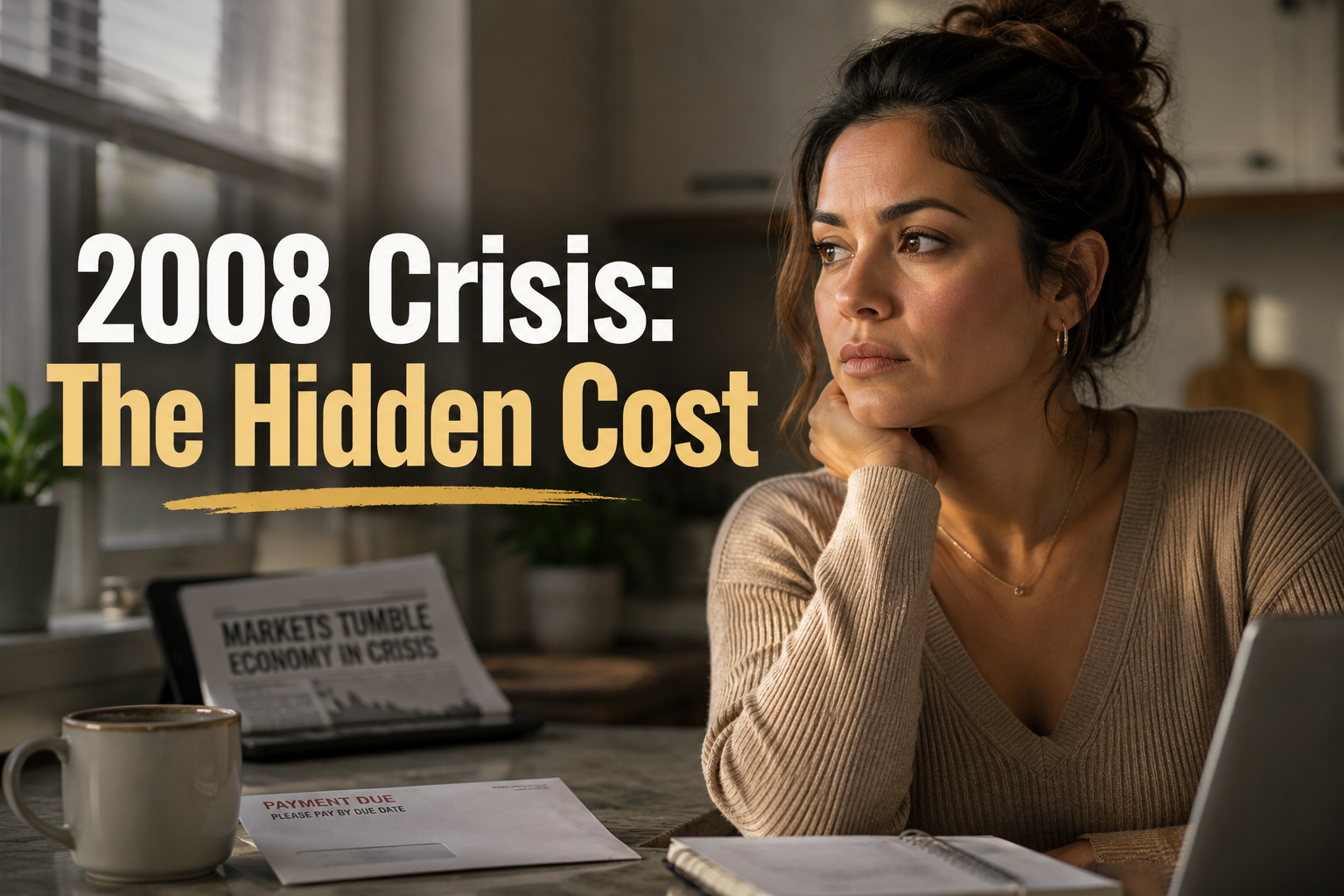
Editorial Note: This article examines the 2008 financial crisis through the financial experiences of women in the United States. It connects housing instability, employment disruption, caregiving pressure, credit use, and unequal wealth recovery to explain how a market collapse became a longer hidden recession inside many households.
It is a historical and educational analysis, not an individual debt-management guide. Links throughout the article lead to more focused HerMoneyPath resources on credit card debt, emergency savings, financial stress, and long-term wealth protection.
How the 2008 Financial Crisis Became a Hidden Recession for Women
The 2008 financial crisis was not only a collapse of banks, housing markets, and investment portfolios. For millions of women across the United States, it became a second, less visible recession inside paychecks, family budgets, credit-card statements, caregiving routines, and long-term financial plans.
As the Great Recession moved from Wall Street into American neighborhoods, women often experienced the crisis through a series of household emergencies. Work hours were reduced. Jobs became less secure. Home values fell. Retirement contributions stopped. Childcare and medical expenses continued even when income did not.
For many families, credit cards became a way to keep groceries in the kitchen, gas in the car, utilities connected, and essential bills paid. Borrowing could create temporary breathing room, but balances accumulated when income failed to recover quickly. What began as short-term financial support could become years of interest charges, damaged credit, and delayed saving.
Why Women Entered the Recession With Less Financial Margin
Economic shocks do not begin on equal ground. Before the crisis, many women were already earning less, accumulating less wealth, and carrying a larger share of unpaid caregiving. Single mothers, women of color, lower-income workers, and women employed in unstable or poorly protected jobs often had even smaller financial cushions.
These disadvantages mattered when the economy contracted. A household with limited savings had fewer ways to replace lost income without borrowing. A woman responsible for children or aging relatives had less freedom to relocate, change schedules, accept additional work, or return to school. A career interruption could affect not only the next paycheck, but also future raises, retirement contributions, Social Security benefits, and opportunities to build wealth.
The mortgage crisis created another layer of vulnerability. Women who had been directed toward higher-cost or riskier loans faced greater exposure when payments increased or home values declined. For homeowners, foreclosure threatened both housing stability and accumulated equity. For renters, neighborhood disruption, job losses, and damaged credit could make secure housing harder to obtain.
How the Crisis Moved Into Household Budgets
Official accounts of the Great Recession often focus on bank failures, unemployment rates, government interventions, and the decline of the housing market. Those measures are essential, but they do not fully capture how a financial crisis is lived inside a household.
A woman might keep her job but lose overtime, benefits, or predictable hours. She might use savings to support an unemployed partner, help an adult child, or care for an aging parent. She might postpone medical treatment, reduce retirement contributions, or rely on revolving credit because several essential expenses arrived at once.
These decisions were frequently described as personal financial choices. In reality, many were responses to shrinking options. Women were not necessarily borrowing because they misunderstood money or lacked discipline. They were often managing income loss, caregiving responsibilities, housing pressure, and essential expenses within a financial system that offered costly forms of relief.
This is why credit-card debt is central to the story of women and the 2008 financial crisis. Credit allowed households to transfer an immediate shortage into the future. But when interest accumulated and earnings recovered slowly, the future became another source of pressure.
Why Recovery Lasted Longer Inside Women’s Financial Lives
An economy can begin expanding before individual households have recovered. Financial markets can rise while a woman is still rebuilding credit, replacing lost savings, repaying survival debt, or trying to return to the career path she left during the downturn.
That difference between an official recovery and a household recovery is the foundation of America’s hidden recession. The visible crisis appeared in financial institutions and economic statistics. The hidden crisis continued through interrupted careers, unpaid care, foreclosure losses, high-interest balances, reduced retirement security, and years of postponed wealth-building.
The emotional consequences also mattered. Many women carried the responsibility of protecting children and relatives from financial uncertainty while privately managing fear, guilt, and exhaustion. Cultural expectations often celebrated this response as resilience. Yet resilience was not free. It could require women to absorb financial shocks with their time, health, careers, savings, and future security.
Understanding this history is not about assigning individual blame or treating every woman’s experience as identical. It is about recognizing a recurring economic pattern: when a crisis reaches households, existing inequalities influence who has the most protection, who must rely on debt, and who needs the longest time to recover.
This article examines the 2008 financial crisis through that wider lens. It explores:
- How the housing and credit bubbles created risks that were transferred into American households.
- Why wage inequality, limited savings, and caregiving responsibilities increased women’s financial exposure.
- How mortgages and credit cards shifted from financial tools into survival mechanisms.
- Why foreclosure, job disruption, and debt produced consequences that lasted beyond the official recession.
- How policy failures and structural inequality shaped the recovery.
- What the experience of 2008 can teach women about credit, financial resilience, and long-term wealth protection.
The central argument is that the 2008 financial crisis created two recessions at once. One unfolded publicly through collapsing markets, failing institutions, and rising unemployment. The other unfolded more quietly inside women’s financial lives.
That second recession did not end when economic growth returned. It continued wherever women were still paying interest on essential expenses, rebuilding careers, replacing lost home equity, caring for relatives, or trying to recover years that could otherwise have been used to save, invest, and prepare for retirement.
Bringing that hidden recession into view helps explain not only what happened in 2008, but why financial shocks can deepen inequality long after the most visible signs of crisis have disappeared.
Quick Answer
The 2008 financial crisis affected women through more than job losses and falling home values. Many entered the recession with lower earnings, smaller savings cushions, greater caregiving responsibilities, and unequal access to safe credit. As household income weakened, credit cards and high-cost mortgages often became survival tools, turning a market collapse into a longer hidden recession of debt, interrupted careers, and delayed wealth recovery.
Key Insight
The hidden recession was not simply that women lost income or wealth. The deeper pattern was that financial risk moved from institutions into households, where women often absorbed it through unpaid caregiving, reduced work hours, interrupted careers, credit use, and postponed retirement saving.
This helps explain why an official economic recovery could coexist with years of financial fragility. Markets and employment statistics could improve while many women were still repaying survival debt, rebuilding credit, replacing lost savings, and recovering valuable time that might otherwise have been used to earn, invest, and build long-term wealth.
Table of Contents
View All Sections
- Introduction — How the 2008 Financial Crisis Became a Hidden Recession for Women
- Quick Answer
- Key Insight
- Chapter 1 — What Caused the 2008 Financial Crisis—and Why Women Were Exposed
- Chapter 2 — How the Housing Crash Reached Women’s Jobs and Family Budgets
- Chapter 3 — Why the Great Recession Hit Women Unevenly
- Chapter 4 — How Credit Became a Household Survival Tool
- Chapter 5 — When Foreclosure, Bankruptcy, and Debt Became Long-Term Crises
- Next Step — Turn the Lessons of 2008 Into Financial Protection
- Chapter 6 — What Helped Women Rebuild After 2008
- Chapter 7 — What Policy Failures and Reforms Reveal
- Chapter 8 — What 2008 Teaches About Credit and Financial Safety Today
- Chapter 9 — How Crisis Lessons Shape Generational Financial Resilience
- Frequently Asked Questions
- Recommended Reading
- Conclusion — The Hidden Recession Did Not End When the Markets Recovered
- Research Context
- References
- Disclaimer — Educational and Legal Notice
Chapter 1 — What Caused the 2008 Financial Crisis—and Why Women Were Exposed
The 2008 financial crisis did not begin with a single failed bank or one sudden market event. It developed over years as home prices rose, mortgage lending standards weakened, household debt expanded, and financial institutions transformed risky loans into securities that appeared safer than they were. The Financial Crisis Inquiry Commission later concluded that the collapse was avoidable and reflected failures in regulation, corporate governance, risk management, and accountability.
For many American households, the years before the crash felt prosperous. Credit was widely available, homeownership was promoted as a dependable path to financial security, and rising property values created the impression that debt could be managed through future appreciation. Yet the apparent stability depended on assumptions that could not hold indefinitely.
The Housing Bubble and the Illusion of Permanent Growth
Home prices climbed rapidly during the first half of the 2000s, encouraging buyers, lenders, and investors to believe that housing values would continue rising. Families were often told that a difficult mortgage payment would become easier as income increased, rates were refinanced, or the home gained value.
This logic made households vulnerable to even a modest change in economic conditions. When home prices stopped rising, borrowers could no longer depend on refinancing or selling at a profit. Adjustable-rate mortgages reset, monthly payments increased, and homeowners who owed more than their properties were worth had fewer ways to escape unaffordable loans.
Housing was not simply another asset. For many families, it represented their largest source of wealth, their children’s stability, and their connection to schools, transportation, relatives, and community support. When the bubble collapsed, the damage reached far beyond a line on a balance sheet.
How Unequal Lending Increased Women’s Exposure
Women were not uniformly affected, but research from the pre-crisis mortgage market found that female borrowers were disproportionately represented in higher-cost lending. A Consumer Federation of America analysis reported that women were more likely than men to receive subprime mortgages, even though many women entered the market seeking the same basic opportunity to purchase a home and build equity.
The pattern was especially concerning for Black and Latina borrowers, who faced the combined effects of racial and gender inequality in income, wealth, neighborhood access, and lending treatment. Higher-cost loans reduced the amount of each payment that could build equity and increased the risk that a future income disruption would make the mortgage unaffordable.
These outcomes did not mean that every woman received a risky loan or that every subprime mortgage failed. They show that access to credit was not always access to safe credit. The terms attached to a loan often determined whether homeownership created stability or transferred additional risk into a household.
Credit Expansion Beyond Mortgages
Mortgage borrowing was only one part of the pre-crisis credit expansion. Credit cards, home-equity loans, auto loans, and other products helped households manage expenses during a period when wages and essential costs did not always move together.
For a woman balancing employment, childcare, medical expenses, and support for relatives, credit could feel like a practical tool for smoothing uneven cash flow. The danger was not the existence of credit itself. The danger was building a household budget around the assumption that income, employment, and asset values would remain stable.
When several forms of debt depended on the same paycheck or the same home value, one economic shock could affect the entire financial structure. A job loss could make both mortgage and credit-card payments difficult. A decline in home value could remove refinancing options. A missed payment could raise borrowing costs at the moment a household had the least capacity to absorb them.
Regulatory Blind Spots and Financial Complexity
The financial system also became increasingly difficult for ordinary borrowers to evaluate. Mortgages were pooled, sold, repackaged, rated, and distributed across global markets. Incentives rewarded the volume of loans originated and securities created, while responsibility for the long-term performance of those loans became fragmented.
Regulators did not adequately respond to deteriorating lending standards, growing leverage, opaque financial products, and conflicts of interest. Borrowers were expected to understand contracts whose risks were often obscured, while institutions with far greater information and resources continued to profit from expanding credit.
This imbalance matters to the story of women and the crisis. Financial vulnerability was not created only by what an individual borrower chose. It was also created by which products were offered, how those products were marketed, what protections existed, and whether the borrower had enough income and wealth to withstand a change in terms.
Why Existing Inequality Mattered Before the Crash
Women entered the downturn with different levels of education, income, wealth, debt, housing security, and family support. Yet broad inequalities made many women less able to absorb a large financial shock. Lower median earnings could limit savings. Career interruptions could reduce retirement contributions. Caregiving could restrict work flexibility. A smaller asset base could make one lost paycheck more consequential.
These conditions did not cause the financial crisis. They shaped who had the widest margin for error when the crisis arrived.
Understanding the psychological pull of credit and financial optimism can also help explain why risky systems often feel normal before they fail. HerMoneyPath’s analysis of the psychology of money, saving, and debt explores how emotion, social expectations, and financial pressure influence decisions long before a crisis becomes visible.
Patterns That Often Appear Before Financial Bubbles Break
- Asset prices rise faster than the incomes supporting them.
- Borrowers are encouraged to focus on introductory payments rather than long-term costs.
- Debt becomes easier to obtain while the quality of underwriting weakens.
- Complex products make risk difficult to see and responsibility easy to shift.
- Households become dependent on continued income growth, refinancing, or asset appreciation.
- Regulators and market participants treat warning signs as temporary rather than structural.
By the time the housing market turned, millions of households were connected to the same fragile system. Women who had less savings, less equity, more caregiving responsibility, or higher-cost credit were not responsible for creating that system. They were among those with fewer protections when it failed.
Chapter 2 — How the Housing Crash Reached Women’s Jobs and Family Budgets
When the housing bubble burst, the effects spread quickly from mortgage markets into employment, consumer spending, local government revenue, retirement accounts, and household confidence. What began as a crisis in finance became a national recession that changed the daily lives of families across the United States.
The Bureau of Labor Statistics estimates that payroll employment fell by approximately 8.8 million jobs between January 2008 and February 2010. The losses were severe, but they were not evenly distributed across industries, occupations, communities, or stages of the downturn.
Foreclosure Was Both a Financial and Community Loss
Falling home values left many owners owing more than their homes were worth. At the same time, unemployment and reduced income made monthly payments harder to maintain. Federal Reserve officials reported millions of foreclosure starts during the crisis years, with historically high numbers of loans seriously delinquent or already in the foreclosure process.
For a family, foreclosure could mean more than the loss of an investment. It could require leaving a school district, moving farther from work, losing nearby childcare, separating from relatives, or entering a rental market with damaged credit. A woman managing both finances and care responsibilities often had to rebuild several systems of daily life at once.
Neighborhoods were affected as well. Vacant homes reduced nearby property values, weakened local tax bases, and disrupted community networks. The consequences therefore extended to renters, local workers, small businesses, schools, and families that had never taken out a subprime mortgage.
Job Losses Changed Over the Course of the Recession
Men experienced a larger share of the initial employment losses because construction and manufacturing contracted sharply. That fact is important and should not be obscured. The gendered impact on women appeared through a different combination of forces.
Women were concentrated in sectors that faced reduced hours, low wage growth, unstable scheduling, and later public-sector cuts. Education, local government, retail, hospitality, administrative support, and care-related work did not all follow the same timeline. Some health-care employment remained comparatively resilient, while other women-dominated jobs were weakened during the slow recovery.
Women who remained employed could still lose overtime, benefits, predictable schedules, or opportunities for advancement. A job did not necessarily protect a household if the job no longer provided enough income or flexibility to meet essential costs.
Household Income Could Fall Without a Formal Layoff
The recession reached budgets through many channels. A partner might lose a job. A small business could lose customers. A family member might need help with housing or medical bills. Property taxes, transportation costs, and childcare expenses could continue even while income declined.
These pressures mattered because families did not experience the crisis one expense at a time. Mortgage payments, rent, utilities, food, insurance, transportation, childcare, and debt payments arrived together. A household that could manage each expense under normal conditions could become vulnerable when several pressures occurred in the same month.
Women frequently coordinated the response. They renegotiated bills, changed shopping patterns, postponed medical care, reduced personal spending, shared housing, or provided unpaid care that replaced services the household could no longer afford.
Credit Cards Became Temporary Household Liquidity
When income declined and savings were limited, revolving credit offered immediate access to money. A credit card could pay for food, a utility bill, a car repair, or transportation to work. In that moment, borrowing was not necessarily about consumption. It was about preserving daily continuity.
The Federal Reserve reported that the average interest rate paid by cardholders who incurred finance charges was approximately 14.3 percent in 2009 and 2010. Individual penalty rates and higher-risk products could cost more. Even at the average rate, carrying an essential expense from month to month increased the amount a household ultimately had to repay.
The problem deepened when the income interruption lasted longer than expected. A balance created to bridge one difficult month could remain after several months of minimum payments. New emergencies could be added to old balances. Credit that had protected the household in the short term could restrict its future choices.
The Emotional Work of Keeping a Household Stable
Financial stress was not limited to the person whose name appeared on a loan or credit-card statement. It changed family conversations, sleep, health, relationships, and decisions about children and older relatives.
The American Psychological Association’s 2010 Stress in America survey found that women were more likely than men to identify money and the economy as sources of stress. This does not mean every woman experienced distress in the same way. It shows that economic pressure was also a psychological and caregiving burden.
Many women tried to protect relatives from the full extent of the crisis. They minimized their own needs, avoided difficult conversations, or carried the responsibility of deciding which bill would be paid first. The emotional labor of preserving normalcy was largely invisible in headline measures of recession and recovery.
Adaptation Helped Families Survive—but Did Not Erase the Loss
Families responded creatively. They moved in together, exchanged childcare, shared transportation, combined incomes, took temporary work, and relied on community organizations. These responses demonstrated resourcefulness and solidarity.
Yet adaptation should not be mistaken for full recovery. A family could avoid foreclosure but lose retirement savings. A woman could find another job but accept lower pay. A household could remain current on bills by accumulating credit-card debt. The visible emergency might end while the financial consequences continued.
What the Household Experience Reveals
- Employment loss was only one way recession reduced household income.
- Foreclosure disrupted housing, caregiving, schooling, transportation, and community ties.
- Credit often functioned as emergency liquidity before it became long-term debt.
- Women’s experiences differed by race, family structure, occupation, age, and housing status.
- Initial job losses were heavier for men, while later recovery patterns created distinct pressures for many women.
- Household recovery could remain incomplete long after national indicators improved.
The housing crash therefore became a household crisis through several connected systems. Jobs, credit, housing, care, and emotional security did not fail separately. They reinforced one another, making the recession deeper for families that entered it with the least financial margin.
Chapter 3 — Why the Great Recession Hit Women Unevenly
The Great Recession affected people across the country, but it did not begin from a position of equality. Before the crisis, women already faced differences in earnings, wealth, occupational opportunities, caregiving responsibilities, and access to affordable financial products. Those differences shaped how much protection a household had when income or housing stability disappeared.
Gender alone does not explain every outcome. Race and ethnicity, disability, age, education, immigration status, marital status, family structure, geography, and occupation all influenced exposure and recovery. The most useful question is therefore not whether every woman suffered more than every man. It is how existing inequalities altered the financial consequences experienced by different groups of women.
Lower Earnings Reduced the Margin for Error
U.S. Census Bureau data show that women working full time, year round earned substantially less than comparable men before the recession. The broad female-to-male earnings ratio was close to 78 percent in 2007. This measure does not control for every occupational or demographic factor, but it captures an important reality: many women entered the crisis with less income available for saving, debt repayment, and retirement contributions.
A lower paycheck affects more than current spending. It can reduce the size of an emergency fund, limit the down payment available for a home, increase the share of income devoted to essentials, and make it harder to recover from an unexpected expense.
The effects were particularly serious for families maintained by women without a spouse present, which experienced much higher poverty rates than married-couple families. For households already close to the financial edge, a reduction in hours or one medical bill could trigger missed payments and new borrowing.
Wealth Gaps Made the Same Shock More Damaging
Income describes money received over time. Wealth describes what remains after assets and debts are considered. A household with savings, home equity, retirement assets, or family support can often absorb an income disruption more safely than a household with similar earnings but little accumulated wealth.
Women’s lower lifetime earnings, caregiving interruptions, occupational segregation, and unequal access to employer-sponsored retirement plans contributed to smaller financial cushions for many households. The Department of Labor has continued to document gaps in retirement savings associated with race, ethnicity, and gender.
This meant that two households could face the same layoff but experience very different consequences. One might use savings and resume normal contributions after employment returned. Another might rely on credit, withdraw retirement funds, fall behind on housing costs, or delay medical care.
Higher-Cost Mortgage Lending Increased Housing Risk
Research conducted before the crash found that women were disproportionately represented in the higher-cost mortgage market. This did not mean women were inherently riskier borrowers. It raised questions about product steering, pricing, information, lender incentives, and whether borrowers who qualified for safer loans were consistently offered them.
Black and Latina women faced especially complex barriers because racial and gender disparities overlapped. Historical discrimination had already affected neighborhood access, inherited wealth, home equity, and the ability to make large down payments. Higher-cost mortgage terms could then make it harder to build equity and easier for a temporary income shock to become a foreclosure risk.
When housing values fell, borrowers with expensive or adjustable loans had fewer options. Refinancing became difficult, selling could produce a loss, and a missed payment could begin a sequence of fees, credit damage, and legal pressure.
Caregiving Limited Financial Flexibility
Caregiving is economically important even when it is unpaid. During the recession, women often provided care for children, older parents, partners, or relatives who had lost work, housing, or health coverage.
These responsibilities could limit the jobs a woman was able to accept, the hours she could work, and her ability to relocate. A position with higher pay might be impossible if it required unpredictable scheduling or unaffordable childcare. Returning to school could be delayed. A promotion could be declined because the household had no alternative care arrangement.
The financial cost accumulated over time. Reduced hours lowered immediate income. Missing employer retirement contributions weakened future security. Career interruptions could affect later promotions and earnings. Social Security benefits could also be lower when lifetime covered earnings were reduced.
Women of Color Faced Compounded Exposure
Aggregate statistics can hide major differences among women. Black women experienced elevated unemployment and a difficult recovery in the years after the official recession. Latina workers were heavily represented in lower-paid jobs with limited benefits. Women of color were also more likely to live in communities targeted by high-cost mortgage lending and more likely to have less inherited wealth available as a private safety net.
These patterns were not simply the result of individual education or budgeting decisions. They reflected labor-market discrimination, occupational concentration, residential segregation, unequal lending, and longstanding wealth disparities.
A gender-aware analysis must therefore avoid describing “women” as a single financial category. The same national crisis could create very different outcomes depending on the resources and barriers a woman carried before it began.
Recovery Was Uneven Across Time and Sector
Because men lost more jobs during the initial recession, some early descriptions called the downturn a “mancession.” That label captured one important labor-market fact but missed later developments.
During the recovery, women were affected by cuts in state and local government employment, where they represented a large share of workers. Research from the National Women’s Law Center and the Institute for Women’s Policy Research documented slower gains for women in parts of the recovery and especially difficult outcomes for Black women and younger women entering a labor market with fewer quality jobs.
Recovery also depended on job quality. Returning to employment did not fully restore financial security if the new position paid less, offered fewer benefits, provided fewer hours, or required an unstable schedule.
A Systemic Failure Should Not Become Personal Blame
The recession exposed how wage inequality, wealth inequality, care infrastructure, and lending practices interact. A household may experience the final result as a personal debt or foreclosure, but the pathway to that result can include forces far beyond one person’s control.
Recognizing those forces does not remove individual agency. It creates a more accurate foundation for understanding risk. Women can make thoughtful financial decisions and still be harmed by unstable work, discriminatory lending, inadequate insurance, or a collapse in asset values.
Structural Disadvantages That Shaped Financial Security
- Lower earnings often meant less room to save before a crisis.
- Smaller wealth cushions increased dependence on borrowing after an income shock.
- Higher-cost mortgage terms made homeownership more fragile.
- Caregiving reduced job mobility and interrupted long-term earnings.
- Race and gender inequalities compounded one another rather than operating separately.
- Recovery depended on job quality, not only the number of jobs regained.
The crisis did not create every inequality described in this chapter. It revealed and intensified them. That is why the financial effects lasted longer for many women than the official recession itself.
Chapter 4 — How Credit Became a Household Survival Tool
Debt during the Great Recession cannot be understood only as a record of consumer choices. For many households, borrowing became a substitute for missing income, inadequate insurance, unaffordable care, or savings that had already been exhausted.
Credit cards, home-equity lines, medical payment plans, payday loans, and personal loans offered different forms of short-term liquidity. Their costs and risks varied widely, but they shared one feature: they moved an immediate financial shortage into the future.
Credit Cards Could Preserve Daily Continuity
A credit card could prevent a utility shutoff, purchase groceries, cover transportation to work, or pay for a prescription. In the middle of an emergency, that access could be valuable. The problem emerged when the emergency continued and the balance could not be repaid quickly.
Federal Reserve data show that cardholders who incurred finance charges paid average interest rates of approximately 14.3 percent in 2009 and 2010. Some borrowers faced higher rates, fees, reduced limits, or penalty pricing. When only minimum payments were affordable, a relatively modest balance could remain in the household budget for years.
This is why describing every crisis-era credit-card balance as overspending is misleading. Some balances represented consumption that could have been delayed. Others represented food, healthcare, childcare, housing costs, or transportation. The financial product was the same, but the circumstances and available alternatives were not.
Debt Became More Dangerous as Credit Conditions Tightened
During the expansion, lenders had encouraged borrowing and extended credit widely. As losses increased, institutions tightened standards, reduced credit limits, closed accounts, and became less willing to refinance distressed borrowers.
That reversal created a difficult sequence. Households were encouraged to depend on credit when the economy appeared strong, then lost access when they needed flexibility most. A lower credit limit could increase utilization and weaken a credit profile even without new spending. A closed line could remove the only remaining emergency option.
Federal Reserve research later documented a sharp rise in credit-card delinquencies and charge-offs during the Great Recession. The figures reflect more than missed payments. They show how quickly a household’s financial position could deteriorate when employment, housing, and credit contracted together.
Medical Costs and Insurance Gaps Added Pressure
Health expenses were another source of instability. A job loss could reduce both income and access to employer-sponsored insurance. A woman might also reduce work to care for someone else, creating costs on both sides of the household budget.
Medical debt did not always appear as one large hospital bill. It could develop through deductibles, prescriptions, specialist visits, transportation, unpaid leave, and small balances owed to multiple providers. Families sometimes placed these costs on credit cards, where a health expense became revolving consumer debt and was harder to identify later.
Women’s caregiving roles increased exposure to these pressures. They were often the people coordinating appointments, purchasing medications, and deciding how medical needs would fit around work and other bills. The care itself was essential, but the financing could weaken long-term stability.
High-Cost Alternative Loans Created Additional Risk
When mainstream credit was unavailable, some borrowers turned to payday loans, auto-title loans, and other high-cost products. These loans were frequently marketed as fast solutions to temporary emergencies, yet their annualized costs could reach triple digits.
The structure of a short-term loan matters. If repayment consumes a large part of the next paycheck, the borrower may need another loan to cover the expenses that paycheck was supposed to meet. The result can be repeated borrowing rather than resolution of the original shortage.
Women responsible for household essentials could be especially vulnerable to marketing built around family emergencies. A loan framed as a way to protect children or keep a car running could feel necessary even when the repayment terms threatened the following month’s budget.
Debt Pressure Carried an Emotional Cost
Debt changes the way people experience ordinary decisions. A grocery purchase can produce guilt. A phone call can trigger fear that a collector is calling. A medical need can be postponed because it might create another bill.
The American Psychological Association found that women were more likely than men to report money and the economy as sources of stress in 2010. This pressure could be intensified by the expectation that women should remain calm, protect children from worry, and continue providing care regardless of their own financial fear.
Financial shame often made the burden harder to discuss. Borrowers might delay asking for help because they believed the debt proved they had failed. In reality, many were responding to a convergence of lower income, essential costs, expensive credit, and inadequate protection.
Survival Debt Can Delay Wealth-Building
The cost of crisis debt is not limited to interest. Every dollar directed toward an old balance is a dollar unavailable for an emergency fund, retirement contribution, home repair, education, or investment.
Credit damage can also raise future costs. A lower score may affect the price of borrowing, insurance in some states, rental applications, and access to certain financial products. A temporary emergency can therefore influence opportunities years later.
This compounding effect is central to the hidden recession. The original shock may have ended, but the household continues paying for it through interest, restricted choices, and delayed asset-building.
What Crisis-Era Debt Reveals
- Borrowing often reflected an income shortage rather than luxury spending.
- Interest converted temporary expenses into longer obligations.
- Tighter credit conditions removed flexibility when households needed it most.
- Medical costs and caregiving could reduce income while increasing expenses.
- High-cost alternative loans could turn one shortage into repeated borrowing.
- Debt affected emotional well-being as well as household cash flow.
The key lesson is not that credit should never be used. It is that credit becomes most dangerous when a household must depend on it for recurring essentials without a realistic path to repay the balance.
Chapter 5 — When Foreclosure, Bankruptcy, and Debt Became Long-Term Crises
By the time the Great Recession reached its deepest point, many households were no longer choosing between comfortable financial options. They were deciding which loss would do the least damage.
Total U.S. household debt reached approximately $12.68 trillion in the third quarter of 2008, according to the Federal Reserve Bank of New York. Mortgage debt represented the largest share. As home prices declined and unemployment rose, delinquency increased across mortgages, credit cards, and other obligations.
Financial Strain Became a Chain Reaction
A household crisis rarely followed a single path. A job loss could lead to a missed mortgage payment. The missed payment could produce fees and credit damage. Damaged credit could make refinancing or renting more expensive. A move could disrupt work, school, and childcare.
Credit-card limits could be reduced just as the household needed them. A home-equity line could disappear when property values fell. Retirement savings might be withdrawn to prevent foreclosure, leaving less protection for later life.
Each decision could be reasonable in isolation. Together, they could transfer the cost of one recession across many years.
Foreclosure Displaced More Than Homeowners
Federal Reserve estimates showed that millions of foreclosure proceedings were initiated during the crisis years. The scale reflected both unsustainable loan structures and the deterioration of household income.
For women-led households, displacement could dismantle carefully constructed care arrangements. Moving might require a new school, a longer commute, different medical providers, or the loss of help from nearby relatives. A woman who had depended on a neighbor for after-school care could suddenly face an expense she could not absorb.
Foreclosure also affected identity and belonging. Homeownership had been marketed as proof of responsibility, adulthood, and progress. Losing a home could therefore feel like a personal failure even when the loss resulted from a national collapse in employment and housing values.
Bankruptcy Was Relief With Lasting Consequences
Bankruptcy filings increased sharply during and after the recession. U.S. Courts data show that more than 1.5 million bankruptcy filings were recorded in 2010.
Bankruptcy can provide legal protection and a structured path for addressing unmanageable obligations. It is not a moral judgment. Yet it can involve costs, complexity, credit consequences, and public stigma. The appropriate choice depends on a person’s debts, assets, income, state law, and legal circumstances.
Women facing medical debt, caregiving interruptions, divorce, or the loss of a household income could arrive at bankruptcy through several overlapping pressures. The filing was the visible event; the causes often developed over years.
Credit Damage Outlasted the Original Emergency
Even without foreclosure or bankruptcy, delinquency could affect a household long after employment returned. Negative credit information could raise borrowing costs, limit housing options, and make it harder to replace a vehicle needed for work.
Rebuilding required time and stable cash flow. Yet the same household might still be repaying balances, replacing lost possessions, supporting relatives, or rebuilding savings. Recovery therefore involved competing priorities rather than one simple task.
Women who reduced work during the crisis could face an additional problem: the income available for rebuilding was lower than the income they might have earned without the interruption.
The Breaking Point Was Also Emotional
Financial crises narrow attention. When every decision feels urgent, long-term planning becomes harder. A borrower may focus on the payment due tomorrow rather than the total cost over several years because tomorrow’s consequence is immediate.
Shame can make the situation worse. A woman may avoid opening statements, contacting a counselor, or speaking with relatives because she fears judgment. Delay can increase fees and reduce the number of available options.
Recognizing the role of shame is not an excuse to ignore debt. It is a way to understand why practical help must be paired with language that does not treat financial hardship as a character defect.
Why Crisis Losses Can Become Intergenerational
A foreclosure can erase home equity that might otherwise have supported retirement or helped a child with education. A retirement withdrawal can reduce future compound growth. Years spent repaying high-interest debt can delay investing.
Children may also absorb the emotional lessons of the crisis. They may learn that money is dangerous, that financial problems must be hidden, or that homeownership and investing cannot be trusted. Those beliefs can shape later decisions even when economic conditions improve.
The intergenerational effect is not inevitable. Families can also pass down knowledge, caution, and stronger financial communication. But the possibility of long-term transmission shows why the cost of a recession cannot be measured only in the year the loss occurred.
Patterns Associated With Lower Debt-Driven Fragility
- Households with accessible savings had more options before missing payments.
- Clear, fixed loan terms reduced the risk of sudden payment shocks.
- Early contact with lenders, counselors, or legal professionals sometimes preserved more choices.
- Consumer protections influenced fees, servicing practices, and available remedies.
- Community support reduced the practical and emotional isolation created by displacement.
- Recovery was stronger when income stability returned alongside debt relief.
The breaking point of 2008 was not one moment. It was the point at which several manageable pressures became one unmanageable system. For many women, the consequences continued through credit records, career losses, depleted assets, and postponed financial goals.
Chapter 6 — What Helped Women Rebuild After 2008
Recovery after a financial crisis is rarely a single event. It is a sequence of small restorations: stable income, current bills, repaired credit, renewed savings, safer housing, resumed retirement contributions, and a return of confidence.
Women rebuilt under very different circumstances. Some regained employment quickly. Others entered lower-paid work, added multiple jobs, returned to school, started businesses, moved in with relatives, or continued providing care while the economy improved around them.
Reframing Debt Reduced Personal Shame
One of the first steps in recovery was understanding the difference between responsibility and blame. A borrower remains responsible for addressing debt, but that does not mean every balance was created by carelessness.
During the Great Recession, many debts reflected job loss, medical expenses, housing instability, or the need to support relatives. Seeing the full context could make it easier to examine statements, ask questions, and seek assistance without treating financial hardship as proof of personal inadequacy.
This reframing matters because shame often encourages avoidance. Clarity supports action. HerMoneyPath’s guide to how money shame affects financial decisions explains why separating self-worth from a financial setback can be an important part of rebuilding confidence.
Stable Cash Flow Came Before Long-Term Goals
For many households, recovery began with income that was predictable enough to cover recurring expenses. A higher annual salary was not always as useful as reliable hours, benefits, transportation access, and a schedule compatible with caregiving.
Women often had to evaluate job quality through several dimensions at once. A position might pay more but require expensive childcare. A flexible job might offer fewer retirement benefits. A longer commute could increase both transportation costs and time away from family.
This helps explain why recovery cannot be measured only by whether someone is employed. The stability, pay, benefits, and flexibility of the job determine how much financial rebuilding is possible.
Financial Knowledge Improved the Quality of Decisions
Research by Annamaria Lusardi and Olivia Mitchell has linked financial literacy with planning, saving, and retirement outcomes. Knowledge does not eliminate low wages or structural inequality, but it can help people evaluate interest, compare loan terms, understand risk, and recognize when a product is too expensive.
For women recovering from the crisis, useful knowledge included understanding credit reports, mortgage servicing, compound interest, retirement-plan rules, and the difference between nonprofit counseling and debt-relief marketing.
Education was most valuable when it was practical and accessible. A person working several jobs or caring for relatives might not have time for a formal course. Clear digital resources, workplace programs, libraries, community organizations, and trustworthy counseling could make information easier to use.
Community Networks Replaced Missing Financial Capacity
Families and communities shared housing, meals, transportation, childcare, job leads, and information. These exchanges did not appear as income, yet they reduced the amount of money a household needed to remain stable.
Community support was especially important where formal systems were difficult to access. A relative who watched a child during an interview, a neighbor who shared transportation, or a local organization that helped with a mortgage application could preserve opportunities that would otherwise disappear.
However, informal support also had limits. Women often became the providers of that support, adding unpaid responsibilities to their own recovery. A resilient community still needs affordable services, fair employment, and consumer protection.
Income Diversification Offered Some Households Flexibility
The recession demonstrated the risk of depending on one employer or one industry. Some women responded by combining part-time work, freelance services, small businesses, or other income sources.
Additional income could create flexibility, but it was not automatically secure. Self-employment could involve irregular cash flow, taxes, unpaid administrative work, and no employer-sponsored benefits. A side income was most protective when it added capacity without creating unsustainable time pressure or new debt.
The broader lesson is not that every woman should work more. It is that households with more than one dependable source of support—income, savings, insurance, family assistance, or benefits—often had more options during disruption.
Credit Recovery Required Time and Consistency
After missed payments or foreclosure, rebuilding credit was usually gradual. Accurate reporting, on-time payments, lower balances, and the passage of time could improve a credit profile, but there was no instant repair.
This process could feel discouraging because the effects of past hardship remained visible after the household’s behavior had changed. A woman might have stable employment and still face higher costs because her credit record reflected the worst period of the recession.
Recovery therefore required patience as well as practical steps. It also required protection from companies promising rapid credit repair or guaranteed results.
Retirement Recovery Was Often the Slowest
Retirement accounts could be damaged through market losses, interrupted contributions, employer matches that were never received, hardship withdrawals, or loans taken against workplace plans.
Even when account values later recovered, the time lost from saving could not be fully replaced. Women who already expected longer retirements and had lower lifetime earnings faced a particularly difficult rebuilding challenge.
The U.S. Department of Labor has documented how gender, race, earnings, caregiving, and access to workplace plans contribute to retirement-savings gaps. These differences show why a crisis can shape financial security decades later.
Recovery Was Stronger When Several Supports Worked Together
- Predictable income made debt repayment and saving possible.
- Accurate financial information improved the evaluation of credit and risk.
- Community networks reduced childcare, housing, and transportation pressure.
- Consumer protections limited some abusive practices.
- Time allowed credit records and household balance sheets to heal.
- Resumed retirement contributions restored a long-term direction.
Women did not rebuild through resilience alone. Recovery was more durable when personal effort was supported by stable work, reliable information, community care, fair financial products, and institutions that reduced rather than multiplied risk.
Chapter 7 — What Policy Failures and Reforms Reveal
The Great Recession demonstrated that household financial security is shaped by rules as well as individual decisions. Lending standards, mortgage servicing, bankruptcy law, workplace benefits, unemployment insurance, childcare systems, and public employment all influenced who absorbed the crisis and how quickly recovery became possible.
Policy does not eliminate personal responsibility. It determines the environment in which responsibility is exercised.
Regulatory Failure Allowed Risk to Spread
The Financial Crisis Inquiry Commission identified widespread failures in regulation, supervision, corporate governance, risk management, and accountability. Risky mortgages were originated, securitized, rated, and sold throughout the financial system while the possibility of a nationwide housing decline was repeatedly underestimated.
Borrowers faced contracts they did not always understand, but complexity was not limited to the household. Large institutions also failed to understand or control the risks they had created.
The consequences reveal why disclosure alone is not always enough. A financial product can technically present its terms while remaining difficult to compare, unsuitable for the borrower, or structured around incentives that reward failure.
Consumer Protection Became a Central Reform
The Dodd-Frank Wall Street Reform and Consumer Protection Act of 2010 introduced changes to financial regulation and created the Consumer Financial Protection Bureau. The bureau was designed to implement and enforce federal consumer-finance law and promote markets that are transparent, fair, and competitive.
Post-crisis reforms addressed parts of mortgage lending, servicing, credit-card practices, and financial-institution oversight. The Credit CARD Act, enacted in 2009, also limited several card practices involving rate changes, fees, and disclosures.
No reform removed all risk or prevented every harmful product. The importance of these measures was the recognition that household outcomes depend partly on the conduct of lenders and servicers—not only on the behavior of borrowers.
Public-Sector Cuts Shaped Women’s Recovery
The recovery did not affect every employer at the same time. State and local governments faced budget pressure and reduced employment after the official recession ended. Women held a large share of jobs in education, administration, and public services, so these cuts affected their recovery disproportionately.
National Women’s Law Center research found that public-sector job losses offset part of women’s private-sector employment gains during the recovery. This helps explain why a national expansion could coexist with continued insecurity in many women’s careers.
Public employment also supports household infrastructure. Cuts to schools, transit, health programs, and local services can increase the unpaid work families must perform, often shifting more responsibility to women.
Wage Equity Is Part of Crisis Protection
Pay inequality is often discussed as a fairness issue, but it is also a resilience issue. Lower earnings reduce the amount available for savings, insurance, retirement contributions, and debt repayment.
A wage gap accumulated over many years can become a wealth gap. When a recession arrives, the household with fewer assets has fewer alternatives to borrowing or asset liquidation.
Policies affecting pay transparency, discrimination, minimum wages, scheduling, paid leave, and access to quality employment therefore influence how deeply a crisis reaches into household finances.
Care Infrastructure Influences Economic Recovery
Childcare, eldercare, health insurance, and paid leave determine whether a worker can remain employed during a family emergency. When these systems are unavailable or unaffordable, households must provide the care privately.
Women have historically performed a large share of that unpaid work. A policy failure in care can therefore become an income loss, a retirement loss, and a future wealth loss.
This relationship became visible during the Great Recession and has appeared in later economic disruptions as well. Employment policy and care policy cannot be separated when evaluating women’s financial security.
Affordable Credit Requires More Than Approval
Financial inclusion is sometimes measured by whether a person can obtain a loan or credit card. The crisis showed that access without affordability can deepen vulnerability.
A useful financial product must have understandable terms, a realistic repayment structure, and costs proportionate to the service provided. Approval for an expensive loan is not the same as access to safe credit.
Community banks, credit unions, nonprofit programs, and responsible small-dollar products can provide alternatives, but oversight remains important. Financial pressure makes borrowers more vulnerable to urgency-based marketing and promises of immediate relief.
Why the Policy Story Belongs in a Household-Finance Article
Policy may seem distant from a kitchen-table budget, yet it influences the interest charged, the protections available after a missed payment, the benefits attached to a job, and the services a caregiver can access.
Understanding why financial crises recur can help connect individual household experiences with larger economic systems. HerMoneyPath’s historical guide to why financial crises keep returning examines the recurring interaction between leverage, confidence, weak oversight, and unequal loss.
Policy Lessons From the Great Recession
- Complexity can conceal risk even when a contract contains formal disclosure.
- Consumer protection influences household outcomes before and after default.
- Public-sector employment and services are part of women’s economic security.
- Pay and care policies affect the size of a household’s financial cushion.
- Access to credit is beneficial only when the terms are affordable and transparent.
- Recovery is stronger when institutions share responsibility for preventing avoidable harm.
The larger lesson is that women cannot budget their way out of every structural risk. Individual preparation matters, but the rules governing work, credit, housing, and care determine how much protection preparation can actually provide.
Chapter 8 — What 2008 Teaches About Credit and Financial Safety Today
The purpose of revisiting crisis-era credit is not to turn a historical article into a debt-payoff manual. It is to understand how a financial tool changes when income becomes unstable and essential expenses continue.
Credit can create flexibility, but it cannot permanently replace income. The Great Recession showed that the difference between temporary support and long-term harm often depends on the cost of the product, the duration of the emergency, and whether the household has another source of protection.
Survival Credit Is Different From Planned Borrowing
Planned borrowing begins with a defined purpose, a known cost, and a repayment path supported by income. Survival borrowing begins because an expense cannot wait and other resources are unavailable.
A household may understand that a credit card is expensive and still use it to preserve housing, transportation, food, or health. Financial knowledge does not remove the emergency.
This distinction matters because advice based only on spending discipline can miss the cause of the balance. Reducing discretionary purchases may help, but it cannot fully solve debt created by unemployment, medical costs, caregiving, or a large income interruption.
Interest Determines How Long an Emergency Remains
When a balance is carried, the original expense is only one part of the cost. Interest and fees determine how much future income must be devoted to the past.
Minimum payments can keep an account current, but they may reduce principal slowly. A household under pressure can therefore make every required payment and still experience little visible progress.
The lesson from 2008 is to evaluate credit not only by whether it solves today’s problem, but by how much flexibility it removes from future months. This is especially important when the amount borrowed will cover a recurring expense rather than a one-time need.
Credit Terms Matter More Than Rewards During a Crisis
Rewards, points, and introductory promotions can make a card attractive when finances are stable. During an income disruption, the most important features are often the interest rate, fees, payment rules, grace period, and consequences of delinquency.
Products that appear similar can create very different outcomes when a balance is carried. A promotional rate may expire. A deferred-interest offer may charge accumulated interest if the balance is not cleared by a deadline. A fee can reduce the value of a small credit limit.
HerMoneyPath’s analysis of the hidden costs of credit-card convenience explains how ease of use can separate the immediate benefit of a purchase from its long-term financial cost.
A Safety Buffer Changes the Role of Credit
Emergency savings does not eliminate every need to borrow. It can reduce the amount placed on a card and give the household time to compare options before acting.
Even a partial buffer can cover a deductible, utility bill, repair, or several days of essential spending. The protective value comes from creating choice. A household with some cash may be able to borrow less, avoid a high-cost product, or wait for income to arrive.
The crisis also showed that a safety buffer is not only a savings account. It can include insurance, available paid leave, access to family support, a manageable fixed expense structure, and knowledge of reputable assistance programs.
Credit Limits Are Not the Same as Financial Capacity
A lender may approve an amount that is difficult for the household to repay under stress. The credit limit reflects the institution’s underwriting and business model; it does not define what is safe for a particular budget.
Before the crash, easy approval often encouraged borrowers to treat available credit as evidence that the obligation was affordable. When employment and home values changed, the weakness of that assumption became clear.
Financial capacity depends on income stability, essential expenses, existing debt, savings, insurance, and the possibility of future caregiving needs. Those factors can change faster than a lender updates an account.
Early Attention Preserves More Options
Financial problems often feel easiest to avoid when they first appear. Yet early review of statements, interest rates, due dates, and household cash flow can reveal whether a temporary balance is becoming persistent.
Contacting a lender, nonprofit counselor, housing counselor, attorney, or other qualified professional before a payment is missed may preserve options that become more limited later. The appropriate resource depends on the type and severity of the problem.
No single strategy is right for every borrower. The historical lesson is that delay, shame, and unclear information can allow costs to compound while the household’s choices narrow.
Financial Safety Is the Ability to Choose Among Imperfect Options
- Lower-cost credit creates more repayment flexibility than high-cost credit.
- A cash buffer can reduce the amount borrowed during an emergency.
- Clear terms are more valuable than rewards when a balance may be carried.
- Early attention can preserve access to assistance and negotiation.
- Insurance, paid leave, and community support are also forms of financial protection.
- Credit is safest when it supports a plan rather than replacing income indefinitely.
The lesson of 2008 is not to fear every use of credit. It is to recognize when credit is being asked to perform a job it cannot sustain. A card can bridge a gap. It cannot repair a long-term mismatch between income and essential costs without creating another financial problem.
Chapter 9 — How Crisis Lessons Shape Generational Financial Resilience
Financial crises leave more than debt and lost assets. They leave stories, habits, fears, and rules that families carry into the future.
A child who watched a parent lose a home may become cautious about borrowing. A woman who used credit to keep her household stable may avoid cards entirely after the balance is repaid. Another may become determined to build savings, learn about investing, or speak more openly about money.
These responses can protect future generations, but they can also preserve fear if the lessons are never examined.
Families Teach Money Through Daily Life
Financial education does not occur only in classrooms. Children observe how adults discuss bills, respond to emergencies, use credit, save, and make trade-offs.
During the Great Recession, many families tried to shield children from financial stress. That protection was understandable, but complete silence could leave children aware that something was wrong without the language to understand it.
Age-appropriate conversations can turn hardship into knowledge. A family can explain that income changed, that some expenses had to be delayed, and that asking for help is part of responsible decision-making.
Open Conversations Can Interrupt Financial Shame
Shame encourages families to hide foreclosure, bankruptcy, debt, or unemployment. When the event remains secret, younger relatives may inherit the anxiety without learning the economic context or the decisions that supported recovery.
Honest discussion does not require sharing every private detail. It means presenting financial hardship as a problem to understand rather than a verdict on a person’s worth.
This distinction can help the next generation approach money with more curiosity and less fear. It can also make it easier for family members to speak before a problem becomes a crisis.
Generational Wealth Begins With Financial Continuity
Generational wealth is often associated with large inheritances, but continuity can begin with smaller forms of stability. Avoiding a high-cost loan, maintaining insurance, preserving retirement savings, or helping a child complete education can influence future opportunity.
A modest emergency fund may prevent a family from selling an asset during a downturn. A retirement account that remains invested may support an older woman and reduce the financial pressure placed on adult children later.
These effects compound across time. The amount transferred is important, but so is the reduction in emergencies that the next generation must absorb.
Retirement Security Is Part of the Intergenerational Story
Women who lost earnings, employer contributions, or home equity during the Great Recession could reach retirement with fewer resources. This affects not only the individual retiree, but the entire family network.
Adult children may provide housing, transportation, care, or financial support. Those responsibilities can then reduce their own saving and investing, transferring part of the earlier crisis into another generation.
Planning for later life is therefore connected to family resilience. HerMoneyPath’s guide to retirement planning for women examines how longevity, career interruptions, caregiving, and wealth gaps influence long-term preparation.
Preparedness Should Not Become Permanent Fear
A crisis can create useful caution. It can also lead people to avoid every form of risk, including opportunities that support long-term growth.
Keeping all money in cash, avoiding retirement accounts, refusing safe credit, or delaying necessary financial decisions may feel protective after a traumatic loss. Over time, extreme avoidance can create different risks, including inflation loss and insufficient retirement growth.
The goal is not to forget what happened. It is to convert the lesson into balanced preparation: understanding terms, diversifying resources, maintaining liquidity, and evaluating risk rather than treating all financial participation as dangerous.
Community Memory Can Improve Future Responses
Communities also carry financial memory. Organizations that helped families navigate foreclosure, unemployment, or debt gained knowledge about which barriers appeared first and which forms of support were most effective.
Preserving that knowledge can improve responses to later downturns. Libraries, schools, nonprofit organizations, workplaces, faith communities, and local agencies can provide trusted information before misleading or predatory offers reach vulnerable households.
Women are often central to these networks as caregivers, educators, organizers, and financial decision-makers. Supporting their access to accurate information strengthens more than one household.
Lessons That Can Strengthen the Next Generation
- Talk about financial setbacks without turning them into personal shame.
- Explain how interest, credit, insurance, and savings work in everyday situations.
- Preserve long-term assets when possible rather than using them as the first emergency resource.
- Recognize retirement security as part of family-wide financial resilience.
- Balance caution with informed participation in saving and investing.
- Share reliable community resources before the next crisis arrives.
The most valuable inheritance from 2008 is not fear of the financial system. It is a clearer understanding of how risk moves through families and how knowledge, savings, fair products, communication, and supportive institutions can prevent one economic shock from defining the next generation.
Frequently Asked Questions
How did the 2008 financial crisis affect women differently?
Women entered the Great Recession with unequal financial starting points. Many had lower earnings, smaller savings and retirement balances, greater caregiving responsibilities, and less flexibility to respond to job or housing disruptions. Single mothers, women of color, and women in lower-paid or insecure work often faced even greater exposure. These conditions meant that lost income, foreclosure, or new debt could take longer to overcome.
Why did some women rely on credit cards during the Great Recession?
As work hours were reduced and household income declined, some women used credit cards to cover groceries, utilities, transportation, childcare, medical expenses, and other essential costs. Credit provided temporary access to money when bills could not wait. However, balances became harder to repay when income recovered slowly, allowing interest charges to turn short-term survival borrowing into longer-term financial pressure.
Were women more exposed to high-cost mortgages before the housing crash?
Research on mortgage lending before the crash found that women, particularly Black and Latina borrowers and some single women, were disproportionately represented among recipients of higher-cost subprime loans. Not every woman faced the same experience, and loan outcomes also varied by income, location, credit history, and lender. Still, discriminatory steering and unequal access to safer mortgage products increased the vulnerability of many women when home prices declined and payments became unaffordable.
How did caregiving affect women’s financial recovery after 2008?
Caregiving could limit the hours a woman was able to work, the jobs she could accept, and her ability to relocate or pursue additional education. Some women reduced employment or left the workforce to care for children, partners, or aging relatives during periods of financial instability. These interruptions could affect immediate income as well as future promotions, retirement contributions, Social Security benefits, and long-term wealth accumulation.
Why did the economic recovery feel slower for many women?
An official economic recovery does not immediately restore a household’s savings, credit, home equity, or career trajectory. Even after employment and financial markets began improving, many women were still repaying debt, rebuilding damaged credit, replacing depleted savings, or returning to work after a caregiving-related interruption. Recovery could therefore continue for years inside a household, even after the recession had officially ended.
What does the 2008 crisis teach women about financial resilience today?
The crisis shows that financial resilience is not simply a matter of willpower or perfect budgeting. It is strengthened by having more options before an income shock occurs. Reducing exposure to high-interest debt, gradually building emergency savings, understanding borrowing terms, protecting retirement contributions when possible, and recognizing structural financial risks can make a temporary disruption less likely to become a prolonged setback.
Recommended Reading
- Women on the Frontlines of the 2008 Recession — Explore how layoffs, career disruption, caregiving responsibilities, and debt shaped women’s experiences during the Great Recession.
- How Families Used Credit Cards to Survive Economic Shocks — Understand how credit cards became emergency lifelines when income disappeared and essential household expenses continued.
- Women and Financial Stress After 2008 — Examine the emotional and financial pressure women carried as they rebuilt household stability after the crisis.
Conclusion — The Hidden Recession Did Not End When the Markets Recovered
The 2008 financial crisis is often remembered through collapsing banks, falling home prices, widespread unemployment, and emergency government interventions. Yet those public events tell only part of the story. Inside millions of American households, the crisis continued through unpaid bills, interrupted careers, depleted savings, damaged credit, lost home equity, and difficult decisions about which essential expense could wait.
For many women, this was the hidden recession. It unfolded not only through direct financial losses, but through the responsibility of keeping households functioning when income became uncertain and family needs remained constant. Women stretched budgets, provided care, reduced work hours, postponed personal goals, and sometimes relied on credit to cover expenses that could not be delayed.
These responses helped families survive. But survival carried long-term costs.
Economic Recovery Was Not the Same as Household Recovery
The official end of a recession does not immediately restore what a household has lost. Employment statistics may improve before a woman regains stable hours. Financial markets may recover before her retirement account is rebuilt. Home prices may rise while she is still repairing credit or repaying balances accumulated during a period of unemployment.
This difference between national recovery and personal recovery is central to understanding the gendered consequences of 2008. A temporary disruption could permanently alter a woman’s career trajectory, reduce future earnings, interrupt retirement contributions, or delay the years in which she might otherwise have saved and invested.
Credit-card debt made this gap especially visible. A card could keep food on the table, utilities connected, or a car running during an emergency. But when high interest was added to unstable income, the cost of surviving one difficult period could remain inside the household budget for years.
The crisis therefore transferred more than financial losses. It transferred time. Women lost months or years that could have been used to advance professionally, build savings, purchase assets, strengthen retirement security, or recover from earlier disadvantages.
Resilience Should Not Be Confused With Protection
Women demonstrated extraordinary adaptability during and after the Great Recession. They reorganized household spending, combined jobs, shared caregiving, supported relatives, changed careers, and rebuilt after foreclosure, unemployment, or debt.
But resilience should not be used to minimize the systems that made those sacrifices necessary. The ability to endure financial pressure is not the same as having adequate protection from it. Praising women for absorbing every shock can hide the economic cost of expecting them to do so.
The lessons of 2008 are therefore both personal and structural. Emergency savings, manageable debt, clear credit terms, diversified income, and continued retirement contributions can strengthen household options when circumstances allow. At the same time, fair lending, equitable pay, affordable care, employment protections, and accessible financial services influence whether those options are realistically available.
Financial outcomes cannot be explained by budgeting behavior alone. They are shaped by the resources a woman has before a crisis, the risks she is asked to carry during it, and the opportunities she can access afterward.
What the Hidden Recession Teaches Us Today
The most important lesson from 2008 is not that every financial crisis will unfold in the same way. It is that economic shocks tend to expose weaknesses that were already present.
When wages are unequal, savings are limited, care responsibilities are concentrated, and safe credit is difficult to access, a downturn can deepen those disadvantages. What appears to be a temporary recession can become a long period of debt, financial stress, and delayed wealth-building.
Understanding this pattern changes how financial hardship is interpreted. It challenges the idea that every balance, foreclosure, or interrupted career reflects an individual failure. It also makes clear why recovery cannot be measured only by stock indexes, employment totals, or national economic growth.
A meaningful recovery must also be visible inside households. It should appear in restored savings, lower financial stress, stable housing, manageable debt, renewed retirement contributions, and the freedom to make long-term decisions without being controlled by the consequences of an earlier emergency.
Bringing the Second Recession Into View
The 2008 financial crisis created two recessions at once. The first appeared publicly in financial markets, banks, housing data, and unemployment reports. The second unfolded more quietly through women’s unpaid care, credit-card balances, lost work opportunities, reduced retirement security, and delayed financial independence.
The first recession eventually ended according to official measures. The second lasted much longer for many women.
Bringing that hidden recession into view does more than correct the historical record. It helps explain why some households recover quickly while others remain financially vulnerable long after the headlines change. It also shows why protection before a crisis and fair opportunities after it are both essential to long-term financial security.
The lasting legacy of 2008 should not be a demand that women become endlessly stronger in the face of instability. It should be a clearer understanding of how financial risk reaches households, how inequality magnifies its effects, and how greater savings, safer credit, supportive policies, and stronger economic choices can create more room to recover.
Markets may recover in months or years. Rebuilding income, credit, confidence, home equity, retirement security, and lost financial time can take far longer. That is why the story of women and the 2008 financial crisis is not only about how a recession began. It is about who continued carrying it after the rest of the economy appeared to have moved on.
Research Context
This article examines the 2008 financial crisis through a gender-aware household-finance lens. Its purpose is to explain how a collapse that began in housing and financial markets reached women through employment disruption, mortgage exposure, credit use, caregiving responsibilities, reduced savings, and slower wealth recovery.
The analysis draws on historical economic data, labor-market research, housing and mortgage studies, consumer-credit reporting, gender-pay and wealth-gap research, and publications from public agencies, academic institutions, and established policy organizations. These sources are used to connect broad economic events with the financial realities experienced inside American households.
National statistics do not show that every woman experienced the Great Recession in the same way. Outcomes varied according to income, race and ethnicity, age, family structure, occupation, housing status, geographic location, access to benefits, existing debt, and responsibility for children or other dependents.
The article therefore does not claim that women experienced more job losses than men in every stage or sector of the recession. Men were heavily affected by the early collapse of construction and manufacturing, while many women later faced pressure through public-sector cuts, service-sector instability, reduced hours, caregiving demands, and slower household-level recovery.
References to women’s greater exposure to higher-cost mortgages should also be understood within a broader lending context. Research from the pre-crisis period found unequal outcomes among borrowers, particularly for Black and Latina women and some single female borrowers. These patterns were influenced by discriminatory steering, neighborhood conditions, lender practices, income inequality, credit access, and the structure of subprime lending.
Credit-card use is discussed as one mechanism through which households managed income disruption and essential expenses. The article does not assume that all borrowing during the crisis was irresponsible or avoidable. In many cases, revolving credit functioned as temporary liquidity when savings, wages, insurance, or public support were insufficient.
The phrase “hidden recession” is used as an editorial framework rather than an official economic classification. It describes the period in which national indicators began improving while many women were still dealing with debt repayment, damaged credit, lost home equity, interrupted careers, depleted retirement savings, and unpaid caregiving burdens.
This framework also distinguishes economic recovery from financial restoration. A recession may end according to official measures before a household has replaced lost savings, regained stable employment, repaired credit, resumed retirement contributions, or recovered the time and opportunities lost during the downturn.
Historical data may be revised as agencies update methodologies, definitions, and estimates. Figures related to employment, foreclosure, household debt, mortgage lending, wages, and wealth should therefore be interpreted within the dates, populations, and measurement methods used by each source.
This article is educational and historical in scope. It does not provide individualized guidance about debt repayment, mortgages, investing, retirement planning, bankruptcy, taxes, or legal rights. Readers making decisions in these areas should consider their own circumstances and seek assistance from appropriately qualified professionals when necessary.
References
- American Psychological Association. (2010). Stress in America 2010: Key Findings. https://www.apa.org/news/press/releases/stress/2010/national-report.pdf
- Bernanke, B. S. (2008). Housing, Mortgage Markets, and Foreclosures. Board of Governors of the Federal Reserve System. https://www.federalreserve.gov/newsevents/speech/bernanke20081204a.htm
- Brown, M., Haughwout, A., Lee, D., Scally, J., and van der Klaauw, W. (2013). The Financial Crisis at the Kitchen Table: Trends in Household Debt and Credit. Federal Reserve Bank of New York. https://www.newyorkfed.org/medialibrary/media/research/current_issues/ci19-2.pdf
- Bureau of Labor Statistics. (2011). Employment Loss and the 2007–09 Recession: An Overview. https://www.bls.gov/opub/mlr/2011/04/art1full.pdf
- Bureau of Labor Statistics. (2014). The Rise in Women’s Share of Nonfarm Employment During the 2007–2009 Recession: A Historical Perspective. https://www.bls.gov/opub/mlr/2014/article/the-rise-in-women-share-of-nonfarm-employment.htm
- Butrica, B. A., Smith, K. E., and Toder, E. J. (2010). The Potential Impact of the Great Recession on Future Retirement Incomes. Urban Institute. https://www.urban.org/sites/default/files/publication/27316/412340-the-potential-impact-of-the-great-recession-on-future-retirement-incomes.pdf
- Consumer Federation of America. (2006). Women More Likely to Receive Subprime Home Loans. https://consumerfed.org/pdfs/WomenPrimeTargetsPressRelease.pdf
- Financial Crisis Inquiry Commission. (2011). The Financial Crisis Inquiry Report: Final Report of the National Commission on the Causes of the Financial and Economic Crisis in the United States. U.S. Government Publishing Office. https://www.govinfo.gov/content/pkg/GPO-FCIC/pdf/GPO-FCIC.pdf
- Federal Reserve Board. (2011). Report to the Congress on the Profitability of Credit Card Operations of Depository Institutions. https://www.federalreserve.gov/publications/other-reports/credit-card-profitability-2011.htm
- Federal Reserve Board. (2013). Consumer Experiences with Credit Cards. https://www.federalreserve.gov/pubs/bulletin/2013/articles/consumer-experiences-with-credit-cards/default.htm
- Federal Reserve Bank of New York. (2017). Household Debt Surpasses Its Peak Reached During the Recession in 2008. https://www.newyorkfed.org/newsevents/news/research/2017/rp170517
- Hartmann, H., Shaw, E., and O’Connor, R. (2014). Women and Men in the Recovery: Where the Jobs Are. Institute for Women’s Policy Research. https://iwpr.org/wp-content/uploads/2021/01/C426.pdf
- Lusardi, A., and Mitchell, O. S. (2014). The Economic Importance of Financial Literacy: Theory and Evidence. Journal of Economic Literature, 52(1), 5–44. https://www.nber.org/papers/w18952
- National Women’s Law Center. (2013). Fourth Anniversary of the Recovery Shows Job Gains for Women—But a Long Road to a Full Recovery. https://nwlc.org/wp-content/uploads/2015/08/4thanniversaryrecovery.pdf
- U.S. Census Bureau. (2008). Income, Poverty, and Health Insurance Coverage in the United States: 2007. https://www2.census.gov/library/publications/2008/demo/p60-235/p60-235.pdf
- U.S. Department of Commerce, Economics and Statistics Administration, and Executive Office of the President. (2011). Women in America: Indicators of Social and Economic Well-Being. https://www2.census.gov/library/publications/2011/demo/womeninamerica.pdf
- U.S. Department of Labor, Employee Benefits Security Administration. (2021). Gaps in Retirement Savings Based on Race, Ethnicity and Gender. https://www.dol.gov/sites/dolgov/files/ebsa/pdf_files/2021-gaps-in-retirement-savings-based-on-race-ethnicity-and-gender.pdf
- U.S. Courts. (2018). Just the Facts: Consumer Bankruptcy Filings, 2006–2017. https://www.uscourts.gov/data-news/judiciary-news/2018/03/07/just-facts-consumer-bankruptcy-filings-2006-2017
Disclaimer — Educational and Legal Notice
The information presented in this article is provided solely for general educational, historical, and informational purposes. It is not intended to constitute financial, legal, tax, accounting, credit, mortgage, investment, retirement, bankruptcy, or other professional advice.
HerMoneyPath and its contributors are not acting as financial advisors, investment advisors, attorneys, tax professionals, credit counselors, mortgage professionals, fiduciaries, or representatives of any government agency or financial institution through the publication of this article.
The historical data, research findings, examples, interpretations, and financial concepts discussed in this article are general in nature. They may not reflect every reader’s circumstances, and they should not be used as the sole basis for making financial, legal, investment, borrowing, housing, retirement, or credit-related decisions.
Readers should independently evaluate all information and seek personalized guidance from appropriately qualified and licensed professionals before making decisions that could affect their income, debt, credit, housing, savings, investments, taxes, retirement security, or legal rights.
Although reasonable efforts are made to use reliable sources and present information accurately, HerMoneyPath does not guarantee that all content is complete, current, error-free, or applicable to every situation. Economic data, laws, regulations, financial products, interest rates, lending standards, and professional guidance may change over time.
To the fullest extent permitted by applicable law, HerMoneyPath, its owners, authors, contributors, editors, affiliates, and representatives disclaim responsibility for any financial loss, lost income, lost savings, lost profits, investment loss, credit damage, missed opportunity, legal consequence, tax liability, business interruption, or other direct, indirect, incidental, special, consequential, or related damages arising from the use of, reliance on, or inability to use the information presented in this article.
Any financial decision or action taken after reading this article remains solely the responsibility of the reader. No result, financial outcome, debt reduction, credit improvement, investment return, savings growth, or protection from future economic loss is promised or guaranteed.
Links to external sources or other HerMoneyPath articles are provided for additional educational context and convenience. Their inclusion does not constitute an endorsement, recommendation, or guarantee of any product, service, institution, strategy, or financial result.
HerMoneyPath’s mission is to help women better understand financial systems, historical economic patterns, household risk, and the factors that influence long-term financial security. This content is designed to support informed learning, not to replace individualized professional advice.